This post comes from an anonymous contributor.

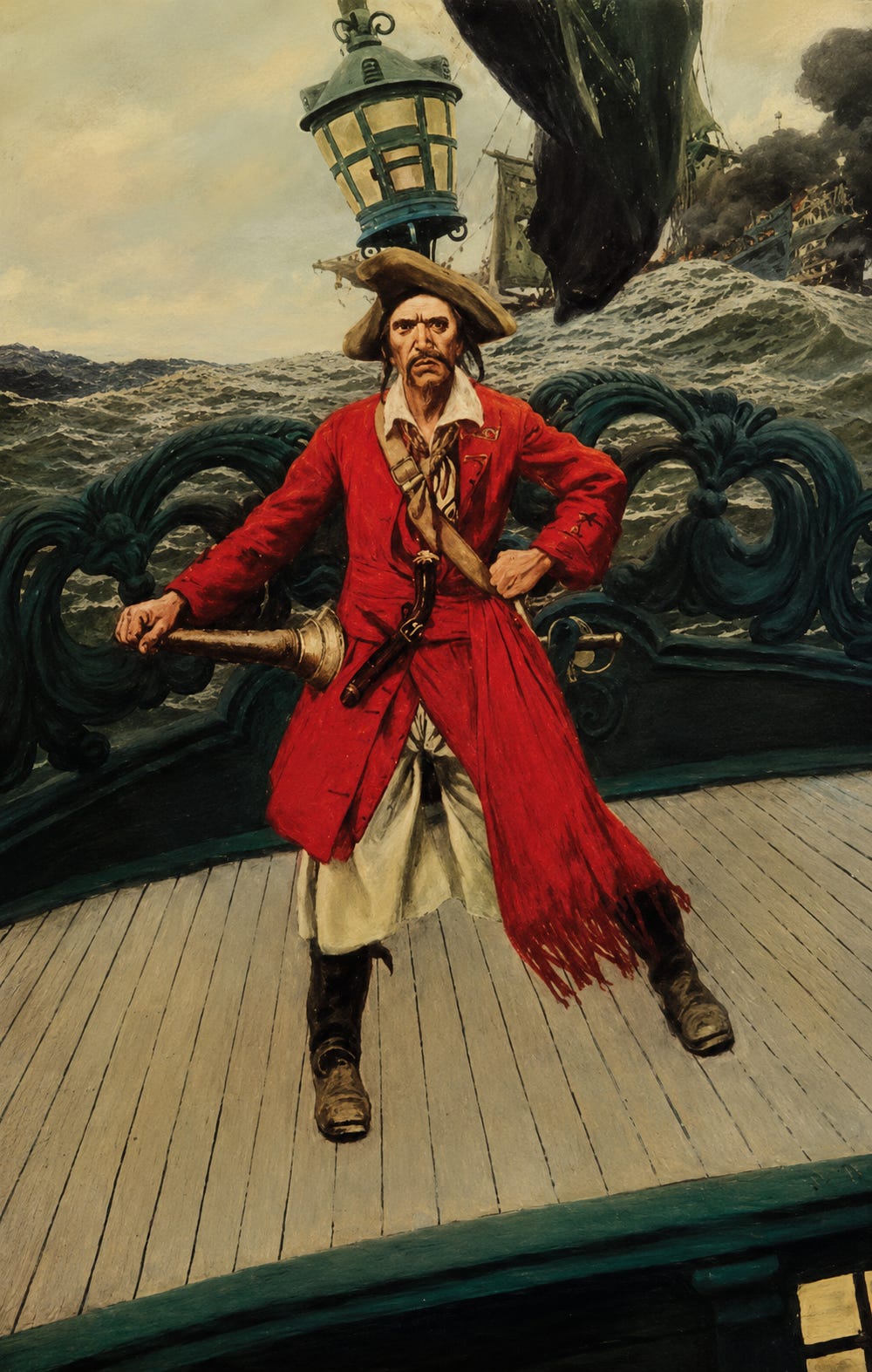
I have this friend and mentor, call him Blue Beard. He’s a pirate captain type of entrepreneur. In his twenties, he left a cozy well-ordered life and moved to Eastern Europe, where he started his first company as a bet that he could create better jobs for his comic-book artist friends there than anywhere in Western Europe. He did. Blue Beard sank a few ships, but his fleet of companies grew strong and lean.
A while ago, someone Blue Beard trusted stabbed him in the back. “The only way to talk to a traitor is with your fists,” he told me over lunch one day. It stuck with me because in over a decade of friendship, I had never heard him speak like that. There was uncharacteristic savagery in his eyes, and I knew he’d been hurt.
I recently found out exactly how treachery feels. I’m writing to say that, while the pain was worse than I had imagined, my gentleman pirate friend was wrong about how to respond. Fifty lashes on the forecastle and a bottle of rum in your cabin is inelegant, unromantic. Deck-hand behavior. A graceful bow from high up in the rigging, as you take your next galleon — that’s how you treat a traitor.
The Tale of my Second-in-Command
Six weeks ago, and with no warning, the operations manager at one of my companies handed me her resignation. She had been with my company for fourteen years, since her first year in college. I had planned to make her a partner. She told me she was leaving over company decisions she found “too capitalist.” Although she blamed those decisions on the company’s other founder, each of those had been mine. Each of them had saved our company that year and put food on her table, but I repeat myself. I already said “capitalist.”
Any serious businessperson would tell you to thank your lucky stars this person left before you gave them any company shares. And yet I felt sucker-punched. Her resignation came at the end of a series of betrayals. Several family members and close business partners had let me know, one way or another, that I wouldn’t get back what I’d invested in them. Some of them left, and I chose to distance myself from others.
The businesses were doing well, but against these personal acts of disloyalty, the improved financials, glowing customer reviews, and professional admiration of my lawyers and accountants felt like nothing.
I was hurt, angry, and irrationally pessimistic, not the frame of mind for running two companies. I pushed through a couple of weeks in cold execution mode, though, determined to not be weird.
A co-founder told me I was the only one worried about “weirdness.” My husband teased me that the only way to avoid people leaving was to fire them proactively. The whole time, I thought about Blue Beard. Was the fist the only language a traitor understood? Any of my people could be next. Should I armor up against them or draw my cutlass?
A Pirate Captain’s Loyalty
Steve Jobs reportedly told his team: “It’s more fun to be a pirate than to join the navy.” Anyone who builds businesses and organizations is a pirate captain in spirit.
Those of us who dare to build from zero have to compete for people with richer, more established employers. We learn to sweep prospects off their feet, showing them the possibilities of a small, agile company doing world-class work against impossible odds. We signal that we don’t care about where you work from or who you vote for as long as the job gets done. We promise hard problems to solve, no HR department, plenty of professional disagreements, and results we are proud of.
This recruitment strategy only works because it showcases the captain’s loyalty to his crew. We are not loyal to a paycheck or because HR told us to be, or because someone will cancel us if we’re not. We will walk across the bottom of the ocean to get the product out, secure the contract, and protect the company. We can go without sleep, proper meals, or a break — fighting one fire after another, saving the day, protecting our team, because that feels good. We are crazily loyal, which is funny, because we’re the ones who left the navy. American tech giants could never steal my top engineers, despite offering them 10-20x the pay.
Addicted to Our Own Loyalty
Gene Wolfe wrote: “Oaths are only mere weak things of honor compared to the benefits we give to others, which are things of the spirit; let us once save another, and we are his for life…One who truly benefits another is for a moment at a level with the Pancreator and in gratitude for this elevation will serve the other all his days.”
Rescuing people gives us a spark of the divine, and we would do anything to feel that rush again. It reminds us we are still pirates. We feed on it.
The advantages of our addiction show up in a crisis. When the firestorm roars and the paperwork becomes irrelevant, your loyalty to your crew is the safety rope that ties you to your ship. Then, your priorities are clear, and you’re free to just fight.
A co-founder once told me he was scared I would manufacture a crisis just because I worked so well in one. I have steered us toward storms rather than away from them. Guilty as charged.
Balance sheets and corporate leave policies don’t have the same draw. Building a company can bury you in exactly the kind of paperwork you became a pirate to escape from. We use our passion to pull ourselves forward. We are different from the boring managerial types that populate large corporate offices.
When Blue Beard talked about fists, that was the addiction talking. I wanted to scream too. Nobody rages like a loyalist in withdrawal.
The Cost
As captains, we’re bound to weaker, less decisive, less reliable people. We can’t beg our crew for approval or hope they’ll be kind (they won’t be, they’re pirates). Our bearing tells them, “Hit me with your best shot, I will wrestle you into submission bare-handed, and afterward give you a few pointers on hand-to-hand.” It’s why they are drawn to us, but they sense the power our loyalty gives them over us.
Have you ever had an enemy who watches your every move like you are his idol? A sullen employee who gets upset by minute fluctuations of your tone? The junior partner who is fixated on your every microexpression and can quote you verbatim years after the meeting in question?
Betrayal is the price we pay for this charisma. No matter how carefully you choose and cultivate your crew, they’ll have their moments of weakness and fear. Give them enough time on your team and most of your people will betray you. They’ll plunge the knife in your back and wiggle it, claiming the best of intentions.
And Yet You Have to Stay Loyal
The ship must stay afloat. The galleons must be captured. Betrayal will come, and the captain must not only stay functional, but face the humiliation publicly and be judged for style by everyone else. Each member of your crew will decide whether to stay on your ship based on your reaction. It’s our job to take such punishment and still make people swoon.
So, what should a pirate captain do?
Do Not Forget Who’s Boss
And don’t let your team forget, either. You are not their friend, and they do not have to like you. You have responsibility, but you also have power. Be the decisive, unflinching menace your team volunteered to join.
Your people must know who and what you are, at a glance, every time you enter a room. Of course they’re all watching and judging you. You can affect their lives, bank accounts, and families in ways most people can’t. Give them a show.
No games
One of my co-founders tells me he sometimes sees me speeding toward a cliff and his only way to stop me is an ultimatum. That’s a mistake because ultimatums between business partners are a game of Chicken. The only way to win Chicken is to convince the other side you’re so crazy, you’d kill your own company before you fold.
At first glance, a reputation for lunacy is useful to a captain. Two years ago, I told one of my teams I’d pay hundreds of thousands to lawyers before I’d pay a single dime in bribes to a public official (remember I work in Eastern Europe). A year before that, I fired a client (a company partially owned by my own father), because we caught them in malpractice and they wouldn’t do anything about it. I am quite good at going Sans Quartier on outside threats. I ensure peace by demonstrating that conflict is hopeless. It’s a good investment.
What I can’t do is slip into full killer mode inside my own company, with my own people.
Control that Loyalty
Wielding such a sharp emotion requires discipline. You can’t just swing loyalty around, even though it gives you a rush of power. You need self-control and hard limits.
Once I’ve decided to be loyal to someone, I set a term for it and won’t renegotiate it until that term is up. I won’t stop testing them in the meantime, but I wait to act.
Expand
Even and especially after a large betrayal, a captain must expand his loyalty outward. He finds new people to join his crew, new allies, new challenges. Every instinct will fight this. When we are betrayed, we want to curl up and cut everyone off. Like Gollum, you will want to crouch over your wounds and hiss righteously. Gollum was never a pirate captain.
You’ll handle the fallout faster once you’re outside it. Your team will think you are crazy, flaky, distracted, but two years down the line, they will be telling stories about how you saved the day when everyone had written you off. You’ve already paid for this, so collect the full reputational benefit.
Offend
A captain must retain offensive capability. This includes growing and sharpening his loyalty to his people. And yes, widening that circle, even as that increases the probability of betrayal. You get stronger emotionally, physically, financially, and spiritually. People are attracted to power because it solves problems, earns money, and protects families and dreams. Grow your power.
Blue Beard, my old friend, you don’t talk to a traitor with your fists. You don’t have to talk to a traitor at all. You talk to your crew, the ones still on deck, and the ones you haven’t recruited yet, and you let the traitor watch from shore while you take the next galleon. That bow from the rigging isn’t for that poor coward. It never was. It’s for the crew deciding, right now, whether you’re still worth following. Show them you are.