

Behold My Screed
I got out of the Publishing Industry in 2022.
On spring break in the middle of COVID lockdowns, my wife and I were on a mission to escape from our apartment and decompress in the Balkan spa-and-winery complex of Starosel. Unfortunately, so was half the population of Sofia.
Just imagine us after a year and a half of being cooped up: with a grandmother, a great-grandmother, a grandfather with Alzheimer’s, a pod of feuding aunts (great and small), and, of course, our kids. We distance-learned, we zoom-met, we face-masked, balcony-clapped, hand-sanitized, and mourned — yes — the death of a great-great-grandmother. Picture my wife and me on the other side of all of that, in a pool filled with half the population of Bulgaria’s capital, attempting to swim.1
One fine day, as I stepped out of the scalding water, trying not to sneeze where anyone could hear, I received this email from my literary agent: “We just got informed that our contact at AWA has left … I do have someone else to query over there but I don’t want you to put in more energy if it won’t pay off.”
AWA was supposed to be a cooperative of comic-book artists and writers. I was going to write one of their story ideas set in Russia with a Russian artist I already knew, but two days after the invasion of Ukraine, our contact had “moved away from the project.” I was organizing classes for refugees, and my friend was getting ready to escape the Motherland, but you’d better move away from the project, Jen. Don’t want to offend anyone in Brooklyn.
I wasn’t upset, but I did feel a certain fatigue, a certain disgust. This “online comic co-operative” had never been a real business. The people pretending to run it weren’t serious. Neither was my agent. Now, I cast no aspersions on this woman, who sent me a bouquet after my colostomy. She was being a good person, but she wasn’t trying to make money. Like everyone else in the Industry, she wasn’t actually in the business of selling books.
The Con’s VIP Room
Back in 2019, my agent sold my debut novel2 to Flametree, a small British press with a line of artsy notebooks that wanted to expand into fiction. They offered very little editing and negligible marketing, but this was standard. Of course a manuscript must be “polished” before a publisher will even consider looking at it, and as for marketing: “the real work begins after you finish the novel. Nobody can market your book better than you.”
What the publisher did offer was copyediting, typesetting, cover art and design, printing, and distribution, a thousand bucks in advance, and most importantly, legitimacy.
With Flametree’s logo and ISBN on my book, I was a Published Author. I got a Kirkus review and an audiobook deal (twice the advance for the print edition). At sci-fi conventions, I could now access certain rooms. A closed web forum was no longer closed to me. Some people, if approached through the right channels, would even speak to me.
Capisce?
One such publishing elite was Sheila. She was a big enough name in the Industry that a meeting with her alone justified my tickets to EasterCon. She began our one-on-one brunch with the story of a cover artist her publishing house had once employed, who had said, in public, that he supported George W. Bush.
Well.
They never worked with him again.
Sheila did not look me in the eye and say, “capisce?” but I got the message.
Now, I did not vote for Bush. I was a well-brought-up young man. I went to a liberal arts college. I knew to face the blade of the butter knife inward when setting the table, and I could be heir to a vast network of favor and patronage. To get access to people like Sheila, I just needed to believe the right things, amuse my superiors, and, I thought, perform competently. That was back in the 2010s. How little I knew.
Take it or Leave It
If Sheila had agreed to publish me, would I have made my characters capital-B Black? Invented some Queer aliens? Maybe liquidated some bourgeoisie? I like to think I’m above peer pressure, but in reality, I would have tried to toe the party line. I would have torn myself up inside as the Party grew more demanding and the Line swept leftward. Probably, like most of my cohort, I would have just stopped writing.
You can’t let inspiration shine through you and self-censor at the same time. Many people choose censorship, and I can’t blame them. They live in a country where you can lose your job for writing something that makes the wrong person laugh. Americans brag about going “zero-contact” with crime-thinking family members. I, on the other hand, am lucky to live in Bulgaria, where I am self-employed and married to a woman who knows what Socialism does to people.
It’s a good thing, I suppose, that Sheila didn’t choose me. She had her own problems, and although it was independent at the time, her publishing house was soon purchased by a wholly-owned subsidiary of a Beijing-based media group. My own publisher would go on to become a “strategic partner” of Hachette, one of the Big Five that consolidated the market in the last thirty years. They monetize IPs, exploit backlists, and acquire portfolios of assets. They don’t, you’ll notice, sell books.
The Industry Doesn’t Work
Books, to the Industry, are at best investment instruments, at worst tokens in a financial shell game. Flametree, angling for strategic partners to woo, bought the rights to a sequel before my first book had sold a single copy, and insisted this time on the audio rights, too. They had no intention of producing an audiobook, but they wanted an Excel graph they could point to when Hachette came calling.
I wrote them their sequel.
My agent told me it was better to accept a bad deal than suffer a yearlong gap in my publishing resume, so I performed. I whipped up a novel in the time it took my editor to respond to one of my emails (6 months), and it was better than the first one. But, when the sales numbers came in, wouldn’t you know it? The line between books one and two trended down. Potential acquirers wouldn’t like that.
No more book offers from Flametree. “The numbers just don’t justify it,” said the guys with a two-point trend-line. Those statistical stallions.
My agent pressed the dull point home:
“So … what we’ve come to here is a challenging part in your career… what you really need to do is find your audience, and I would recommend delaying taking out any manuscripts until we’ve successfully done that.”
No, she wasn’t officially firing me. She would just no longer take on my work until … I was back in the graces of the flattening tastemakers.
You Work
My reply was obvious, but it took me six months to muster up the bravery to actually say it. For half a year – one editor-reply-period – I wondered if I should give up.
Instead I asked my question:
“If I do learn how to market and sell my own books to my own audience, what do I need you for?”
My agent’s answer was the standard one: cover art, printing, distribution. Except I know people who make better cover art than anything you see on traditional books. Amazon POD makes it too easy to print and distribute your books. And that’s the kindergarten level. The real elite self-publishers are capable of paying editors, artists, and designers, and signing contracts with printers and book distributors.
It’s been four years since then, and I’ve wandered the wilderness hard.3 Now I’m here to tell you, in the most grizzled way possible, why the Industry is in ruins, and what we have to build instead.
The Great and Powerful Backlist
My agent didn’t mention legitimacy. That would have been gauche, and, by 2022, a little embarrassing. Other people have already written about the Industry’s vicious purity tests, its smothering ideological monoculture, its systemic exclusion of young, white men. That’s all true, but paints too cheery a picture. If the Publishing Industry were merely a gray Marxist yoke across the necks of suffering writers, it might produce some books worth reading.
For the true scope of the desolation, see U.S. v. Bertelsmann SE & CO. KGaA, et al., in which the US Justice Department blocked the merger of Penguin Random House and Simon & Schuster. The court documents show us some of what’s going in Big 5 executives’ minds and on their spreadsheets.
Markus Dohle, then-CEO of Penguin Random House, testified that, “Publishers are ‘angel investors’ that ‘invest every year in thousands of ideas and dreams, and only a few make it to the top.’”4 That sounds reasonable, even poetic, until you remember that there is a whole industry of angel investors, and Dohle isn’t part of it. Real angel investors take equity stakes. 21st century Big 5 executives latch onto the accumulated capital of a century of work, and they suck it dry.
They don’t say so, of course. In the words of Madeline McIntosh, the other former-CEO of Penguin Random House: “The fact that we [Penguin Random House] have the largest and richest backlist in the industry is what gives us the latitude to take risks with new acquisitions every day.”5
Penguin Random House published George Orwell, Roald Dahl and P.G. Wodehouse, authors who are all still famous and all – as of this piece – still dead. That means the publisher doesn’t have to send anyone a cut of the profit. Those old books are much better assets than the works of an untested, unpredictable (and un-dead?) living author. If Dahl’s wicked sense of humor offends the current crop of readers, why, there’s always censorship.
So, You Want to Be an Orwell
Where did that backlist come from, Madeline? Dahl, Orwell, and Wodehouse were at one point dumb kids who couldn’t write. They learned how, yes, because of deep desires burning in their bosoms, but why novels? Why didn’t Dahl write intelligence reports, Orwell op-eds, and Wodehouse newspaper columns? They thought someone might buy their books.
But if you are a new Dahl or Orwell today, and you want someone to buy your books …
They won’t.
“Books below [expected sales over 25,000 units or advances over $150,000] received ‘only a contact in the publicity department, smaller book tours (if any), and limited media engagement.’” (p. 34-35)
So don’t quit your day job, kid. You won’t get any marketing or editing unless you have a six-figure advance, and you won’t get a six-figure advance, because the Big 5 actively fix prices (p. 14-15). It’s easy to collude when there are only five of you.
This was all still in 2022. In 2023, Simon & Schuster was sold by Paramount to private equity firm KKR for $1.62 billion. “Sorry, boys,” says Paramount, “the numbers just don’t justify keeping you.”
What Seed Corn?
Remember that time wise old Stephen King rose up and issued this fiery, scathing rebuke?
“I feel that by shrinking the number of big publishers, it makes it more difficult for new writers and midlist writers to get a fair hearing. And if they are heard, I think it makes it more difficult for them to get an advance that they can live on.”
It’s all in the facial expression and tone of voice. You had to be there.6
In other words, the traditional publishing industry is a hollow shell. The Five Biggies can squeeze their big-name authors living and dead, and they don’t need anybody else.
Let’s say it takes seven years for a writer to train up to the point where he’s good enough to write a best-selling novel. Let’s also say that people don’t train for seven years unless they have some incentive to do so. Industry executives have removed that incentive. Now, as the 20th century’s last crop of big names die, there is nobody left to write anything.
What new books have you enjoyed in the last ten years? Did you find them easily?
I didn’t.
The authors we grew up on have lost their minds, sold their souls, or given up on writing at all. Because why should they write?
Publishers don’t sell their books.
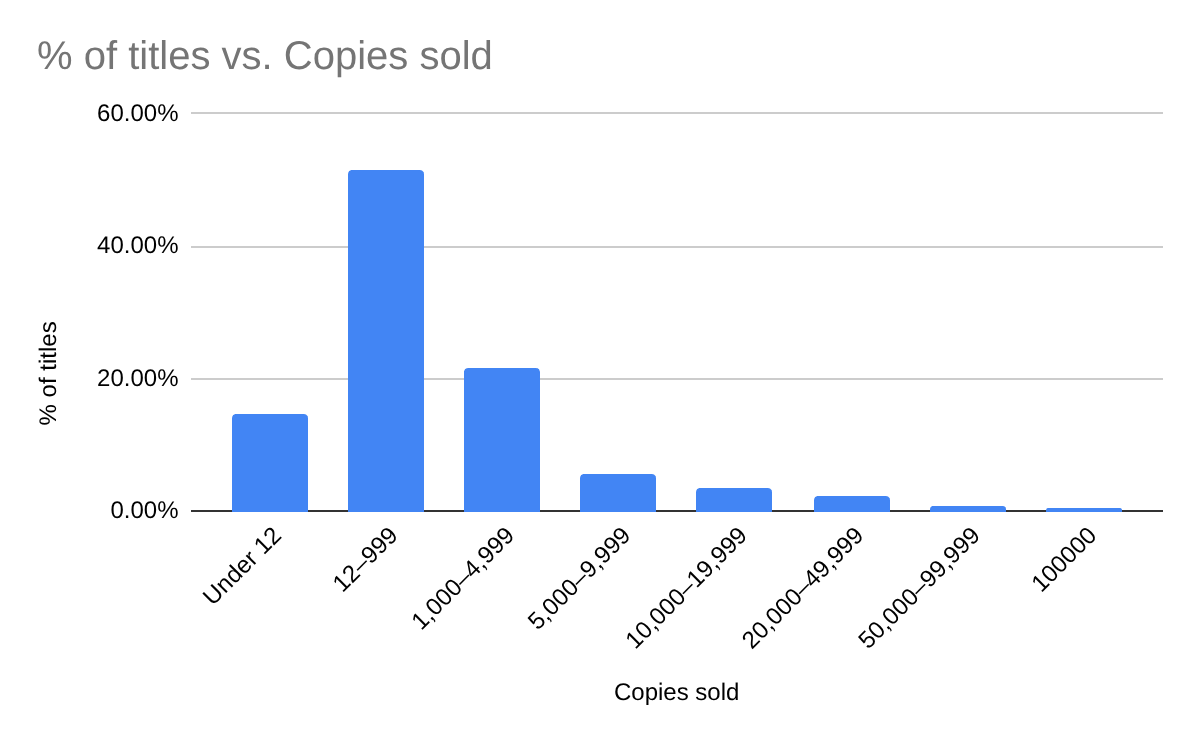
These are the numbers for store sales of physical books published by the top ten Anglosphere publishers in 2022. Yes, third largest category is fewer than 12 books sold, but that’s not the worst part. If we lump this embarrassing figure in with the largest category, we find that 56.1% of new books in the core of traditional publishing’s competence (paper books in brick-and-mortar stores) sell fewer than a thousand copies. For comparison, a thousand copies is half the average print run in the Czech Republic. A thousand copies is essentially none at all.
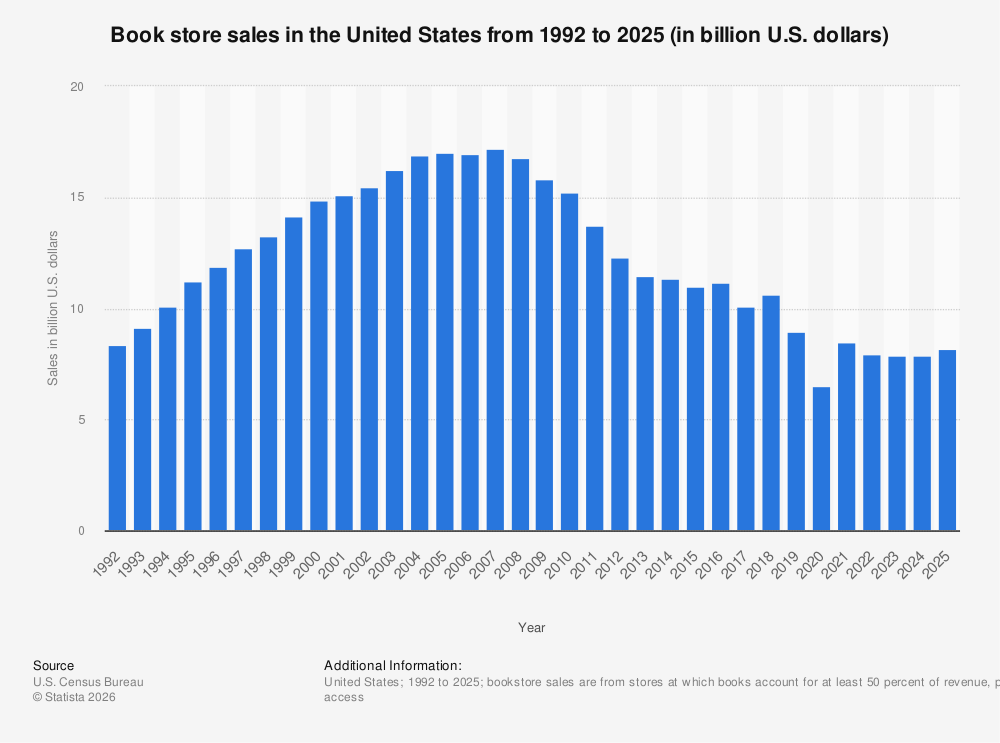
And here are revenues from book sales. That trendline since 2008 doesn’t look so good. Not something I’d put on my resume, if I’d done that. The picture gets worse if you compare 2024 to 1992. 1992 saw A Fire Upon the Deep and Snow Crash, while 2024 gave us the stultifying The Mercy of Gods as well as Womb City, which apparently has “gender-expansive feminist rage.”
Just copy-pasting that last quote depressed me, but there’s good news. We no longer have to face the choice between toeing the party line and starving out in the cold. You think the Party has food and heat for you? The Industry doesn’t sell books, it can’t sell books. It’s in ruins. You might as well learn to like the great outdoors, because now, that’s where everyone lives.
The Outer Darkness
We’re in good company. Just in the past two years I’ve had the privilege of reading new books that work, whose authors held out against witch hunts, dopamine addiction, and the utter lack of any financial incentive. John C. Wright emerged from the contempt Tor gave him to write series after series of big-idea adventures that don’t just refrain from punishing, but actively celebrate the male reader. Travis J.I. Corcoran indulges my Randian fantasies of just floating away from the oppressive managerial state, and Karl K. Gallagher gives the Censor a good drubbing for me. Theft of Fire is actually hot. And that’s just in scifi. To really get me in trouble, ask me about my taste in contemporary literary fiction.7
Since my own exit, I’ve self-published books that would never have stood a chance in trad-pub, about such things as Christian terrorists, Pagan cults, and a disastrous pet-napping heist run out of the kitchen of an inter-species UN. I kickstarted a comic about an “Anglo” boy who teams up with a Haitian shaman to free his people in a post-apocalyptic future.8 My collaborators on that project come from three different countries and we agree about nothing politically, but that’s not what matters. What matters is that the story works, the art is beautiful, and our project was 200% funded in less than a day, at $20,000.
The Lost Reader
Good for me, but where can you buy those books? You have to sift through Royal Road or, God help you, Kindle Unlimited to find them. The Kickstarter is closed, and you can’t even buy that Haitian shaman comic.
There used to be a time when you could go to a library, run your fingers down the line of plastic-encased book spines, snag the one with a rocket ship sticker, and open it with a better-than-even chance of liking what was inside. Now, you spend hours every week reading book reviews, hitting up your friends for recommendations, trying to prompt around an AI’s political guardrails so it will tell you whether the latest BookTok craze is actually agitprop9 or just very badly written.

What readers need is a filter between them and the great mass of writing. They need someone with the taste to discriminate between good and bad, and the authority to apply it. This trust is in high demand, but currently unmet: an opportunity.
The writers I recommended above are all independent, but I’ve heard of them because they’ve built structures around themselves like little publishing houses. Devon Eriksen created an LLC to hire specialists for editing, art, audio, and distribution. Karl Gallagher and his wife started a family company. They actually sell books.
Back to Work
In a way, the marketers were right. The real work does begin after the book is finished. The question is, who is working for whom? And for what? You made this story and readers need this story, but somebody has to build the bridge between them.
First, take your writing seriously. Would you write a manuscript and then file it away in a cabinet in your house? That’s a hobby. Would you write a manuscript and fire it through a cannon directly into the brains of all your neighbors? That’s a profession. You love your reader and you know what’s good for them, which is to read your books.
Books that you have to write. Every day. Finish that novel and start the next one. Then stop, keep some energy aside for the necessary work of paying invoices, interviewing marketers, and carrying heavy boxes back and forth from the post office. Twenty percent of your work should support the other eighty percent.
Find the overlap between what you like doing and what makes money. Too much of the first and you’re back in hobby territory again, designing one alien lifeform or alternate-history language after another, to the interest of nobody. Too much of the other, and you’ll teach yourself to hate your art and you’ll burn out. You got to do both.
Get good.10 Fall upon every information source like a starving corsair and steal every piece of good advice you can find. After that, Thomas Umstattd’s AI tools are multifarious and well worth the $10 price of subscription. Go to the “AI Thomas” tool and ask “what are all the steps I need to go through from finished manuscript to printed book in the purchaser’s hands?” Then just do it.
Finally, once you’ve got yourself figured out, find people you can trust and work with them. Both of those are important, too: trust and work. Potential readers trust you when they agree to add their emails to your mailing list.11 Fans trust you when they open your next book. Your cover-artist trusts you not to fire him when you find out who he voted for. All of you share in the belief that the next book you write will be worth spending time on.
It’s sad that the publishers aren’t publishing and the editors aren’t editing. Sad, but no longer important. We’re still reading. We’re still writing. That’s why we’re lucky.
They made us walk the plank, but it turns out their ship was sinking. And constructed mostly of spreadsheets and loud opinions. We don’t have to put up with that nonsense any more. We can build something real here, as we swim with half the population of the world.
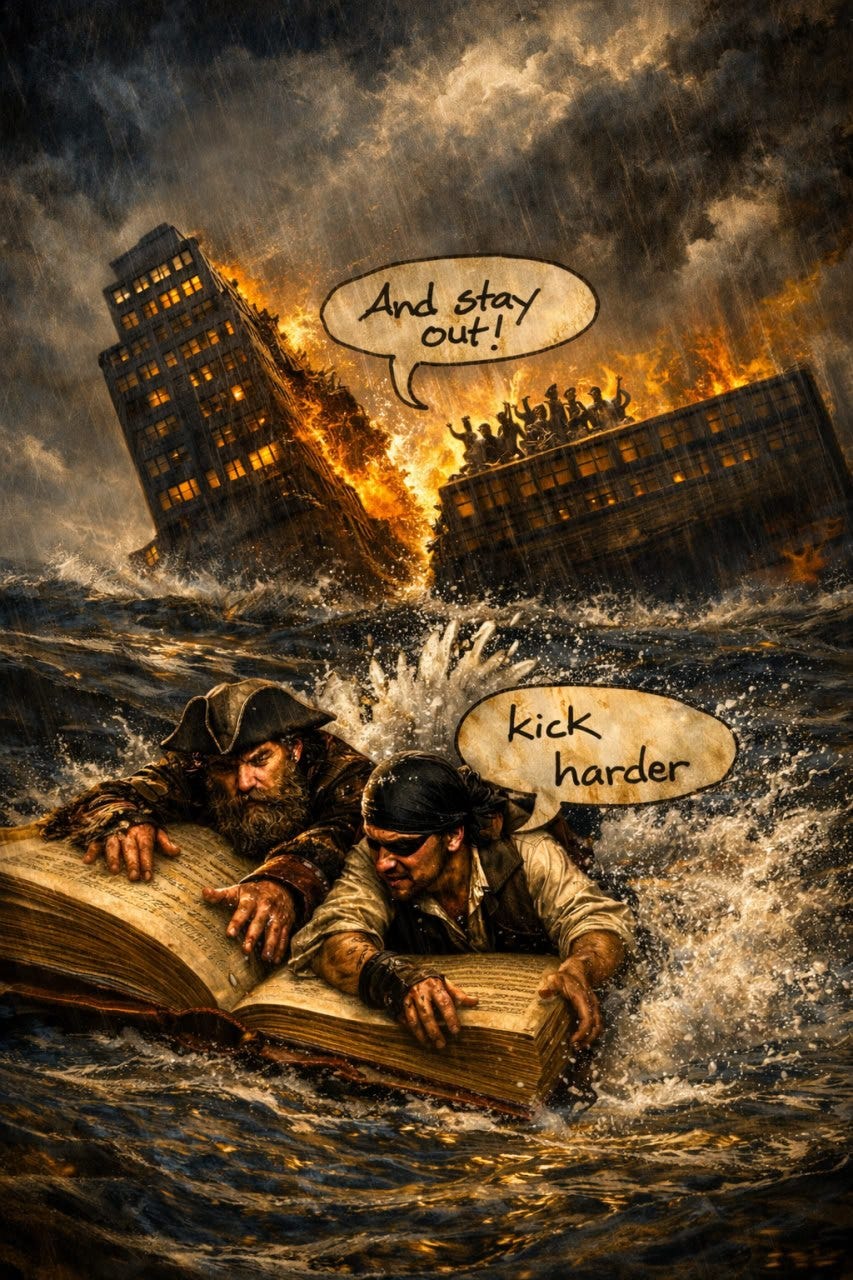
Credit for this astounding image goes to Centaur Write Satyr
Not my first novel, which was bad, nor my second, whose hero is a terrorist, nor my third, passed over because of its “violence against women.”
Okay, I mostly toured Balkan spa hotels.
see slide 70 of these demonstratives
Marty Philips, Cairo Smith, and Krug, but don’t tell anyone.
Gemini: “The 2026 Wuthering Heights film…has faced backlash, with some critics labeling it “woke” or criticized for…whitewashing of Heathcliff and intense, added sexual content.” Whitewashing and sexual content! Just what the Woke are most known for! Curse those beautiful palefaces!
I recommend Story Genius, The War of Art, and The Poetics of Aristotle.