

Author’s Note
This story was written in the mountains of Nepal in 2019 when I was 24. I was attempting to finish an impressionistic travel memoir entitled My Giant Goes with Me (which if it were published today would be subsumed under “autofiction”). While much of that work displeases me now, this little part of it hasn’t lost its shimmer and is the best thing I wrote during that period. This is also the first literary work that I was genuinely proud of and willing to share. My Urania (or LVIV, as it was originally titled) is the worst length possible for commercial purposes, sitting at around ten thousand words—too long for a short story and too short for even a novella. It falls under the category of the ever-neglected novelette. In today’s fast-paced world, however, such a length is perfect for a quick read, ideal for a chapbook. Perhaps I will do that one day, for it was written with the care and intensity of a lyric poem. While I have changed much, both as a writer and as a man, I can’t help but feel that this little story still perfectly encapsulates the kind of person that I am, for it marked something of an awakening for me. I have decided to not edit it because I know that the pretentious 24 year old me would not want some 31 year old guy messing with his stuff.
Lugano, Switzerland. May 2026
Je dis qu’il faut être voyant, se faire voyant.
—Rimbaud
LVIV
1
I always thought my best days while travelling would be full of adventure. I thought they would come from big events, daring escapes, tumultuous romances, and never in a million years would I have guessed that a dreary November week spent in a small town in Western Ukraine would contain the one genuinely transformative event in my life, the one moment that changed the way I perceive the world: against it the rest seems like denouement.
What happened during that week? To put it simply, I experienced the most intense and the most consistent form of happiness a man can know. For about a week my internal state remained fixed at the absolute maximum, though nothing much happened during that time. Not only was that week in Lviv devoid of all luxury, but there was no drama, no adventure, no sublime views. The feelings I felt rose suddenly and violently to the surface, though I suspect the pressure had been building for weeks, rising incrementally day by day. It may have just been luck that the eruption happened in Lviv, during the most relaxing part of the trip.
I had been travelling for two months. I had just graduated from college and was touring through Eastern Europe. After having been constantly around new people for more than two months I was finally all alone. Lviv was the first place where I had a room to myself. In every other country I followed the usual code of hostel life: I slept in crowded hostel dorms with squeaky, steel bunk beds; I showered with flipflops because the bathrooms were communal and stank of rotting hair; I wore a sleep mask and ear plugs to drown out the snoring; I put my bag in a locker to ensure that nothing was stolen; I wrote my name on the food I placed in the fridge—or if I forgot, found that the following day it had been eaten by some other person. To have one’s own space, to lay one’s clothes out over the floor in piles, to leave the dishes until later—these are luxuries that I didn’t know I had back home. For over two months I followed the rules of hostel life, and now, after all that time, I was finally by myself.
During that time I carried a thick leather-bound journal, which was only a quarter full despite my trip being all but finished. In my small apartment, in a room that contained nothing but a bed, a desk, and a small window overlooking the early winter grey, I resolved to work day and night to fill its pages with stories of what I had experienced, or if not with those then with thoughts, ideas, poems, with anything and everything that came to mind. I felt that I was somehow at war with that journal and my strategy was to blitzkrieg my way over the enemy’s white, lined territory as quickly as possible. My days passed according to a militant schedule: I would wake up, write in the journal, go for breakfast by myself, read, write more, go for a walk and continue on like that until about six o’clock at night, at which point I would meet up with some friends I made in Kyiv a few days earlier, and the four of us would go out for dinner and drinks at one of Lviv’s local gimmicky restaurants.
For a day or two things went on as normal. I was cheery but I’m naturally cheery, so that was no surprise. Then all of a sudden the water within me, which until that point was pleasant and relaxing, like a warm bath, was brought to a violent boil.
2
It all started with an awakening. Not a spiritual one, not some drug-induced enlightenment. I mean a literal awakening: it was 5am and my eyes snapped open so fast I almost felt the weight of my eyelids smack against the orbital bone. I have never been a morning person, and while travelling I slept until at least nine in the morning every day, sometimes getting out of bed as late as 11am and sleeping for more than ten hours. For that reason waking at 5am with no alarm and without a reason to get up was perplexing.
I also found that I was filled with desire, sexual desire. An almost unbearable pressure. I couldn’t remember any erotic dreams, and when I really thought about it all the erotic dreams that I had had in the past never led to anything as intense as this. Every cell of my body, it seemed, was trembling, flexed and flickering with excess energy. The average person would have just relieved themselves, but as I lay in bed, with sky beyond the windowpane still dark and dawnless, an obscure section of a famous book rose to the surface of my mind and convinced me otherwise. Months ago I had read Think and Grow Rich by Napoleon Hill, and although I’m not sure I buy many of the claims made by Mr. Hill, the chapter on sexual transmutation suddenly made perfect sense to me. As I understand it, sexual transmutation involves focusing your sex-drive onto your work. In Hill’s case that was making money; in mine The Great Journal War. The idea made sense to me in theory when I read it (I’d considered writing a short entry about the effects of pornography and diminished productivity in the journal); however, the full implications didn’t fully resonate with me until I experienced them for myself, until that morning when I sat down at my desk, the cells of my body buzzing like a hive of queenless, sexual bees, and began to write. All morning I wrote. I didn’t get up to do anything. Not to eat, not to use the toilet, not even to have a glass of water. Then at about 9am I went for breakfast at a small cafe.
I walked out into the street outside which smelled of espresso and cigarettes. The sky above me was lead-grey, with clouds so thick and gauzy that they hid the sun entirely. I was wandering around the inside of a snowglobe with frosted glass and no confetti. At the restaurant I ate by myself, unable to talk to the middle-aged woman at the counter who spoke no English, unable to talk to anyone, and the grey sky, the bland food, along with the omnipresent smell of cigarettes and the sight of bad teeth would be enough to make anyone feel cold, reflective and alone. But I am not anyone. After eating my breakfast in silence like a monk I wanted to explore, to see the city, to exert myself physically. I decided to walk to the top of a large hill at the edge of town, and all the way there I felt a spring in my step, felt my legs wanting to take off from under me, and whenever I went down a flight of steps I let gravity carry me down at a jogger’s speed—not so much walking as falling feet-first from step to step.
To be honest, no matter how hard I try I can’t rationally explain my experience of climbing that hill. In the end these words, no matter how skillfully written, no matter how cleverly contrived, will fail to capture what I felt. I can say that I felt amazing, that I felt energized, full of life; but those are logical thoughts, abstractions, and what I felt—perhaps all feeling in general—was beyond logic, and to that extent I need an illogical explanation, one that describes what I experienced during that walk on a more fundamental level. So when I say that some unknown force had anesthetized my body while I slept and removed my heart, I don’t mean it literally. And when I say they had replaced it with a V8 engine, I’m not crazy. They had drained my blood and pumped me full of gasoline, stripped the meat from my bones, shattered the bones themselves and cast me a new shining skeleton. I had a brand new body. Piece by piece they replaced the bones, the organs, the nerves, the muscles—everything except my brain. I was living in the future. I was normal on the outside but inside I was gyrating mechanically, held by steel braces and powered by gyroscopes, alternators and cogwheels. My heart stopped beating and began to purr softly, and as I made my way up the steps I felt restless, like a car about to stall. The RPMs were rolling too low; the clutch was burning. I jogged the rest of the way to the top, passing nobody but an old man with deep wrinkles who drew caricatures. He was waiting with canvas and pencil in hand for someone. I gave him a smile as I passed. I was the only one there.
When I got to the top I looked at the view, and it was terrible. They call Lviv “The Paris of the East” but there is nothing to look at, no major landmarks, only a few churches and older buildings, but nothing on the scale of what I had seen in Rome or Prague or Vienna, nothing that would impress me. Only the blue corrugated roofs covering the houses stood out—baby blue, metallic roofs which looked bright under the grey overcast sky, the colours being more saturated because of the lack of light. Apart from one segment of a crumbling stone wall the hill itself contained nothing of interest either. All of which made my feelings at that moment even more bizarre, for at the top of that hill those blue roofs could have held my attention forever, not because they were beautiful but because everything was beautiful. The sky, the trees, the steps, the blank canvas, it didn’t matter. You could have placed any vista before me and nothing would have changed. Replace the dreary Ukrainian countryside with a sunset in the Caribbean or a view from Dubai’s Burj Khalifa and all would have remained the same. I was maxed out—or so I thought.
After many pages of journaling and a nice dinner with my friends I went to bed, expecting that I would wake up at noon the following morning feeling tired, lonely, and terribly sad. Each action must have its reaction, yes? When I placed my head on the pillow at 1am I fell asleep instantly, only to awake with the same libidinous energy at about 6am the following morning. I wrote for another few hours and then left for breakfast. The cafeteria I liked was about ten minutes away from my apartment, and while walking there I experienced the rarest of events: a completely new feeling. Genuine ecstasy. I should note before continuing that I have never taken drugs and that I remain the only person I know of who never even tried weed in high school and college. The feelings I felt came from within me. I had no foreign substances in my body. I barely even drank while I was there, which is almost a cultural sin in the Ukraine.
It was another sombre morning of grey on grey. I was walking along happily when I passed straight out of my quotidian reality and stepped into another. I crossed a boundary, opened a doorway to another part of experience that until that point I had never known existed. And it was divine. I could exhaust the entire English language and still I wouldn’t have the words to describe it, for it was the most powerful form of happiness a man can know. It was so powerful that I can’t even think of a time in my life with which to contrast it against. That must be how it feels to become the Heavyweight Champion of The World after knocking out Mike Tyson, how it feels to win the World Series with a home run late in the 9th with two outs, how it feels to be reunited with a loved one after you thought they were dead, how Moses felt when God gave him the stone tablets—a happiness so full and deep that it fills every pore of your being, a flood of feelings so intense that you drown because you’re unable to swim back to the surface of everyday life. If somebody had asked me the time I would not have been able to give an answer. Only a smile. If a man would have tried to mug me I would have offered my watch as a tip. It was almost unbearable in its totality, and as I walked I looked across the streets, passing houses, benches, trees—all familiar vistas that I had seen previously that week, many times and in better light; I saw how they now possessed a sort of incandescent glow, a shimmer, how everything gave off these graceful undulations, like the air above black pavement in the summer heat. It was all liquescent and unstable somehow, as if I were in a dream. I even closed my eyes for a few seconds to see if the world would return to me in its solid form but it didn’t. Not for that block, nor for any of the following ones. In fact, I spent my breakfast in this state of divine bliss, sitting there by myself, eating a pancake and few bowls of fermented vegetables with no book, no phone. Nothing. Just the world which I felt as a fine, translucent fluid swirling around me and which I inhaled through the pores in my skin like a salamander.
Eventually it all congealed, and I returned to a state of functional contentment. On the way back home this state soon shifted and I began to worry that I was going insane. I have never been depressed, but still! Who else experiences these highs but a manic-depressive or some other mentally disturbed person? When I got back to my apartment I wrote a quick note about how I was feeling. A timeline of sorts. If I were going crazy at least I could show the doctor my progression. I was curious to see if I would have more of these episodes in the future, and how they were spaced. I had a few more but that first one remains unique, for it was the first opening, a kind of fissure along the glassy surface of an otherwise normal life, an open wound through which a deeper, more mysterious reality bled. Later, at the end of the week, that small opening would be ripped open and the full force of what flowed beneath it would bubble up and consume me completely. But that story starts a few weeks before coming to the Ukraine, when I was in Lithuania, in Vilnius.
3
I had been to Vilnius once before on that trip but after finding a cheap flight to Ukraine I came back for a couple days to wait for my flight. When I arrived the staff greeted me by name. I had spent a long night playing Risk with them the previous week, losing after my massive army was defeated by a paltry force of divinely protected soldiers at the tip of Australia who rolled a continuous string of sixes. I remember asking if I had the room to myself and they said no, there were two others in my room: a Polish girl and a Georgian one. Too bad, I thought. By this point I desperately wanted a room to myself, though I did fall asleep without seeing either of my roommates that night.
In the morning I remember rolling over and seeing long locks of wavy black hair spilling over the side of the adjacent bed. Perhaps I had hair on the mind because I was in Lithuania. I never noticed women’s hair until I went to Vilnius. It felt like I was in a shampoo commercial while I was there because every woman I saw had long, thick, silky hair. In any case the jet-black locks cascading over the edge of the bed stood out somehow. Upon reflection I can’t think of another moment where someone’s hair made such an impression on me, which is strange. Even now I’m surprised with how vividly I can picture those dark waves shining in the early morning light. While eating breakfast I met the owner of that amazing head of hair. Her name was Tamari, and she was from Georgia. Perhaps it’s the primacy effect, but her hair is always the first image that rises to the surface when I think of her.
I knew nothing about Georgia except for a few random historical facts and where to find it on a map, and to this day I have only met one Georgian person—namely her—and my ignorance with respect to this country and its people has formed the belief in my mind, however irrational, that the country is populated by the most beautiful and the most powerful people on earth because my sample size, which consists of a single individual (her), is so magnificent.
I knew Georgia was at one point part of the Soviet Union, so I had envisioned Russian features the previous night: a cold stare, fat cheeks, thin eyebrows, a large lower lip. Instead she had coffee coloured skin and dark brown eyes. There was something Asiatic in her appearance too, but she lacked the daintiness that women from India, China and Southeast Asia have. She was tall, with sleek, feline legs, large hips, a small waist, and perhaps the biggest back I have ever seen on a woman—a thick, broad, muscular back which the average person failed to notice because her features were so perfectly balanced, and because her movements were slick, graceful. Yes, she had a big back, but it looked no more out of place than the powerful shoulders on a puma. She had a wide mouth full of chalk-white teeth, each one perfect and without a trace of erosion. The geometry of her mouth must have fit the Greek golden ratio, for I’ve never seen such a perfect crescent of a smile. They didn’t stand out either, her teeth, which is to say they didn’t dominate her features. I noticed them only because she smiled often and easily. With her liquid hourglass shape, with her brown eyes and her straight white teeth, with those and with all the other complementary combinations and juxtapositions, she appeared to be a perfect mix; and one feels that if racism ended tomorrow and the best parts of every ethnic group were mixed together you would end with a people that looked like her.
We were formally introduced at breakfast but I can recall almost nothing from that first meeting. It obviously went well because it wasn’t long before me, Tamari, her Polish friend and a friend of mine named Ray went to see the Three Crosses, a monument that commemorates some famous event I knew nothing about. There was one moment of friction during that walk. An awkward silence. It came early on. I don’t remember what caused it but it was long and deep. We were walking through the park, along the edge of the river. The leaves were ablaze and the air was cold. Neither of us saying anything. It was the kind of silence that can be socially terminal if it is not handled with care. Then, all of a sudden, the perfect line came.
“You better say something,” I said, “this is getting really awkward.”
She laughed and the tension dissolved in the wind. I kept the joke for a little longer though.
“You better say something quick. This is getting super weird.”
“No you say something!” she said, smiling uncontrollably.
“Don’t turn this around on me. It’s your turn.”
“My turn?”
And so on”¦ After that everything passed effortlessly. There was never another bum note in all the time I spent with her. She was so happy, always smiling, always in good spirits. I wanted so badly to get to know her more, to talk with her more, one on one, but that evening her and her friend had to bus back to Warsaw. I went with them to just outside the hostel where they got a taxi. We hugged and said goodbye. Warsaw was behind me by this point (a previous stop), and I walked back to the hostel feeling a little sad because I knew I would never see her again—at least on this trip. There wasn’t enough time to go back West. I was on a freefall through Eastern Europe and would be passing through Ukraine and Romania before coming to Sofia where I would then be lifted all the way to London (on a flight that was cheaper than the shuttle bus from the airport to central London). There was no way of stopping that descent. The tickets were booked and the dates were set. But as luck would have it, Tamari had a weekend free while I was in Lviv and agreed to take the eight-hour bus ride to come for the weekend with me before I went South.
I had a few more days of reading, writing and walking between my first prolonged fit of ecstasy and her arrival at the end of the week. And what wonderful days they were! I thought my cheerful exuberance would fade after a day or two, but no: my feelings never dipped, never wavered. Sometimes I think the journal entries were the source, for I have never written so many words with so much passion. In Lviv, after two months of almost no writing, I had planned to catch up on all the events I had failed to record, to write down what had happened to me, what I had seen, where I had been, but soon I began writing about whatever was on my mind: about writing, reading, philosophy, walking, food, drink, happiness, and anything else that popped up. I sat down at the small desk in my bedroom before the leather-bound book with a full fountain pen and an empty mind, yet when I put pen to paper it flowed out of me at such a speed I could barely keep up: long sentences containing thoughts I didn’t know I had, sometimes using words whose definition I didn’t know. I felt I had dug a tunnel directly to a kind of subterranean mental spring, to the substrata where the unconscious absorbs its nutrients, and once there I slurped up everything I could, sucked all the muck that had been stuck there for decades along with a few glittering, unpolished gems through the straw of my fountain pen, day after day, all day, and when I finished I felt cleaned out, fresh. Like a piece of polished crystal I refracted a pleasant light in all directions.
I sometimes worried that a crash would come, that one day I would awake with a pitch-black depression that was every bit as dark as my joy was bright. But the terrifying fall never came. I was all lightning and no thunder. Day after day life pulsed along. The journal was steadily increasing in size and every night I went with my friends to a new restaurant. Lviv is full of fascinating restaurants, places so strange that they could exist nowhere else on earth. There are no regulations in Ukraine, or if there are nobody cares about them. The people of Lviv take full advantage of this and open all sorts of gimmicky restaurants, like a Jewish restaurant that has no prices on the menu and makes you negotiate, or the bar that reduces the price by half if you flash a special card. I even heard of a place (on my last day) whose entrance is an apartment door. You knock, an angry old man opens, yells at you for a few seconds, and then he leads you to the bar which is hidden deep inside. The whole town loves these strange ideas, and during the day at around 1pm you can see all the mascots from the various restaurants go for lunch, see a table with a hangman, an army general, fireman and a bunch of other strange characters seated in a circle drinking vodka, always vodka. But of all these interesting places one will forever stick out in my mind: the Masoch Cafe.
I knew that sadism comes from Marquis de Sade but had no idea that masochism finds its name from Leopold von Sacher-Masoch, an Austrian writer who was born in Lviv and whose short novel Venus in Furs detailed his bizarre sexual predilections. One of my friends, Danny, a great hulk of an Australian, thinking it would be a fun night out, suggested we go to the bar erected in his honour. When we arrived a hundred-pound Ukrainian girl dressed in an eighteenth-century corset carrying a leather whip greeted us. She was beautiful but she had these ice-blue eyes, the hard emotionless eyes of a shark. In a thin voice she told us we would have to sit downstairs in the cafe until a space opened in the bar, so we decided to have a drink and wait.
The cafe made in Sacher-Masoch’s honour is not a seedy place. I had actually spent an afternoon there a few days earlier without knowing about any of the history. The cafe section, moreover, remains free—which is to say you aren’t flogged by the servers. For about half an hour we drank, talked and looked at the various quotes that were printed across the walls, along with portraits of Sacher-Masoch. Then the girl with an icy glare returned, said there was space up at the bar and followed behind us as we left our table. Unbeknownst to us, we had been enjoying a regulated protection by sitting in the cafe section, and as soon as we began walking towards the bar we had become fair game. She began to whip us—and not in a cute, playful way but with the intent to hurt. The worst part was that she knew the most painful spots to hit. I would have been fine if she’d have smacked me on the ass a few times, but she continued aiming for that small area behind the knee where the skin is soft and tender. While she smacked us we all laughed (all except my friend Tom who was terrified) but she herself never so much as smiled. She just looked at us with this predatory stare, twirling the whip round and round as she looked for the proper angle to strike, like a viper.
At the top of the stairs the lights were dimmed and the walls bore exposed brick. There were about two dozen people up there, all seated at tables. (As an aside, I love that the bars are so strict about allowing people in. If there is no space they turn you away without hesitation, or they make you wait). We sat down and Tom took the space closest to the wall, hoping to avoid any future lashings. Of course, our new server—a smaller, bespectacled, librarian-looking girl—was even more cruel than the one who had greeted us initially and seemed to genuinely enjoy inflicting the pain. It was such a strange atmosphere because most of the time it was like any other bar, but when the girls came around they would give you a firm smack on the back. And they were stealthy about it. Tom was always looking around, not wanting to get hit, and occasionally I would see that small Ukrainian girl slide around behind him, tensing her arm for a quick snap, and then receding into the centre of the room after noticing that Tom had sensed her presence. Occasionally she did slink up on him, give him a big whack and then saunter away silently while she held back the curl of a smile.
All of this was quite fun, but things really got interesting when the show started. After about fifteen minutes they selected two girls, Americans I think, and made them bend over a pair of adjacent stools. The girls were only smiling drunkenly at each other awaiting their comical punishment. The rest of us looked over at them, bewildered. Had anyone walked in a few seconds earlier they would have thought this was like any other themed bar. The librarian and the ice queen came out with their whips, and we all expected a cute, funny demonstration. Instead they both gave the Americans a hard smack, and the crack of the whips muted the small whimper that both girls let out. They looked to the other in disbelief at how hard they had actually been hit. They couldn’t believe it. None of us could. They endured half a dozen similar strikes and were brave about it. When they returned to their seats everything returned to normal. the servers continued their rounds, acting as if nothing had happened.
I had been teasing the librarian all night, telling her that the slaps felt good, flipping the power switch a bit. I was just so full of energy that I couldn’t help being difficult. I also wanted to get in one of the shows. For one thing, when was I ever going to do something like this again? For another, I was genuinely curious to see if I would enjoy it. I’ve never had thoughts about being flogged, but one never knows what lies in the depths of the dark spring! I was game for anything. When she finally came out I was made to remove my shirt and she brought this large stick with leather straps around the ends.
“Okay, sexy boy,” she said in a high-pitched voice.
I didn’t like being subdued with the straps, but I had already committed to participating. I didn’t want to be that guy and duck out at the last minute. I put my hands in the straps and the large stick over my shoulders. I checked to see if I could get out of it, and I could. (I’ve always had a slight fear of being helpless; seen too many movies where people are killed after being incapacitated.) I knelt down against a chair with my hands behind my head. She lit two candles and began dripping the hot wax over my back to the sound of everyone’s discomfort. To be honest, it wasn’t that painful. The wax congeals as soon as it touches the skin and you feel only the flash of the first contact. Nothing very erotic about this either. If I’m honest it was just annoying. After about a minute she blew out the candles and plunged the stalks into my back. That I felt. I thought I was done so I stood up, but she angrily told me to get back down. She wasn’t finished. Then the whip came back out—perhaps a bigger whip—and she said to me in a piercing, strangely cute voice that was loud enough so the rest of the bar could hear, “I will now hit you seven times, and after each time you must say: I want more.” The I want more bit seemed repulsive to me somehow, servile. And I think here, at this moment, I understood the essence of masochism: it’s not about the pain per se; it’s about submission. The pain exists to stimulate the I want more bit. It’s wanting more, the desire to be dominated that some find so pleasurable. I felt like I understood though I did not feel it. To be honest, I just wanted to get it over with. When she hit me the first time I said, very unenthusiastically,
“I want more.”
“Louder,” she said, hitting me again.
This time I was quiet, and my silence seemed to anger her a bit, to frustrate her.
“Say it!”
Again, unenthusiastically: “I want more.”
“Louder!”
And here I may have let my high spirits get the best of me. Perhaps I would have been better off playing along, indulging her a bit, but instead I replied, “You’re going to have to hit me harder if you want me to say it louder.”
I don’t know if these words enraged her or removed the precautions that she normally took, but she began to beat the living shit out of me. She brought the whip high above her head and came down hard. The bar gave out a loud vicarious cry as I kept silent. I think it was my desire to see how far she would go and my curiosity to see how much I could take. My silence made her even more wild and she continued well after the seven hits she had promised. “Say it!” she said, hysterically. Silence. Determined to get a reply she adopted a new, machine-gun-style technique and began to hit me non-stop, as hard as she could with no breaks.
“Say it! I want more.” And then, timed with every hit: “I. Want. More. I. Want. More.”
Finally the pain was so intense that I said it, and as if it were a safe word, she relented. I must have been hit over twenty times. I stood up but she still wasn’t satisfied.
“One more.”
“You know what, I think I’ve had enough,” I said.
“No! One more!”
“Say please.”
“Please? I don’t say please. You say please!” Her eyes were burning behind her square-rimmed glasses. I thought I saw steam on their surface.
“Okay one more.”
I knelt down and she gave me one final smack. I was silent. When I was finished my back was almost bleeding. Large red striations ran lengthwise with studded bits of wax still caked on. The raw skin flared and burned as I slipped my shirt back on. When I got back to the table Tom asked me why I had taunted her so much and to be honest, I didn’t know then and I am unsure even today. All I know is that I like to push things to the end. I constantly want to feel the edge of what I am comfortable with, and while in Lviv I had the strange feeling that the edge had dissolved completely, that every obstacle could be overcome—every obstacle, that is, except for that demonic, hundred-pound Ukrainian girl.
I left the Masoch Cafe full of energy, not sexual energy but adrenaline, as if I had been in a fight, and to be completely honest in the minutes following our departure I would have loved a fight, would have loved if some drunk had come out of a shadowed alleyway looking for trouble. My body was on red alert. The nerves on my back were flaring up intermittently, as if someone were revving the engine. Of course, nothing happened on the walk back to the apartment. I wrote to relieve some of the tension and then fell instantly asleep. On my side.
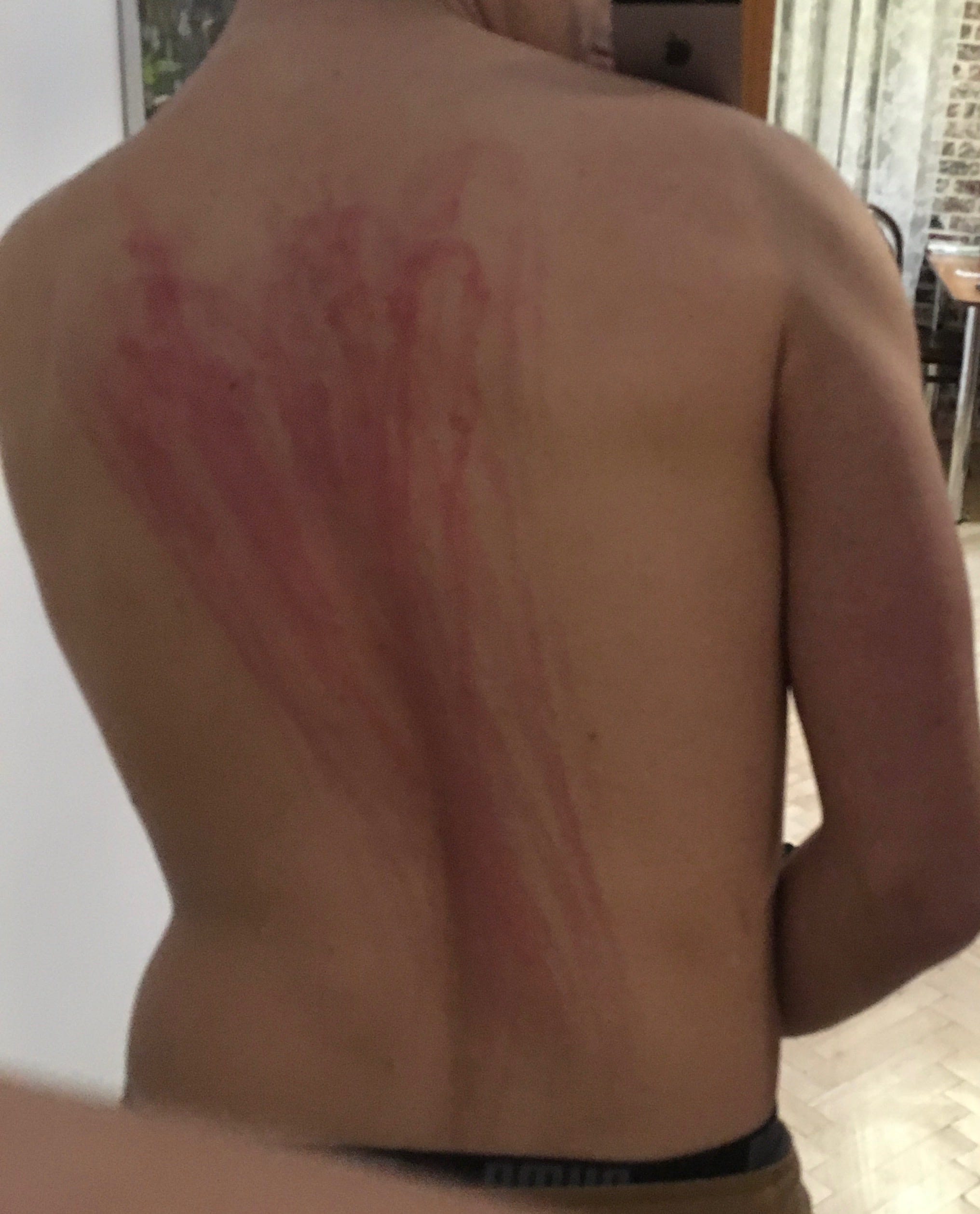
Sometimes when I tell this story (and I don’t show the video) people think I am making things up or exaggerating. But as you can see, this was what I looked like when I got back to my apartment. I learned then that I’m definitely not a masochist. I must admit I didn’t really see the appeal then and I still don’t. I just remember being very angry and very sore.
4
Were there any problems that week? Any low points? Yes, yes there were. But only one. It was the morning Tamari arrived. She had taken the night bus and was scheduled to arrive in Lviv early that morning. At 4:30am. I didn’t want her arriving by herself in this strange country early on a cold November morning, so I roused myself at 3am and walked to the bus station. Although the rain had stopped some time ago, the light from the streetlamps wriggled across the cobblestones in wavering filaments, and the trees lining the streets were slick and gleaming, like bundles of black wire, each branch diamonded with small drops of water.
It was a long walk. Took me about 40 minutes. When I finally got there I ordered an espresso at the small cafe and texted her. She would be there soon. She was just crossing the border, and once past her data would be gone which meant I would no longer be able to talk with her or find out where she was. When first she passed into the blind zone I waited patiently, even happily. I had brought an ereader and a pen and paper, so I could easily distract myself until she arrived. I still remember the name of the company: Polski Bus. And I remember everything during the next hour.
At 4:15am I see a large blue bus enter the station. I think for a moment that perhaps she is early, but soon I see that it is not a Polski Bus. I read for a bit, jot some notes in a small notebook and then see another bus pull into the station. It’s 4:30 now. The time she should be arriving. I can’t see the company name in the distance, so I pack up my things, pay my tab and head out through the cold November wind. When I get there I see that it is no Polski Bus. More reading, another coffee. Then a new set of buses pull in, but still there is no Polski bus. Now she is late and my mind starts to wander. Perhaps they are stuck in traffic. Perhaps they had a flat. Perhaps”¦ and then thoughts of every kind assail me: the bus has a flat tire and is pulled over at the side of the freeway—no, it crashed and everyone died; there is another bus station in Lviv and she is waiting there; she is already here and is robbing my apartment. There is still no Polski Bus. A battle ensues between my rogue unconscious mind and the higher-level version of myself whose job it was to patiently and carefully disassembled those deranged arguments, but every time I succeeded in convincing myself that no disaster had occurred a new one cropped up, a new disaster, a new strange conspiracy. She was never coming. There never was Polski Bus. This was all a cruel joke. And on and on and on”¦.
I wanted to leave that small cafe but was worried that I might leave and then Tamari would arrive, alone, expecting to see me, and then be stuck out in the cold. Finally at 5:15 I made an ultimatum: I would leave at 6am. By now the paranoia had subsided and I was waiting again without any mad thoughts, though they were waiting too—anxieties and fears, doubts and worries—they were rapping their knuckles on the cold frame of the door, trying to get in.
Then at 5:30 a bus pulled up. A Polski Bus! I ran from the cafe and stood outside the door. A herd of old Poles passed me down the steps and collected their baggage. The smoke from their breath mixed with the exhaust fumes of the bus. So many Polish people, so much pale skin, so much blond hair. Where was she? I waited and waited, but she never came. An old man stumbled out of the bus and I looked inside and saw that it was empty. With a cloud of worries closing in around me yet again I started walking towards the cafe—but then I heard my name, heard it the way one hears a car driving past beyond the open window, far off, as if coming from the night itself. I turned, looked around, and then I saw a silhouette with a scarf wrapped around its head, a shadowy, backlit body from which no details could be discerned, but I could tell her by the shape, by that feline hourglass torso, that it was her. I came closer and then I saw her smile, a sort of crescent moon rising out of the wispy folds of her scarf. We embraced and then I immediately asked her why she was so late. She looked at her watch. “I not late. I ten minutes early!” I told her it was almost an hour past the time she said she would arrive, and then everything clicked, with the memories of maps, flights and latitudes falling into place all at once: there was an hour time change between Warsaw and Lviv.
The sky now paling at the edge. The air still sharp and frosty. Warm exhaust fumes from the taxis rising up between our legs, rising and freezing clear. After so much mental activity I felt burned out, tired, frozen stiff. But then, standing there, side by side, I felt her fine fingers weave silently in between my own. So warm! So soft! Her long smooth fingers interlaced with my own. And the spark from that small embrace travelled through the arteries, up the arm, all the way to the heart which was now racing.
5
Back at the apartment I had prepared the fold-out couch for her in case she wanted to sleep in different beds, but immediately upon entering she declared in her usual straightforward manner, “I will sleep in thees bed,” meaning the other one. My bed. We changed, laid down, and I turned off the light. Then, propping myself on my forearms, I leaned over just above her, said goodnight, looked into her eyes, and bending down slowly, kissed her.
The next few minutes were silent but not without sound, for there can never be a perfect silence. What we call silence is really life played softly with an adagio tempo, and those different melodies yield different kinds of silences: there is the silence of the waves breaking across the shore of a deserted beach, the silence of the wind sliding through a field of tall grass, but this was the silence of two bodies coming together, of hands on soft cotton, of sheets shifting, of heavy breaths and hot clumsy kisses. But then there was a noise which, like the first bolt of lightning on a summer’s night, broke the silence:
“Fuck you!”
The soft features of her face had hardened and her jaw was clenched tight. I stopped immediately, but as soon as I did she told me to keep going. Everything was fine, she said. And that was it: no explanation, no warning, no holding back. From my perspective this demonstrated supreme—no, divine trust. Her swearing was so important, so idiosyncratic and remains so vivid in my mind for just that reason. That whole week was marked with extremes, with the dissolution of boundaries, and the swearing (along with the biting, the scratching and all the rest that followed that night) seemed perfectly natural. Sometimes I feel that it couldn’t have happened any other way. Life itself was open, volatile, and crazy during that time; and since sex is part of life like any other part, it follows that it too would be open, volatile and crazy.
I had never given myself to anyone the way I gave myself to her. I had never before surrendered so completely to anything or anyone—even myself. For the first time in my life I allowed the full spectrum of my feelings to manifest, allowed the deepest parts of myself, the darkest, most powerful parts of myself to rise up without fear of what they were or what they meant. It was utter chaos, yet somehow within all that chaos there was an order, a unity. Oneness. And though it seems strange to use a mystical vocabulary when you’re talking about rough sex, it makes perfect sense to me. In Lviv there were no boundaries or borders. Just free expression, creation and liberation. We were barely more than strangers to each other, and yet there was a closeness and a passion that went far beyond the base animal cravings that such a meeting should have engendered. We could say anything, do anything, and it was all perfect. Every word, every act and every thought was justified and righteous because we were their creators. At times it was violent but so are thunderstorms. And if the sea, sun and sky are all good, then thunderstorms—which come from all three working together—must also be good, even though they are dark, violent, destructive.
Afterwards, she nestled up beside me—calm, quiet, content. Like the kettle after it’s been taken off the burner. I never asked why she swore and she never mentioned it. I said only in passing that I thought it was primal—a word she didn’t know—and never brought it up again. There was no need. At the time I understood it all without understanding anything.
6
To be honest, I didn’t know what to expect with Tamari. I knew she was happy and easygoing (my two favourite traits) but in all fairness we hadn’t spent much time together, and part of me was worried we may not get along. There were no problems; our time together was a perfect symphony. In all my travels I have never been around someone so easily. Never any tension, never a single bum note.
As with the rest of that week, the actual events that took place were simple and unexciting: we went for coffee at cafes, we made chicken and rice for dinner—or rather, she made chicken and rice for dinner (I was useless)—we hung out with friends, wandered the geometrically arranged streets of Lviv, inspected the churches that lay sprinkled throughout the city, and she studied for her exams while I wrote. Honestly, I can’t convey what happened when Tamari came to visit me. I could describe the city of Lviv. I could tell you how it fans out in concentric squares with the town hall sitting in the center, how the buildings looked, how the food tasted, but you would never understand what it felt like to walk through them, to wander under the endless grey sky without a plan, stopping now and then at one of the many beautiful cafes to enjoy an espresso, a glass of brandy and a piece of black-forest cake, the occasional cigarette. Perhaps the events aren’t important in themselves; perhaps it was our being there together that made them such. Because during that time I was still full of forked lightning and she was radiant as polished zinc: everything we saw was spangling and metallic, everything we touched was left galvanized and glowing in memory.
She was the most confident woman I have ever met, the most centred, the most joyful. I remember one night she was talking about her childhood, about a certain girl that didn’t like her. I couldn’t believe it. She was so happy, so kind, so easygoing. How could anyone dislike her? She told me the reason: “because I was more beautiful.” What I found amazing was that there was no trace of ego in that statement. She talked about her beauty the way she would have talked about her height or the weather. It wasn’t something to be proud of; it wasn’t a foundation upon which to build self-esteem. It was a fact. She was beautiful. There was no need to feign modesty or any attempt to impress me. It was a detached statement. She had no stake in it. And I feel that if anyone would have told her that she was not beautiful, rather than anger, sadness or some other negative reaction, she would have met them with an emotionless, bemused look—the same look that she would give if they had told her she was four feet tall with platinum blond hair.
She was Orthodox but embodied more stoical and Buddhistic virtues than any self-proclaimed Stoic or Buddhist I have met. She hadn’t read the books, nor did she care about the cerebral arguments: she lived it, embodied it. Nothing could suppress her ardour or diminish her insatiable love of life. She used to be a runway model when she was young but stopped at the age of fourteen. I asked why and she said, “I learn that once you get older you must do things for photographers to be model. I didn’t wish to do those things. So I quit. I would rather be happy. I just want to enjoy my life.” Again, not an iota of negative energy. She retained the same smouldering glow that she always had. And what wisdom at fourteen! To make that decision, to walk away from it. There was no need to get angry at the way the world was, even if that anger was justified. She had made a decision to be happy and nothing, not the cruelty of the world, nor any comment made by any person would disturb that peace.
She smoked occasionally, though you would never have guessed it with those chalk-white teeth. Her body seemed too strong to be affected by the tar and other toxins. I took up the habit for the week I was there, buying a few packs for five dollars, and I retain such fond memories of lighting up in the cafes with an espresso, in front of churches, restaurants and bars, or late at night on the small balcony with all the lights out, overlooking the small courtyard. I had never smoked before and thought I would do it for a week or two and then quit forever. Tom, a recently recovered smoker himself, hated this idea; thought for sure I would get addicted. I didn’t but the week in Lviv and the week that followed made me understand why people smoke—that is, what they get out of it. Having never smoked myself, having never tried a cigarette, I didn’t understand why people did it. There is such a campaign in Canada against smoking that I never considered doing it. In Ukraine, however, as well as the rest of Eastern Europe smoking is the norm, just like drinking. Everyone smokes, and the small kiosks along the streets sell cigarettes in beautiful cases. No pictures of people with rotten teeth or holes in their chests. It’s like going back in time to the sixties, to a place where everyone is blissfully unaware of the dangers.
What else is there to say? I was happy during those days. And although in general I am a happy person, possessing a naturally cheery disposition, this was something different, something more profound, what might be called a metaphysically significant form of happiness: happiness that solves the riddle of human existence. Although I wasn’t able to see all the implications, the first throb of this revelation came to me during the one full night we spent together. She was sprawled out, fast asleep beside me. All the lights were off, but the room was suffused with a dusky blue glow that kept everything from dissolving into darkness, the walls and sheets and limbs of our bodies shining with a cold phosphorescence, as if magnetized with the dust of finely ground sapphires. No camera could have captured the seething beauty of that scene: the smoking blueness, the bed like an ocean under a new moon, those ruffled sheets rising with the tide of her breath. I remember just laying there, looking at the bed, at the spread of it, and thinking how happy I was—not just happy, fulfilled. I remember thinking that I would change nothing. It was a cheap one-bedroom apartment. It was November in a small grey city in Ukraine. And yet if I had all the power and money in the world I would still have chosen to be there. With her.
In an instant I understood that everything I had wanted in the past was an illusion: a penthouse suite could not have given me a better sleep; a five-star restaurant could not have nourished me more than her chicken dinner and my rice pudding. Line up all the woman in the world and I still would have chosen her to be sleeping soundly beside me. All my dreams, all my yearnings, all my desires for more suddenly fell away, dissolved into nothing, and I felt that I was in possession of the one thing that everyone wanted, a peace and happiness that can’t be bought or earned because it is not of this world. The hedonistic calculus which until that point had ruled over my life now seemed worthless, because nothing could have been added or subtracted to make this moment any better: somehow all of those pieces, small as they were, summed to infinity.
7
At night the bus station was terribly disorganized, and she almost missed the bus. We ran from stall to stall asking which one was headed for Warsaw. Nobody spoke English, so Tamari had to ask in Russian which was shakily understood by most. When we finally found it I put her bags in the storage compartment of the bus. Then, with the sour grey fumes spilling out over the road, we hugged, kissed, said goodbye, and before disappearing into the mirrored belly of the bus she turned and gave me one more smile, that same smile I had been enjoying for the past few days, a smile that blazed white hot and steaming amid the frost and then smoke; and that’s my last image of her, that’s how I see her now and what I think of when I reflect back on those days we spent together, days which remain clear and bright and sharp, as if they were tattooed on my brain moment by moment with Japanese wooden needles, days which will remain till the end because they, like her smile, were perfect.
Admittedly, our time together was short but those short days were so densely packed with insights, laughs and meaningful moments that they take up more space in my mental firmament. Never before had I been so consciously aware of time’s relativity, for that week stands out as a trip unto itself. Like a little, glimmering constellation.
When I left the bus station I decided to walk back instead of taking a taxi. It was my last night in Lviv and I know of few more satisfying experiences than to walk the streets alone while reflecting on the silence of the surrounding night. I had prepared mentally for Tamari’s departure, and though I wished she could have stayed, wished that we both could have stayed, I knew all along that it would end like this and that there was a good chance I would never see her again. Nevertheless I felt a wistful sorrow as I crossed over the steel tracks of the tram system, not because she was speeding away from me, but because all of it was speeding away from me—my youth, my time overseas, my memories, my whole life—all of it was slipping away, and there was nothing I could do to stop it. Her departure betokened the end of all things, and now everywhere I looked I saw time ticking down. The sky was clear for once but when I looked up I saw those glittering, steely lights going dark. One by one they dried up and died out, and the darkness around them grew until there was a solid black sheet above me. Then the streetlamps began to fade, and as they dimmed the world broke down: the parked cars fell apart, the leaves and branches blew off the trees, the cobblestones cracked and crumbled. The wind blew through the streets and the houses dissolved as if they were made of dust; then the cars, then the trees, then the whole world—dust. Everything was ticking down to this. A fuliginous, atomic fog. No motion, no heat, no colour, no substance. Everything would eventually go dark and Tamari’s departure was a pencil-thin shadow cast by the monument of the past few days, a cruel reminder of the endless night to come.
It was the only time during that week that I felt low, and it was about as low as I have ever felt in my life. But then as I was walking past an empty park I heard a car coming from behind me, heard its tires popping along the cobblestones, and I felt the sound of each stone reverberating up my spinal column, each one louder than the last, each one bursting like a small carbonated sphere along the surface of a glass of Dom Pérignon champagne. All of a sudden the world came flaring back to life and I felt that I was full of these small spheres, that I was boiling over. I was in awe: in awe of the sound, the stars above me, my past few days; in awe of Tamari, of the food, the coffee, the cigarettes; in awe of my trip so far and all the trips that had yet to come. Having been dropped into the abyss my pupils had suddenly dilated and become accustomed to the lack of light. I could see clearly, and all the previous fears, doubts and worries, all the arguments, theories and conjectures—they seemed utterly unimportant. In a way, what I felt then was the obverse of depression. One need not ask the depressed person why they feel that life is not worth living in the moment because their symptoms are immediate and self-evident. Now, as I fell tumbling into the end of everything I just knew: it was all worth it. I wouldn’t say I had any answers, but rather all the questions ceased to matter. If mysticism begins when you stop asking questions, then I’m a mystic. There was no need to cling to a metaphysics or an idea about God, reincarnation, life after death, destiny, no need to try, no need to do anything but spread your arms and take it in.
To surrender yourself completely, to allow the world to fill your every pore, to inhale the cold air, hear the sound of rippling rubber tires and see the stellar lights trace their arcs across the sky, to soak it up like a sea sponge and inhale the mineral-rich currents of the present moment. What else was there to know?
All this happened within the span of a couple seconds, and once the car passed and the popping faded into the night I was left with a strange mélange of disparate feelings. Such a juxtaposition! The darkest depths and the brightest heights! I was staring into this pit of pain and sorrow and felt myself falling into it. A second later I was floating, pumped full of helium. But if space is infinite what is the difference between falling and floating? Perhaps that which I loved and that which I hated were one and the same thing, for during that week I was constantly intoxicated by the flux of phenomena, by the sun rising, by rain falling, by a soap bubble popping as I did the dishes, by anything and everything, but at the same time all of those changes cast a melancholy shadow because they meant the end of whatever beautiful thing had just preceded them. A sunrise burns out the nighttime peace and rain destroys a sunny day. I love watching the change but I mourn the loss of what is changed. And though I felt that everything was somehow worth it in the end, this recognition did not negate the essential tragedy: Tamari was gone, my perfect week had ended, I was getting older, and someday far in the future it would all go dark.
I write this now as if looking back through the back end of a telescope. Everything is far away, cold, petrified. As I sat for a few minutes on the curb I felt all of this physically: a pressure behind my eyes, a sense of being too full, as if my body contained too much blood. I was bloated and forced to sit down on the curb for a few minutes with the liquid hanging at the edges of my eyes, held in place by mental surface tension. Gradually, the tears began to recede from my eyes and pooled at the base of my throat, where they coagulated into a hot, sharp lump. Then they were shed, slowly, breath by humid breath, into the night.