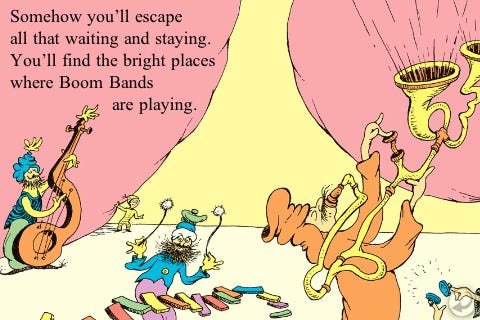
A few years ago, I was sitting in a pointless MBA elective about innovation or some bullshit. The guest speaker (some hot chick) was blathering on about something girl-bossy and dropped this cringey dime: “Your Net Work is Your Net Worth.” I briefly looked up from the r/simpsons subreddit and giddily imagined defenestrating her.
Perhaps that was an uncharitable thought. At the time, I was stressing about a pending job offer and wedding (mine), and counting the days until I could start my real job. Still, years later, I would be glad I showed up to class that evening. The speaker was kind of right, and definitely hot.
Hot rich people do have a lot of hot rich friends, right? Most of my friends are middle-aged, middle-class, mid-wit mids. I must have blown it with social networking.
I’ll admit to squandering opportunities. Anyone who says they have “no ragrets” is likely a monster and they also can’t spell. My college peers who intuited and played the status games that I eschewed are living comfortable upper-middle-class lifestyles in California, yet here I am living a comfortable upper-middle-class life in Parts Unknown. I guess two roads diverged in a yellow mood, but I still have to make a confession of all the times I repeated a pattern of mistakes. How else do I inculcate in my online Network and Fan Club a sense of seizing the moment? How do I guide my sons from making similar stupid errors?
In college, instead of joining the rugby or crew team, I made the key mistake of selling weed. Weed that turned me gay (I’m better now). Weed is a low-status network. I realized this at 20 when it dawned on me that hanging out with the stoners meant a monetary tithe to the network - buying weed and weed accessories. The reward: paranoia and bad grades. Luckily, I cured myself of the weed habit by starting a cigarette habit and dumping the weed friends.
Now I’m in touch with maybe 5 people from my college class. Dunbar’s Number and all that, but still, not a lot, and I don’t see them much anymore. These were key friends, but our recent time spent together is scarce and yields none of the economic benefits boasted by many other college cliques. My fallbacks were law school, a Naval Commission, or teaching (English) in Korea. Real median wage depression in the legal profession and a DUI disbarred me from all three. Whoops.
In hindsight, there’s no shame in working for your dad, but in 2009, this shamed me greatly. Still, I made the best of it, learning a lot about power plants and other plants. Did you know that plants make oil and oil makes plants? Fascinating stuff when you unpack it. Five years later, I was assigned a book by his boss: The Second Machine Age, and, in a twist of irony, it convinced me to quit. I was missing an opportunity by not getting involved in software technology. Boy did I feel dumb: I’d gone to school adjacent to Silicon Valley, and now here I was on the East Coast with no computer skills and no network.
It was also at this time that I abandoned my stand-up comedy aspirations. I found the scene to be a huge opportunity cost both in terms of time and network. Even the cool comics are losers by most colloquial definitions, and the mentally ill drug abusers frequenting the mics are not the people you want to be hanging out with on Tuesday at midnight. A part of me wonders what commitment would have looked like - the Philly scene at that time included Shane Gillis and his whole orbit of friends, but none of those guys would be successful until many years after I quit.
I’d had enough with low-status networks, and picked an MBA to serve as my launchpad for upskilling to the workplace of tomorrow. Cleverly, they only teach you about debt and the time value of money after your first check clears, but for me the timing was right, and I am paying down my loan at 2.8% right now.
The other thing about MBA Programs below the top 25 is that they are kind of bullshit. I leveraged my genius verbal IQ and dumb math IQ to get a good GMAT score, then came to learn that many of the racial minorities and women in my cohort had been exempted from the GMAT! I’m in touch with maybe 5 of these people.
My MBA class was mostly not impressive, but it did land me a coveted internship at a Crayon Manufacturer. All the crayons I could eat. My mentor quit during my first week, but one of my MBA cohort (no GMAT) complained that her internship at a large German tech company would require her to work during the school year, and would anyone like to interview? Since our course load was mostly BS (except for finance) I took this one weird interview while on the clock at Crayon Corp and got the new internship at SuperSoft Tech Corp.

This particular job sucked, but I was able to finagle some recommendations and get into a coveted international sales training program in the same company. I closed the deal by walking to the HR lady’s desk in a dreary corner of the building, acting like I already had the job, and asking her when I would receive my offer letter. I think she was so taken aback that I’d even found her that she hotshotted me through the process. This happened all the way back in 2018, when it was still legal to be a white man. It may seem like a boomer story, but younger folks take note, if you’re auditioning, be audacious.
The cool thing about the SuperSoft sales program was that it was a rehash of the more important parts of my MBA. Also, it was global. I made really cool friends from all over the world! Now I’m in touch with maybe 5 people from my SuperSoft Academy, and my network is looking knotty.
COVID ran its course, and one of my impressive new friends at SuperSoft had found a job at a startup in the cloud hyperscaler ecosystem. I was tickled to say goodbye to my boss, who had a CRM system for a head and a fat golfer for a body.
My friend got me an interview, and I waded behind him into the capital flows and salary raises in a series of failing startups. One failed spectacularly, due to an executive embezzlement scheme, and two hundred people lost their jobs overnight. As another startup approached failure, I began to think a bit more asymmetrically. I joined the Tortuga Society. This was in tandem with a desire to try and cash in on the Substack lottery and build an audience for my book. It worked!
Wes Pearce promised me that I could escape the cubicle by playing the Substack lottery. The thing about his newsletter is that it is the only newsletter out there that promises to help you grow your newsletter. I forget what else it’s about. Walt Bismarck promised untold riches through the black magic of job stacking. I decided to try my hand at it.
It was elating at first, the quadruple life. I thought I had it all: a beautiful wife, a family, a home, 2 jobs, and likely one of the bigger dicks in my neighborhood. You know who probably shouldn’t job stack? 40-year-old guys who coach little league for two kids. I got the speed wobbles.
Job two was more fun, more pressure, and less lucrative than my primary W-2. I had to walk away. This was a decision that cost me a fair amount of psychic unease and probably burned some short-term social capital as well. I suppose you could call all this a midlife crisis. Maybe I was psyopped by Dr. Seuss into believing that I was destined “to race down long wiggled roads at a break-necking pace
and grind on for miles across weirdish wild space, headed, I fear, toward a most useless place.
The Waiting Place…”
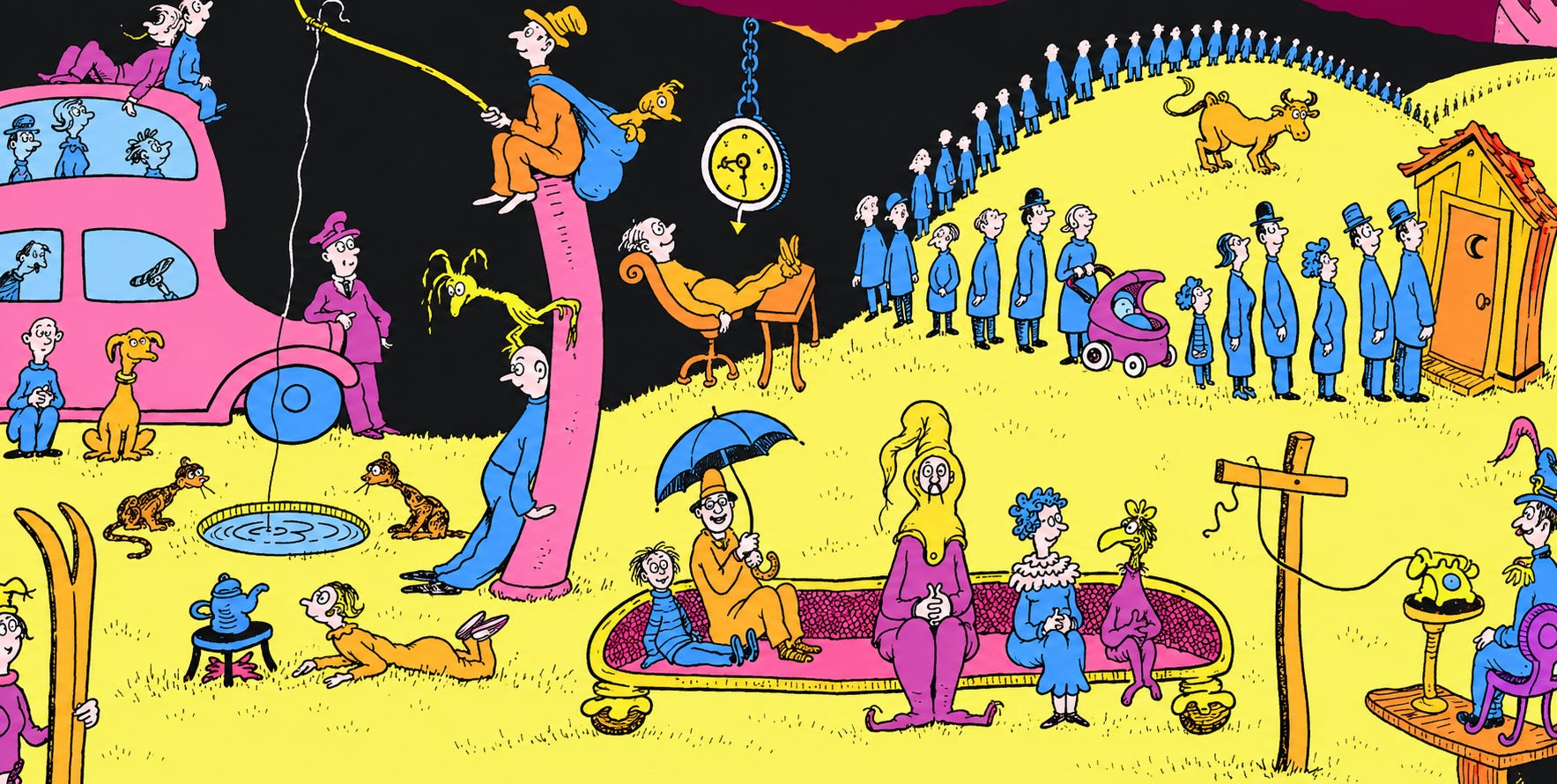
But Thing 1 is that I’ve sort of been in the Waiting Place since I got that stupid MBA, and Thing 2 is there’s an element of dues-paying to all of this. Bet on this: you will see peers around you hit lotteries that they don’t deserve, but then again maybe you are playing the wrong game.
Is there advice here? If you missed all the nuggets, re-read this post closely. Like all internet ephemera, it will vanish with the next dank meme, thirst-trap, or hot take.
Now you are ready for the ultimate piece of advice that will either help you escape the cubicle or master the cubicle: there’s very few people you will work with that you’ll actually want to work with. Those outstanding people will inevitably move to other jobs and not take you with them. Keep those people in your Dunbar’s Number Rolodex. Check in with them every three months or so. Share intel.
Until something changes drastically in white collar work, your job is to get your next job. The informal network that will get you that job requires energy - yours. A small sacrifice of effort to keep you afloat in unsteady seas.

So what do I tell my sons? And what do I tell you, my spiritual sons, uncs, and nephs? Consider an analogy from dating: almost every mature man would prefer having a spank bank full of dimes rather than a body count rife with busted uggos.
Your professional life will be shaped by the rooms you enter, the people you help, the people who remember you, and the people you are still presumptuous enough to call after three years of estrangement.
Go to the dumb MBA class and sift through the muck to pocket the gold nugs. Attend the networking dinner (protip: unless you are hosting, you can always figure out a discreet excuse to exit early). Take the weird interview, maybe on the clock. Follow up with the impressive guy, yeah that guy from SuperSoft. Not the lady: she’s not that impressive. Do the thing that feels a little temeritous, provided it is not illegal or ghey.
Ask the favor before you are desperate. Offer the favor before they ask. Every three months, check the Rolodex. Do not confuse alienation with intelligence. Do not mistake cynicism for taste. Do not build your whole identity around refusing to play games that are, in fact, just the ordinary machinery of human opportunity. Lots of games are stupid. Some are downright corrupt. Some are merely how people find each other.
People say that luck is when preparation meets opportunity, but luck is also proportional to the amount of novelty you’re open to. You get opportunities when you’re open to new commitments. I’ve always been high in openness and skeptical of committedness. But, as I learned in my philosophy (whoops) undergrad, the notion that a person “could have done differently” is a metaphysical and ethical dead end. The past is locked, but mapping your mistakes can be a key to your future.