

Last month, Professor Axelrod told us to drink coffee and smoke. Now, it’s time to discuss The Ol’ Rona. Is Long COVID a thing? What do you do if you have it? Read on for facts, conspiracies, and health advice. - Ed.
Brace yourself: we’re going to talk about COVID and the vaccine.

Except this time, for once, we’ll have some data, not just screaming denialists and deboonkers.
There’s a lot of controversy about mRNA vaccines and the pandemic. Depending on what you’ve heard, and inevitably … who you believe … one or a couple of the vaccines (or perhaps the boosters) proved to be more hazardous than the others. Maybe this was Pfizer, Moderna, or Johnson & Johnson, maybe you had natural immunity to the virus, or maybe you were one of those populations who got hit hard. There’s a lot of rumor and accusation, so it might be nice to know what the data actually says.
What Data?
Take the question of vaccine effectiveness versus risk. The information needed to answer that question was never made available in a form that would allow independent researchers to determine whether one booster in one area of the country was more dangerous than another. Lot-number-level adverse event data is precisely what VAERS collects, but the CDC restricted access to the full VAERS dataset during the pandemic and actively discouraged lot-level analysis, characterizing it as scientifically invalid. When independent analysts like Jessica Rose attempted lot-number analyses from the publicly available extracts, public health authorities denounced them as misinformation. The question of whether Rose et al.’s findings of lot-to-lot variation in adverse event signals reflected genuine manufacturing inconsistencies, geographic clustering of reporting behavior, or statistical noise remains unresolved because the institutions with the complete data chose not to answer it transparently.
Here’s a particularly keen example. Before the data made denial impossible, the public-health apparatus spent an embarrassing amount of energy downplaying the relationship between booster shots and myocarditis and pericarditis (inflammation of the heart muscle and its surrounding sac). Yes, the boosters did prove to be dangerous, certainly by the standards we’d usually like for generally available medicine.
The second dose was the real troublemaker. Not the first, and not the third or fourth to the same degree. A Nature Communications paper from 2022 confirms that the highest risk clusters right after dose two, particularly in males under 24. The booster doses showed lower myocarditis signal than the second, which makes some immunological sense - the priming plus the first boost produces the most aggressive spike-protein expression and inflammatory cascade. Subsequent exposures find a more tempered, already-primed system.
On comparing boosters to each other, Moderna was worse than Pfizer, unambiguously. The JACC head-to-head population study in British Columbia put it at two- to three-fold higher odds of myocarditis or pericarditis with mRNA-1273 compared to BNT162b2. Canada’s national surveillance data showed an even more alarming 4.72-fold higher risk for Moderna among males aged 18 to 29, the demographic already at the highest baseline. The likely explanation is dosing: Moderna’s shot contained 100 micrograms of mRNA versus Pfizer’s 30 micrograms. More lipid nanoparticles, more spike protein produced, more opportunity for the immune system to mistake cardiac tissue for the enemy (molecular mimicry between the spike protein and cardiac antigens being the leading mechanistic hypothesis).
The sex disparity was stark; testosterone appears to potentiate the inflammatory response to the spike protein in cardiac tissue, with the male-to-female ratio in reported cases between 4:1 and 10:1 depending on the study. A meta-analysis published in Epidemiologic Reviews put the attributable risk after the second dose of mRNA-1273 at roughly 20 per 100,000 doses in males 18 to 24 and about 10 per 100,000 for BNT162b2 in boys 12 to 17. (This is the demographic for whom COVID itself posed a mortality risk so low it was difficult to measure against background noise, the boys and young men who could have walked through a COVID ward unmasked and emerged with nothing but a rage against the technocratic state.) The absolute risk remained low in raw numbers - on the order of a few dozen cases per hundred thousand second doses - but the relative risk concentrated in a demographic (young men) for whom COVID itself posed a minimal threat. This upended the risk-benefit calculus that had been sold as universally favorable.
COVID severity was overwhelmingly a disease of the old and the already-sick. Age was the dominant risk factor by an enormous margin. The CDC’s data showed that people 65 and older accounted for roughly 75% of all COVID deaths in the United States despite being about 16% of the population. Comorbidities - obesity, diabetes, hypertension, chronic pulmonary disease, and immunosuppression - each shifted the odds ratio substantially.
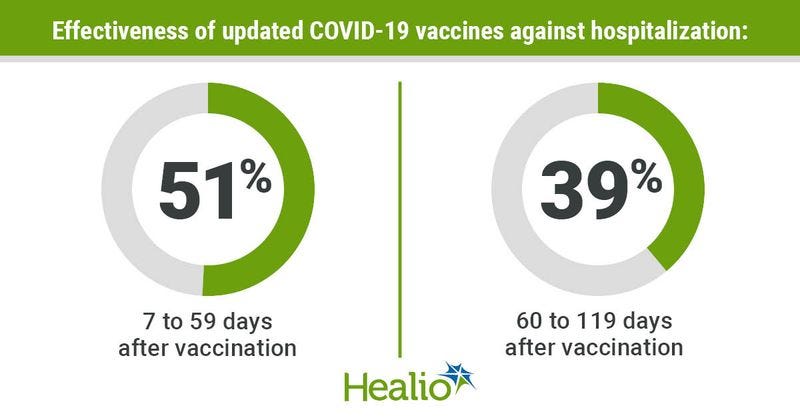
A truly individualized risk-benefit analysis would have produced different recommendations for different populations, which is exactly what several Nordic countries did when they restricted Moderna in males under 30. The American approach was to pretend the calculus was the same for everyone and denounce anyone who noticed otherwise.
(There’s also the question of whether repeated boosting in low-risk populations produced diminishing returns against infection while the adverse-event burden accumulated. The bivalent boosters in particular were authorized without human efficacy data, a regulatory decision that would have been unthinkable before 2020 and that did not age well as the variant-matched antibodies they generated proved scarcely more durable than the original formulation’s, to the great consternation of the public and the manufacturers.)
In addition to just heart conditions, did getting boosted correlate with strokes? Well, yes. In January 2023, the CDC and FDA issued a joint statement announcing that their Vaccine Safety Datalink had flagged a preliminary safety concern: adults 65 and older showed a higher rate of ischemic stroke in the 21 days following the Pfizer-BioNTech bivalent booster compared with days 22 through 42. This was not some internet rumor; it was an official agency disclosure, published on the FDA’s own website. The signal was specific to the Pfizer bivalent, not Moderna’s bivalent, and it was concentrated in the elderly. These were the very people being told that boosters were most critical for them.
The follow-up got murky. The agencies investigated further across the VAERS database, Medicare claims, and the VA system, but failed to replicate the VSD’s flag. The CDC’s final word was that the finding was likely a statistical artifact. Reasonable people can disagree about whether that conclusion was adequately powered or whether the databases were sufficiently independent to serve as genuine falsification checks. What’s not disputable is that the same agencies had spent two years dismissing myocarditis concerns from clinicians and VAERS reporters as coincidental until the international data became overwhelming. The pattern of initial minimization followed by quiet acknowledgment had already been established. Unusual clotting patterns and menstrual irregularities were substantial enough to warrant NIH funding only after two years of women being gaslit about all of this.
Your skepticism of the anecdotal reports is well placed, but the reason anecdote is nearly all we have on that front is, itself, part of the story.

If you’re into COVID nonsense, how about something even more nonsensical? Listen to the upcoming Tortuga Library Podcast’s audio review of Pandemonia, the novel plague plague novel, by Tortugan Centaur Write Satyr, PhD - Ed.
Most Dangerous to China’s Rivals
Now, it might also be useful to ask: Demographically, were the disease and vaccine risks spread even across groups? Were certain genotypes more susceptible to myocarditis (and microclots) than others?
The genetic susceptibility to vaccine myocarditis that has been proposed involves HLA variants - specific class I and class II alleles that influence how the immune system presents spike protein peptides and whether cardiac myosin gets caught in the crossfire through molecular mimicry. This is the same mechanism behind viral myocarditis generally, and it’s why some people suffer inflammation of the heart after a common coxsackievirus infection. The HLA loci are highly polymorphic across populations, but the specific alleles that predispose someone to mRNA-vaccine myocarditis haven’t been mapped with the same resolution as the COVID-severity haplotype. This is largely because the institutions that would fund that work have been reluctant to frame the question in a way that might generate inconvenient answers.
Let’s start with the easy and relatively uncontroversial stuff. On the genetic front, the most famous finding was the Neanderthal-introgressed haplotype on chromosome 3, identified by Svante Pääbo’s group and published in Nature in 2020. That 50-kilobase segment, which includes genes involved in chemokine signaling, raised the risk of severe COVID requiring hospitalization 1.6-fold. It is carried by about 50% of South Asians and 16% of Europeans, but is nearly absent in East Asians and Africans. So the genetic architecture of COVID susceptibility had a real ethnic gradient; Bangladeshis and Tamils in the UK had twice the mortality of the general population, and the South Asian diaspora consistently showed elevated risk across multiple countries.
If that makes you think that this is possibly the sort of thing that might be indicative of a gain-of-function lab leak in a project that looks suspiciously like a prototype for “most dangerous to China’s rivals” and could conceivably have been a bioweapon, well … yes.

If you were a Chinese researcher conducting gain-of-function experiments on bat coronaviruses - modifying them for enhanced human transmissibility through furin cleavage site insertion, serial passage through humanized tissue, or the kind of chimera work the WIV was demonstrably engaged in - and you let the virus escape containment, the population most likely to survive the resulting pandemic with minimal mortality would be your own. Han Chinese populations carry almost none of the Neanderthal risk variant, so the virus would be disproportionately lethal to your western and southern neighbors.
The story above works perfectly well whether as accident or as malice. They “passaged” the virus through human ACE2-expressing mice or cell lines derived from East Asian donors, which selected for efficient human transmission. When the virus escaped the lab, it encountered other human populations whose genetic architecture made them far more vulnerable.
The demographic pattern is not the only circumstantial evidence pointing toward the lab, but it is among the most stubbornly under-examined. The standard zoonotic-spillover narrative requires a chance event: a bat virus jumping to an intermediate host, then to a human at a wet market in a city that happens to be home to the world’s premier SARS-like coronavirus research facility, which happens to have been conducting exactly the kind of gain-of-function work that could produce such a virus, and whose lead researcher then stonewalled international investigators and withheld key viral sequence data. That is a lot of coincidences. Add to them the demographic-genetic pattern - that the virus’s lethality gradient maps almost perfectly onto the Neanderthal haplotype distribution, sparing the population in whose laboratories it was being studied - and the chain of coincidences grows longer still.
As you may have learned from xkcd:
Correlation doesn’t imply causation, but it does waggle its eyebrows suggestively and gesture furtively while mouthing ‘look over there’.
Documents obtained through FOIA requests and reported by US Right to Know describe the DEFUSE proposal: an NIH-funded EcoHealth Alliance project that partnered with Shi Zhengli’s lab at WIV, explicitly aimed to insert furin cleavage sites into bat coronaviruses to assess pandemic potential. The furin cleavage site on SARS-CoV-2 is one of its most distinctive features - and absent from its closest known relatives in the wild - perfectly positioned to enhance human infectivity.
Scott Aaronson, reviewing Chan and Ridley’s book Viral, noted that the case for the lab leak theory does not require a smoking gun. It only requires one to acknowledge that the circumstantial evidence has accumulated to a point where the burden of proof has shifted. The zoonotic-spillover advocates refuse to make that acknowledgment, and so have never adequately addressed the demographic-genetic pattern. Easier to change the subject to anti-Asian hate crimes - which is what happened every time the lab leak theory was raised in 2020 and 2021 - as though the geographic location of a laboratory were a racial accusation rather than a physical fact about where the building stands.

Even if it’s verboten to discuss race and disease in polite circles in Western media, the Indian discourse is far more frank. The Economic Times of India - the country’s leading business daily - ran an analysis in mid-2021 under the headline “COVID-19, China’s Bioweapon Warfare Strategy and Global Security” that examined the lab leak hypothesis as a serious strategic question. The piece situated the pandemic within China’s broader military-modernization program, noting that the PLA has invested heavily in biological warfare capabilities and that China’s biotech sector operates under a dual-use framework that makes civilian research functionally inseparable from military applications.
India and China fought a border war in 1962, have unresolved territorial disputes in Ladakh and Arunachal Pradesh that have produced deadly clashes as recently as 2020, and are locked in a long-term competition for influence across the Indian Ocean and Southeast Asia. China’s Belt and Road Initiative encircles India strategically, and the China-Pakistan Economic Corridor runs through territory India claims. In that context, a pandemic that kills millions of Indians - India lost somewhere between two and five million people to COVID by excess-death estimates - while leaving China relatively unscathed looks less like a natural disaster and more like asymmetric strategic warfare.
Or is it windfall? The “depraved heart” theory states that even if the WIV didn’t deliberately set out to kill Indians, they conducted gain-of-function research in the knowledge that a lab escape would disproportionately spare their own people. The prestige and funding attached to coronavirus research outweighed the risk to foreigners. This theory requires no conspiracy, malevolent intent, or secret bioweapons program, but only careerist ambition and racial indifference. That is consistent with the CCP’s documented attitude toward non-Chinese lives.
The Chinese state media response to Indian coverage of the lab leak theory was telling in its own way. The Global Times - a CCP mouthpiece - ran a piece in May 2021 titled “Lame Indian Media and Politicians Resort to ‘Lab Leak’ Lie to Shift Focus,” attacking Indian outlets for “baselessly accusing China of weaponizing the virus.” The article’s tone was the standard CCP blend of wounded innocence and barely concealed contempt, but the fact that Beijing felt compelled to respond at all - and in English, for an international audience - suggests the Indian discourse was being taken seriously in Chinese strategic circles.
The Western media’s refusal to engage with the Indian discourse is another form of condescension, the assumption being that brown people worried about being bioweaponed by their nuclear-armed neighbor are just addled by conspiracy theories. Western journalists who spent two years insisting the virus came from a pangolin at a wet market, meanwhile, were doing sober science journalism.
Clear the Spike Protein!
Let’s turn our attention to those who did suffer from this disease in one way or another, whether because they contracted COVID directly or because they got a vaccine (or booster). Some showed “long COVID” in addition to the pulmonary side effects and thrombosis events, and they would like to know what’s effective in treating the clotting issues, the spike protein damage, the vague panoply of symptoms. The general suggestion seems to be blood thinners and of course Paxlovid if you want to interrupt COVID immediately, but what else works?
There’s a substantial and growing clinical literature on this, driven almost entirely by independent physicians, because the funding apparatus that produces large RCTs was not interested in studying post-vaccine injury. Their approaches fall into several mechanistic buckets. The more sophisticated protocols combine these rather than relying on any single agent.
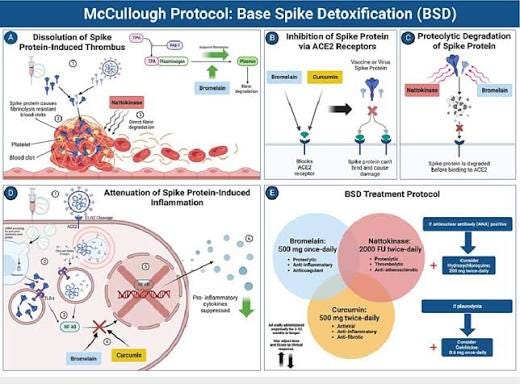
The foundational insight, articulated most prominently by Peter McCullough and the FLCCC group, is that the spike protein itself - whether from infection or from the mRNA instructing your cells to manufacture more of it - persists in tissues far longer than the public-health messaging acknowledges. Spike proteins bind to ACE2 receptors on endothelial cells, directly damage the vascular lining, trigger platelet activation, and form amyloid-like microclots that standard coagulation panels miss entirely. The treatment logic isn’t merely “thin the blood,” but “clear the spike protein.” (And repair the endothelium, dissolve the aberrant clots, and modulate the inflammatory cascade.) That’s a much taller order.
The McCullough Base Spike Detoxification protocol, published in ScienceOpen, uses three over-the-counter agents: nattokinase 2,000 fibrinolytic units twice daily on an empty stomach, bromelain 500 mg once daily, and curcumin 500 mg twice daily, preferably in a liposomal or nano formulation with piperine for absorption.
Nattokinase is the workhorse here, a fibrinolytic enzyme derived from fermented soy that directly degrades fibrin and has shown activity against spike protein in vitro. Bromelain, from pineapple stems, has both proteolytic and anti-edema properties. Curcumin suppresses NF-κB, the master inflammatory transcription factor upregulated by spike proteins.
This protocol is typically continued for three to twelve months, and McCullough frames it as the base layer onto which symptom-specific treatments can be added. This is more of the sort of thing you’re likely to get from your naturopath - which is fine, he’s still a licensed doctor. Pragmatically though, it’s hard to measure progress except by “how do you feel?”
The FLCCC I-RECOVER protocol, now maintained by the Independent Medical Alliance, provides a more granular, tiered framework. First-line additions beyond the base enzymes include low-dose naltrexone for immune modulation - giving significant improvements in fatigue and post-exertional malaise - and, oh boy, ivermectin. In this context, ivermectin isn’t being used as an antiviral, but as an anti-inflammatory. It binds to the spike protein and blocks its interaction with ACE2 and toll-like receptors.
Second-line options escalate to maraviroc for CCR5-mediated inflammation, statins for endothelial stabilization (there is evidence for atorvastatin in particular restoring endothelial nitric oxide synthase function disrupted by spike protein), and, in some cases, corticosteroids for refractory neuroinflammation.
For clotting specifically, the most aggressive approach comes from Resia Pretorius and Jaco Laubscher’s work in South Africa. They identified that the microclots in long COVID and post-vaccine syndromes are not simple fibrin thrombi, but amyloid-like, resistant to normal fibrinolysis, and accompanied by hyperactivated platelets. Their triple therapy protocol - dual antiplatelet therapy (clopidogrel 75 mg plus aspirin 75 mg daily) combined with a direct oral anticoagulant (apixaban 5 mg twice daily) - showed significant symptom resolution and microclot clearance in their published case series. This is prescription-level intervention requiring physician supervision and bleeding-risk monitoring, an important consideration given the intensity of the regimen.
Other agents with mechanistic plausibility and some clinical support include N-acetylcysteine for glutathione repletion and oxidative stress, omega-3 fatty acids at therapeutic doses for endothelial membrane stabilization, sulforaphane for Nrf2 pathway activation, and, in some protocols, lumbrokinase or serrapeptase as alternatives to nattokinase for patients who don’t tolerate it. The Springer review on sustained vascular inflammatory effects of spike protein specifically names renin-angiotensin system inhibitors and statins as endothelial-protective strategies with published positive signals.
The caveat: none of this has large randomized controlled trials behind it. The evidence is mechanistic, observational, and clinician-driven, which doesn’t make it worthless but does mean that dosing, duration, and combination strategies are guided by clinical experience rather than trial data. Anyone pursuing these should be under the care of a physician who understands the protocols, not self-experimenting with anticoagulants purchased online. The Wellness Company and similar telehealth platforms have emerged specifically to connect patients with doctors willing to prescribe these regimens, which tells you something about the state of mainstream medicine’s engagement with the problem.
At the end of this … there is not a definitive smoking gun here, but certainly a series of things that don’t fit the mainstream story. The data suggests you’d be right not to take the controlled narrative at face value. You’re not going to get definitive studies on the topic because the powers that be seem determined to bury their missteps. Unclear what will change this, but at least you are now better informed … and have a pointer to a protocol to fight spike proteins and long COVID, should you need that.