

Hello gentleman pirates, today I (the Tortuga Society’s resident resume writer) am bringing you some of my top considerations, tips, and tricks when drafting your own resumes. Before I get into it, friendly reminder that you can circumvent all this effort and pass it off to me by buying a standard or premium resume package through the Tortuga Society. I charge way less than most professionals and deliver way better results.
If you do want to DIY, I respect that. Just understand what you’re signing up for: resume writing is basically marketing, but the product is you, and the customer has the attention span of a goldfish. That said, this guide is going to help you build a resume that gets read, makes sense quickly, and gets you interviews.
What the hell is a resume, anyway?
First, let’s start with the opposite: a resume is not a diary of everything you’ve ever done.
Nobody cares that you are super smart, and aced college while completing a sub-1 hour Minecraft speed run during class (all while having a 9-inch dick). Well, actually, we care and applaud you: but, sadly, HR McKaren does not.
Alright, so what is a resume, then? It’s a one to two page document designed to answer three questions, quickly:
Can you do the job?
Have you done similar work before, or close enough?
Do you look like someone worth spending 30 minutes interviewing?
That’s it. Your goal is not to impress the applicant tracking system with buzzwords and vibes. Your goal is to make a real person say “okay, I get it” in under ten seconds.
How do you get the largest number of people to that point? There is a simple flow that works best, and continues to work for the hundreds of clients I serve.
The flow that reliably wins
Are you ready?
Here’s how the content should be organized so that is reads clean and builds a compelling “yes”, to even the most intransigent girlboss.
Clean layout: this make the page scannable
Strong top third of page one: this makes the information land instantly
Bullets that show value: not ones that show you’re good at tasks
Proof and specificity: detailed numbers, scope, outcomes
Skills that match the job posting: not personality traits nor fancy adjectives
That’s what we’ll cover. Afterward, I’ll briefly spend some words on:
Debugging: how to identify and fix the stuff that silently ruins resumes)
Examples and further resources
Let’s dive in!
1. Write for the human eye first and foremost
One of the biggest shortcomings I see on resumes I get, whether from society members or from the outside, is that people are not crafting their resume with the human eye in mind. You pack in all the buzz words, optimize your keywords, what have you, but if you forget to ask the simple question “Does this look good?” you’re severely hindering your success rate.
As automated as the job application process is nowadays, ultimately a person is going to end up looking at your resume, and probably just for a few seconds at that, before sorting it into one of several groups. You need the important points to pop immediately and be easy to read and digest. This is not just about sentence flow. It’s the literal design and layout.
Too often I see people:
Include photos: never!
Use “fun” colors: not actually fun!
Try to cram what should be a comfortable two pager into one page because “a resume should be one page” (two pages are completely acceptable)
You must internalize that the way to standing out is not by displaying originality. Standing out means being clean, clear, and immediately readable. Thus,
Keep it clean, professional, and simple:
Use a professional font. Times New Roman and Helvetica are safe. Plenty of other clean fonts work too. Just do not get creative with novelty fonts (sorry Wingdings), or weak fonts like Calibri.
Make section headers obvious. Bold headers like Education, Work Experience, and Skills. Add a strong divider line under each header so the document is easy to scan.
Left align almost everything. People read left to right. At most, center your name and contact info at the top. Otherwise, keep it left aligned.
Design for scanning. Put yourself in the hiring manager’s position. If it takes effort to find your company names, titles, dates, or top accomplishments, you’re losing.

2. The top third of page usually makes or breaks you
What to include up top
Name + location + phone + email + LinkedIn
A short summary; optional, but useful if you’re pivoting roles)
A skills line that matches the job
Summary guidance
Keep it 2 to 3 lines.
Mention your role identity, scope, and a real strength area.
Example:
Operations coordinator with experience supporting cross functional teams, improving workflows, and maintaining clean reporting in fast moving environments. Known for reducing confusion through clear process ownership and consistent follow through.
Use language that sounds like results, not job descriptions
Aesthetics alone will not be enough to win you that interview. The language you use has to be active and clear. Flaccid or clunky language, too many buzzwords, poorly written bullets, and trying to sound overly eloquent are all things that weaken your resume. You want confident, direct writing that shows impact.
Start every bullet with an active verb that shows ownership
Strong options: Led, built, improved, launched, streamlined, resolved, negotiated, delivered, increased, reduced, trained, implemented, coordinated, analyzed, designed, optimized.
Weak options to avoid: Responsible for, helped with, assisted, worked on, was involved in.
Keep tense consistent.
◦ Current job: present tense (manage, lead, coordinate)
◦ Past jobs: past tense (managed, led, coordinated)
Attach a purpose or outcome. If a bullet ends and the reader still wonders “so what?” rewrite it.
3. Write bullets that demonstrate value
Most people write about their duties. Being a workhorse is not a virtue. Being someone that moves the needle actually means something.
Use this structure: Verb + what you did + how you did it + result
Examples:
Reduced invoice processing time by 30% by rebuilding the tracker and clarifying owner handoffs across teams.
Trained five new hires on onboarding workflows, cutting ramp up time from four weeks to two.
Managed scheduling and communication for a 12 person team across rotating shifts.
Built Excel dashboards using pivot tables and lookups to track KPIs and flag exceptions.
Quick rules to incorporate
One idea per bullet. If you have three commas and two “and”s, you’re probably cramming.
Cut filler words. If you can delete a phrase without changing meaning, delete it.
Avoid internal jargon. If your bullet only makes sense to your current company, rewrite it in plain language.
4. Use numbers when they help
Quantifying your work makes it believable fast. You do not need insane stats. Use what you actually know and keep it relevant.
Good things to quantify:
Volume: calls per day, tickets per week, accounts managed, reports built
Time: hours saved, turnaround time, deadlines hit
Money: budget managed, revenue influenced, costs reduced
Quality: error reduction, compliance rate, fewer escalations
People: team size, trainees, stakeholders supported
If you are not sure of an exact number, do not make it up. Use honest scope language:
Handled 30 to 50 customer requests daily during peak periods.
Supported a team of roughly ten with scheduling, reporting, and coordination.
Alright, at this point, save you internalized the basics? At this point, I expect that you can do a first pass of edits and vastly improve your resume.
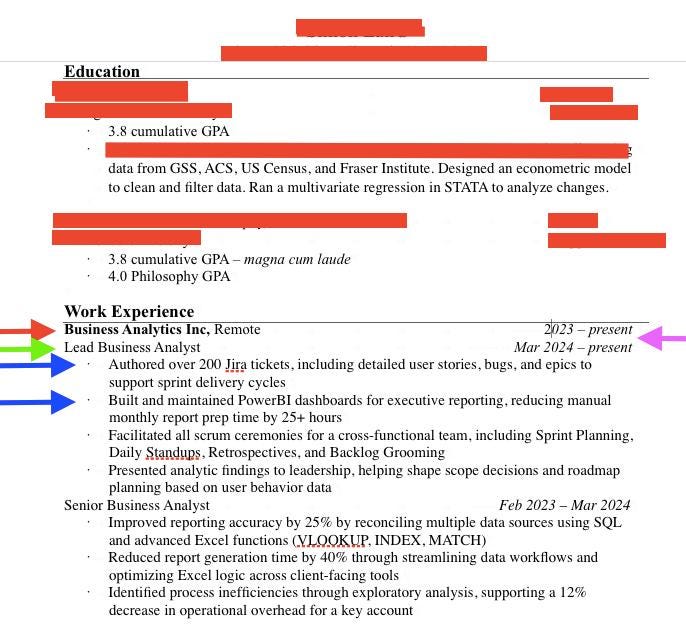
Once you finish that, proceed below: now we need to work on the most important part: how not to fuckup your resume in a hundred small ways.
