

I’m trying to cut down on my caffeine consumption
So when I get up I just have one cup of coffee
And I like to have another cup of coffee with my breakfast
And on the way to work I like to get a cup of coffee
Like the kind of cup of coffee that you get with the donuts
But I never get the donut, I just have the cup of coffee
And when I get to work I like to have a cup of coffee
‘Cause I like to have a coffee when I’m talking on the phone
But it usually goes cold and I need to get another cup of coffee
And it’s lunch, and I have an espressoAnd when I get back it’s not morning anymore
So I have a diet cola and another diet cola
But then I’m feeling fine and I’m feeling pretty sharp
And I’m feeling pretty wired and I’m getting things done
But right about two I get this little tiny migraine
It starts above my eyes and it moves to the back of my neck
And it moves to the bottom of my spine
But it doesn’t get there until five or six o’clock
Which is the end of the day so I’m fine!
- “Stress,” Jim’s Big Ego

0. YOU ARE HERE
If you’re reading this, there’s a roughly 87% chance you consumed caffeine today, a roughly 42% chance you’ve used nicotine in some form this month, and a roughly 99% chance that nobody ever taught you how either molecule works in your body. (The occasional biochemistry major who is reading this can smirk and collect a high-five at this point.)
You learned to drink coffee by watching your parents. You learned about nicotine from a DARE officer who also told you marijuana would make you jump off a building, or from a friend who offered you a Zyn at a party and said “it’s just nicotine, bro. It’s not cigarettes.” None of that is a pharmacology education.
This document is. It covers the two psychoactive substances you most likely already use - caffeine and nicotine - plus the handful of health-food-store nootropics that actually do something. It explains what they do to your brain, how to make them work better, and how to avoid becoming one of the 120 million Americans who worry about more interesting problems while their high blood pressure quietly destroys their cardiovascular system.
The advanced stuff - modafinil, racetams, peptides, the guidelines on how all the various amphetamines work and how to make them safer - that is all in the Tortuga Vault, available only to members. The following prequel covers the stuff you can buy at 7-Eleven, Starbucks, and GNC, although explained at the level of detail usually reserved for compounds that require Bitcoin.
There’s also a TLDR at the end of all this if you really can’t be bothered, because I know my audience.

1. CAFFEINE: THE ADENOSINE HEIST
1.1 What’s Actually Happening
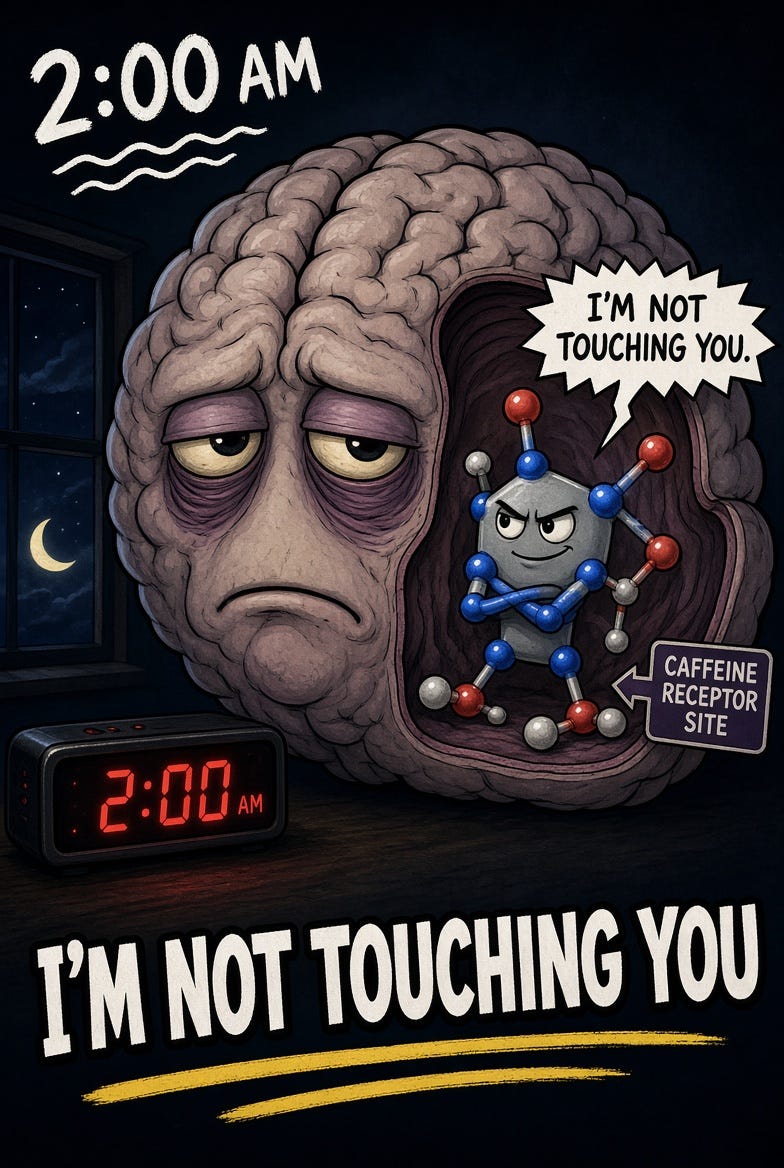
Your brain produces adenosine (and snarky remarks, if it’s anything like mine) all day long. Adenosine is a metabolic byproduct, the molecular equivalent of the odometer on your car. The longer you’re awake, the more adenosine accumulates in your synapses (the gaps between neurons). When adenosine binds to adenosine receptors, you feel tired. That’s not really something to complain about… it’s how your brain works, my dude. (Yes, I suspect we will never escape that California memetic contagion.)
Caffeine is a structural mimic of adenosine, by which I mean it fits into the adenosine receptor like a key that doesn’t turn the lock. It just sits there, occupying the parking space, while adenosine stacks up in the street outside. Think of that inconsiderate roommate you had back in college.
You don’t feel tired because the tiredness signal can’t get through… but the adenosine is still accumulating.
When the caffeine finally unbinds - half-life 5-6 hours in a typical metabolizer, longer if you’re on hormonal birth control, and likewise longer if you’re pregnant (one presumes… not both at once), also longer if you have the slow CYP1A2 variant carried by roughly 50% of the population - all that accumulated adenosine hits the now-vacant receptors at once.
This is that infamous caffeine crash. It’s not “you ran out of energy” so much as “you ran out of the ability to ignore the fact that you were tired four hours ago.”

1.2 The Cortisol Thing Nobody Told You About
Caffeine triggers a cortisol spike. If you’ve heard of that at all, what you’ve likely heard is that cortisol is your body’s primary stress hormone. It mobilizes glucose, sharpens attention, and generally prepares you for the saber-toothed tiger that your hypothalamus assumes must be nearby given the sudden chemical disruption. In the morning, as the meme says, this is fine. (See, there’s a method to the madness of these memes.)
You have a natural cortisol awakening response that peaks about 30-45 minutes after you wake up. Drinking coffee immediately upon waking actually blunts this natural peak. You’re better off waiting 60-90 minutes after waking before your first dose, letting your endogenous cortisol do its thing, then supplementing with caffeine as the natural peak declines.
In the afternoon, the calculus changes… a 2 PM coffee has roughly half of its caffeine still circulating at 8 PM. You may not feel it and you may fall asleep fine, but at midnight there is still some caffeine occupying your adenosine receptors. Those same receptors are involved in deep, slow-wave sleep. You’re asleep, but you’re getting worse sleep. Fitful sleep is a lot harder to notice than no sleep, and you might not notice until the debt accumulates.
1.3 Fast Metabolizers, Slow Metabolizers, and the Genetic Lottery
The CYP1A2 gene codes for the enzyme that breaks down caffeine. It turns out this one is binary: you have either the fast variant or the slow variant. This is one of the few pharmacogenetic findings that actually matters for everyday life, and your doctor has almost certainly never mentioned it. (Heck, he may not know about it in particular.)
Fast metabolizers clear caffeine rapidly: they get the benefits without the cardiovascular risk. Multiple large cohort studies show that fast metabolizers who drink coffee have lower risk of heart attack than non-drinkers.
Slow metabolizers clear caffeine slowly. The same intake that’s cardioprotective in fast metabolizers increases heart attack risk in slow metabolizers. The caffeine hangs around longer, keeps blood pressure elevated longer, and the chronic low-grade hypertension does its silent damage over decades.
There’s some loose ethnic correlation with the variants, but heaven knows discussions of that sort tend to be a minefield. Like many of these things, if you’re curious, I’ve got the breakdowns in the Tortuga Vault.
More practically: you can find out which you are with a $100 genetic test or by observing whether a 4 PM coffee ruins your sleep. If it does, you’re probably a slow metabolizer. Make your plans accordingly. If you’re interested in which genetic tests you can take for this or other factors, again, we’re going to cover this later, inside the Tortuga Vaults.
1.4 The Intelligent Caffeine Protocol
Morning dose: 100-200mg, 60-90 minutes after waking. Coffee/espresso, tea, or caffeine pill: the delivery mechanism matters less than the timing. (Don’t be a jackass and inject caffeine just to disprove this statement.) It’s often good to take L-theanine 200mg co-administered if you are prone to get jitters; it smooths the sympathetic activation without reducing alertness.
Afternoon dose (optional): 50-100mg, no later than 2 PM for typical metabolizers, no later than noon for slow metabolizers or anyone over 40 (CYP1A2 activity declines with age). Green tea is vaguely preferred: the lower dose and the presence of L-theanine naturally smooths the response. But a small coffee is fine. Don’t go knock back a late-afternoon Monster without expecting repercussions: you know who you are.
Evening: Nothing. You are not bulletproof, no matter what the tequila tells you. The people who “can drink coffee and fall right asleep” are getting worse sleep than they think; the research on this is pretty much unambiguous. Yeah, I know people are still going to drink rum-and-cokes or Jaegerbombs out on the edge of the dance floor, but uh, keep it in moderation, OK? You’re going to be paying sleep debt for that longer than you think.
Tolerance reset: 3-7 days cold turkey every 8-12 weeks. The headaches are adenosine receptors screaming for their accustomed blockade. They pass, ibuprofen helps. After a week, your receptor density normalizes and 100mg feels like 300mg. This is a good excuse for “gardening leave” or just a reminder to take a few days off every now and then, hint hint. (Yes, I know I’m one to talk.)
Hydration: Caffeine is a mild diuretic. For every cup of coffee, drink an additional cup of water. Not because coffee “dehydrates you” - that’s mostly an old wives’ tale - but because most people are mildly dehydrated anyway and stimulants mask thirst signals.
2. NICOTINE: THE COGNITIVE PROSTHETIC WITH A DELIVERY PROBLEM
2.1 The Molecule vs. The Cigarette
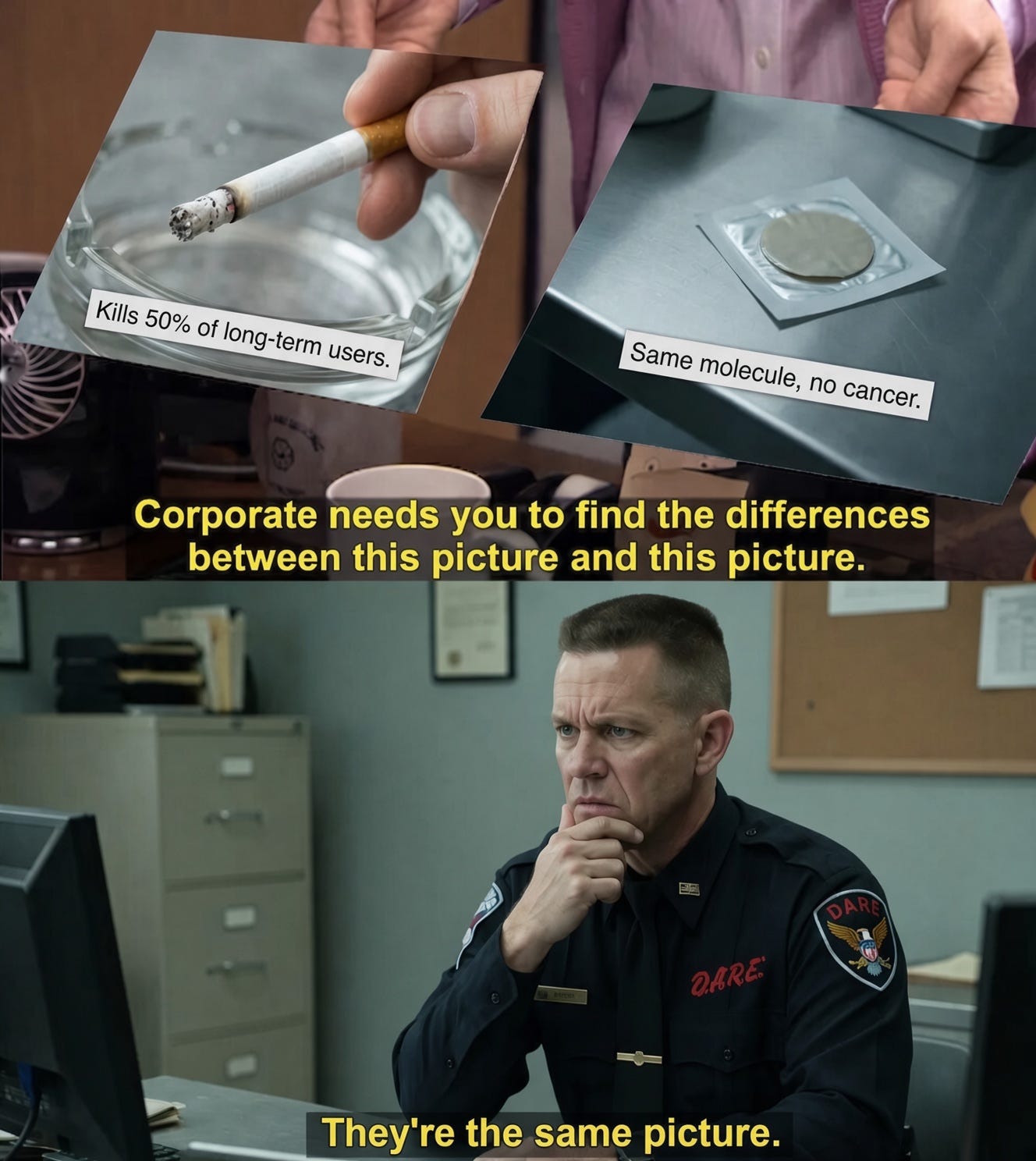
Nicotine is a near-ideal cognitive enhancer with a delivery mechanism that kills half its users.
The molecule itself - at low doses, without the combustion products or the 7,000 other chemicals in tobacco smoke - improves attention, working memory, fine motor performance, and possibly long-term memory encoding. It’s neuroprotective: smokers have dramatically lower rates of Parkinson’s disease, and the protective agent appears to be nicotine itself, not something else in the smoke. There’s evidence for protection in Alzheimer’s and ulcerative colitis as well.
But - enormous caveat here - caveat the size of Cleveland: the cigarette is a suicide device, and it’s not a pleasant way to go. The nicotine pouch, the gum, the lozenge, and the patch are pharmaceutical-grade delivery systems that separate the drug from the death. The public-health establishment’s refusal to meaningfully distinguish between these - their insistence that “nicotine = tobacco = cancer” - has killed millions of smokers who might have switched to safer forms if they’d been told the truth.
2.2 What Nicotine Actually Does to Your Brain
Nicotine binds to nicotinic acetylcholine receptors. (Trivia time: so do tomatoes and other members of the nightshade family, but not nearly as much as tobacco does.) Acetylcholine is the neurotransmitter most directly involved in attention, learning, and memory. Unlike caffeine’s crude blockade strategy - sit in the receptor and do nothing - nicotine actually activates the receptor. It enhances cholinergic signaling rather than just preventing the “tired” signal from getting through.
The subjective effect is a sense of calm focus, not the jittery hyperarousal of too much caffeine. It’s something closer to “I am interested in this spreadsheet and the spreadsheet is interested in me.” If you’re envisioning a meet-cute with your spreadsheet after the smoke break, make sure it was only tobacco you were smoking.
The effect is real, measurable, and reproducible (military research has been interested in nicotine as a cognitive enhancer for decades). The problem has always been the delivery mechanism.
2.3 The Delivery Spectrum (From Safest to Most Dangerous)
The Patch (Safest): Steady-state transdermal delivery over 16-24 hours. The patch is the most pharmaceutical-grade option and the least discussed in bro-science circles because it doesn’t produce a buzz. It produces a cognitive baseline… and uh, that’s the point.
No spikes, no compulsive redosing, no oral absorption variables. You put it on in the morning, you take it off at night. Or leave it on if you want the weird vivid dreams. Nicotine patches are famous for producing unusually intense REM sleep. Also, though, for a lot of people it causes trouble falling asleep, so if that’s you, feel free to peel it off. Theoretically, these things are good for 24 hours, so if you’re trying to stretch your dollars, you can potentially get two 12-hour days out of one patch.
Dosing: 7mg, 14mg, or 21mg per 24 hours. Start at 7mg if you’re nicotine-naive. The 21mg patch delivers roughly the nicotine equivalent of a pack-a-day smoking habit, which is far more than a non-smoker needs for cognitive enhancement. You are not trying to replace a cigarette habit or wean yourself down off one. You are trying to enhance cholinergic tone. Different project.
These are sold as Step 3 Nicotine Patches for the 7mg version and you can just order them from CVS (here’s the link) or from Amazon more cheaply if you don’t mind buying some Waysus brands - but I recommend against that, it’s one thing to buy a wrench of dubious provenance, it’s more hazardous to put chemicals or vitamins into your body when the sourcing is suspect.
Do not do the Krusty the Clown meme. If you need to wear multiple patches, you’ve got a really serious nicotine habit.

Nicotine Gum (Safer): 2mg or 4mg, absorbed through the buccal mucosa. Faster onset than the patch, shorter duration. The “chew and park” technique - in which you chew until you feel a tingling sensation, then park it between cheek and gum until the tingling fades, then chew again - is annoying to learn but produces a smoother pharmacokinetic profile than constant chewing. I gather people who were used to chewing tobacco have an easier time of this, but I never learned the trick.
Nicotine Lozenges (Safer): Similar to gum but less conspicuous, dissolves over 20-30 minutes. The 2mg mini-lozenge is the most discreet option for office use.
Nicotine Pouches (Safe-ish): Zyn, On!, Velo, etc. These are the current cultural phenomenon. They deliver nicotine through the oral mucosa like gum or lozenges, but they’re designed to be parked in the upper lip and left there for 30-60 minutes. The pharmacokinetics are similar to gum - gradual onset, gradual offset - but the social positioning is different. Pouches basically play the same role for nicotine that energy drinks did for caffeine in the early 2000s: they’re a cultural product as much as a chemical one. Not to dress this up too much - it’s just a flavored way to take a hit of nicotine, and the white-Monster-and-Zyn is the same basic ingredients as Great-Great-Granddad’s cowboy coffee and Lucky Strikes - but if you like your poison sweet, it’s popular.
The pouch strengths range from 1.5mg to 15mg and occasionally higher - the higher strengths are designed for former smokers with established tolerance. A nicotine-naive user taking a 6mg pouch will experience nausea, dizziness, and the distinct sensation of having made a mistake. Start at 3mg or lower, or you’re probably going to find yourself vomiting into your buddy’s wastebasket, the classic Zyn social faux pas.
Vaping (Less Safe): Inhalation delivery produces a rapid spike and clearance that drives compulsive redosing. The pharmacokinetic profile is closer to cigarettes than to oral products. The long-term pulmonary effects of inhaling vaporized propylene glycol and vegetable glycerin are unknown (with certain indications of “maybe don’t do this,” there’s some scare-tactics around vape-popcorn-lung which may or may not be plausible) because the technology hasn’t existed long enough for 30-year cohort studies. Vapes are probably safer than cigarettes, and almost certainly less safe than not inhaling anything. People seem to love their bubble-gum flavored vapor though.
Cigarettes (Lethal): OK, you knew I was going to say this: if you smoke cigarettes, switch to literally anything else on this list. The cognitive benefits of nicotine do not outweigh the 50% mortality rate of long-term smoking. This is not a trade; this is a hostage situation where the hostage-taker occasionally helps you focus. Chew/dip is not really much better; lip/tongue cancer is pretty awful.

2.4 The Addiction Question
Nicotine is habit-forming, we’ve all been beaten over the head with that. The addiction potential varies dramatically by delivery method, and the public-health discourse that treats all forms as equally dangerous is actively harmful and objectively asinine.
Inhalation produces rapid brain delivery: nicotine hits the brain within 10-20 seconds of inhalation. This rapid spike-and-clearance cycle is what drives compulsive redosing. Regular stimulus, somewhat unpredictable reward, short interval: it’s the pharmacokinetic equivalent of a slot machine.
Oral absorption (pouches, gum, lozenges) produces gradual onset over 10-20 minutes and gradual offset over 1-2 hours. This makes it model out a lot more like caffeine: habit-forming, yes, but not life-destroying. People don’t rob convenience stores to buy nicotine gum. (Yes, I’m sure they shoplift it, that’s why it’s behind glass - not quite the same thing, Bonnie and Clyde.)
Transdermal delivery (patches) produces the most gradual pharmacokinetic profile of all. The addiction potential is minimal because there’s no behavioral reward loop. You put it on once and forget about it.
If you’re going to use nicotine, use the delivery methods that minimize compulsive redosing. This means oral or transdermal, not inhaled.
2.5 The Intelligent Nicotine Protocol
Delivery: Patch for baseline (7mg if naive, applied in the morning, and ideally removed 2-3 hours before bed since it often interferes with sleep). Pouch or gum for acute cognitive demand (2-3mg, used situationally rather than continuously). Don’t double-up on these; this should be an either-or thing.
Cycling: Nicotinic receptors upregulate with chronic use. This means you need more nicotine over time to get the same effect, and you’ll experience a below-baseline cognitive deficit when you stop. The preferred solution is to not use nicotine every day, which is much easier to do in this sort of situation than if you’re used to smoking. Two or three days a week for high-demand cognitive work: wear a patch on Monday for the big presentation, reach into the pouch on Wednesday for the deep-dive analysis. Nothing on Tuesday, Thursday, Friday, or the weekend.
Blood Pressure: Nicotine is a vasoconstrictor. It raises blood pressure acutely by 5-10 mmHg and heart rate by 10-15 bpm. If your baseline blood pressure is already elevated - and remember, there’s a 47% chance it is - you’re adding load to a system that’s already strained.
Monitor your BP. If you don’t own a blood pressure cuff, buy one. They cost about forty bucks - here’s an Amazon link right here to Omron, the standard/reputable brand. Come on guys, it’s cheap compared to what you’re spending on your energy boosters. Keep an eye on what’s going on in the pipes; heart attacks are expensive.
3. THE OTC NOOTROPICS THAT ACTUALLY DO SOMETHING
The health-food-store cognitive enhancement aisle is mostly expensive urine. A lot of things at your local GNC are overhyped, but this section in particular tends to be a great deal of “chasing the latest fad.” Here’s what survives the evidence filter.
3.1 L-Phenylalanine: The Health-Food-Store Stimulant
Your body makes dopamine and norepinephrine - what you may more commonly think of as “adrenaline” - from dietary amino acids. The synthesis pathway runs: L-phenylalanine → L-tyrosine → L-DOPA → dopamine → norepinephrine. The rate-limiting step is the conversion of tyrosine to L-DOPA, but if you’re not getting enough phenylalanine in the first place, the whole pipeline is substrate-limited.
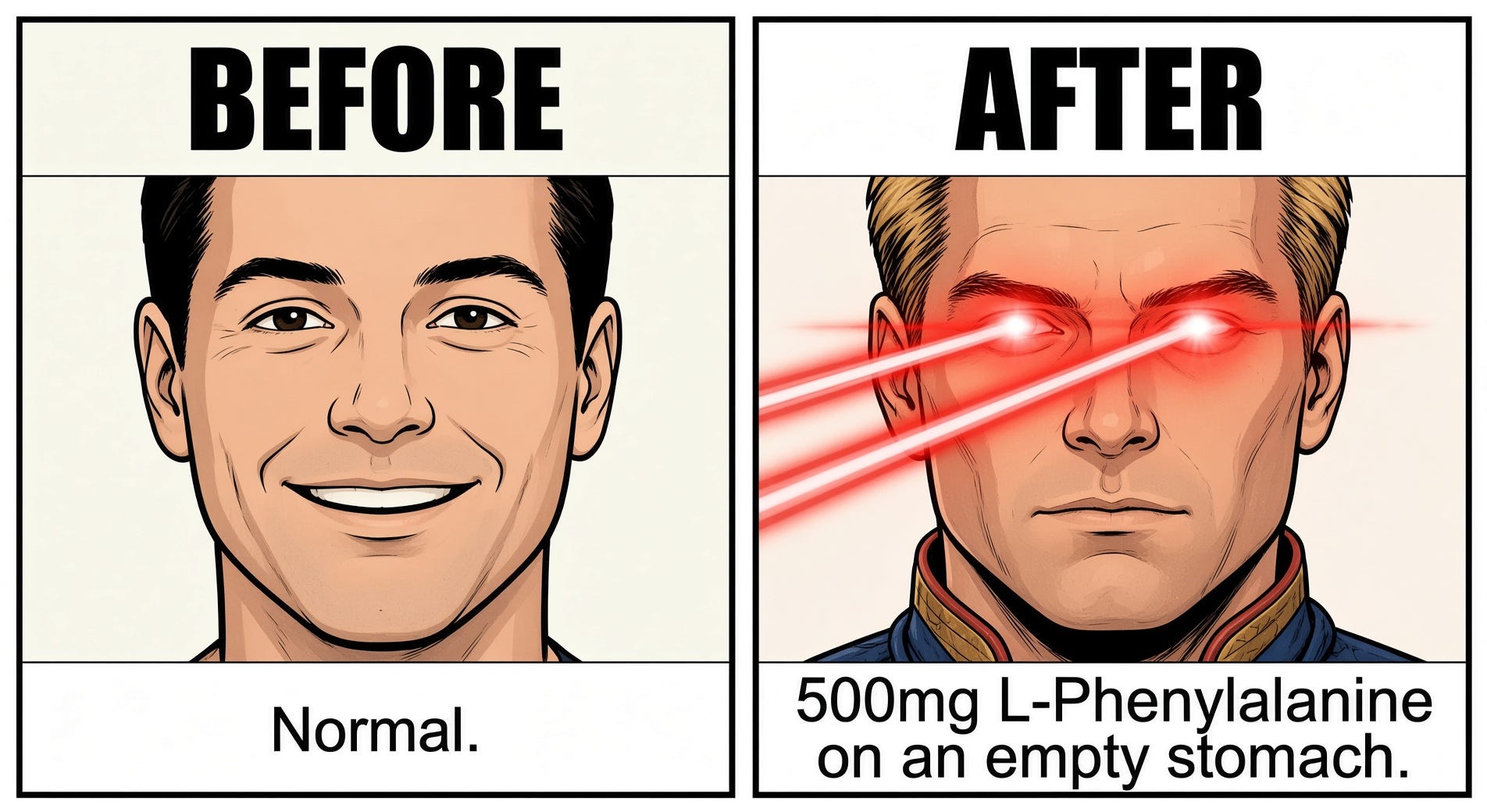
L-phenylalanine supplements bypass dietary protein digestion and deliver the precursor directly. On an empty stomach (this matters, because it competes with other amino acids for transport across the blood-brain barrier), 500mg produces a noticeable increase in energy and focus within 30-45 minutes. The effect lasts 2-3 hours, not the 12+ hours of prescription amphetamines. This is the feature, not the bug; you get the burst, you do the work, you go to sleep.
Don’t bother with DL-phenylalanine; it’ll give you a vague mood boost, but not actually the energy boost you’re looking for. The D-isomer doesn’t participate in catecholamine synthesis and may actually interfere with the L-isomer’s effects. You want pure L-phenylalanine, 500mg to start, up to 4 times daily. Take it with vitamin B6, which is a cofactor for the conversion of L-DOPA to dopamine. A general B-complex or multivitamin usually covers this.
But, again, a caveat: L-phenylalanine will turn you into an asshole. This is not a joke. Increased catecholamine tone reduces impulse control and increases irritability. The effect is milder and shorter than cocaine or amphetamines - you’re not going to start a bar fight, unless you’re already so inclined - but you will be sharper-tongued and less patient than your baseline self. If you have a propensity toward brawling, maybe don’t take phenylalanine before the family reunion, it’ll get your Irish up (pretty sure, given my own heritage, I can get away with saying that).
This same neurochemical mechanism makes people obnoxious when they’re coked up (but, as noted, it only lasts circa 3 hours). If you know exactly what I’m talking about as far as people becoming completely obnoxious when they’ve done a line or two, it’s the same sort of thing, mostly just shorter-lived (and on an empty stomach). You could theoretically do literally the same thing you see the Scarface boys do. If you have a full stomach and amino acid absorption would be constrained, you could snort L-phenylalanine. Again, not particularly recommended, but it does kick in fast.
Ah. Also, L-phenylalanine is contraindicated if you’re schizophrenic. (Legitimately, not “forum-ranters-call-me.”) As are the various amphetamines (and I’m going to make the neurochemical extrapolation that cocaine and the rest of the unregistered uppers probably also are going to trip that same pathway). This problem probably doesn’t come up too often, and hopefully you already have your schizophrenia under control medically, but if you’re for whatever reason deciding not to take your meds and instead just go for whatever gives you lots of energy, be aware that this may make your condition worse.
3.2 Choline Sources: The Acetylcholine Precursor Family
Your brain makes acetylcholine from choline. Most people get enough from diet if they’re eating eggs or liver, but if you’re stacking anything that increases cholinergic demand - nicotine, for instance - you can run short. Citicoline (CDP-choline) 250-500mg is the cleanest option; it crosses the blood-brain barrier efficiently and also donates a cytidine moiety that helps with membrane repair. Alpha-GPC is another solid choice, especially if you need a harder jolt. Stick with one; stacking multiple choline sources is usually unnecessary and can produce the classic “choline headache.”
Alpha-GPC is ideal if you need a high concentration of choline for a test or other mentally fatiguing task, but it will also only last 4-6 hours. I recommend Jarrow Citicoline. It lasts longer and is generally what I take in the mornings.
3.3 Creatine: Not Just for Gym Bros
Creatine monohydrate 5g daily is a good, cheap supplement. Its effects are subtle if you’re an omnivore, but especially if you’re a vegetarian, lock in on this. Creatine buffers cellular energy in the brain the same way it does in muscle. The cognitive data is quieter than the physical-performance data, but it’s real, especially under sleep deprivation or high cognitive load. No cycling required, you can just take it (either post-workout, or with dinner). If you’re picking a brand, I nominate Thorne.
3.4 Phosphatidylserine: The Stress Buffer
300mg on high-stress days. It modulates cortisol response and has decent evidence for reducing perceived stress and improving memory under pressure. Not a daily driver for most people, but useful when the day is going to be a meat grinder. It’s more of a stress buffer - what the literature tends to call an adaptogen. If your cognitive problems are stress-related - and isn’t that all of us these days - phosphatidylserine may help.
You may also want to take this and some omega-3s (e.g., krill oil) if you’re going out drinking. Alcohol depletes these structural fats quickly and replenishing them is helpful. Buy the sunflower version if you have the choice, it tends to be more bioavailable, even though everything sunflower-lecithin-related got more expensive these last few years because Ukraine grows most of the world’s sunflowers. The Jarrow brand is the one I tend to recommend.
3.5 The Rest of the Aisle
Everything else falls off pretty rapidly in value. Tends to be either under-dosed, poorly absorbed, or it simply doesn’t do what the label claims at the doses people take.
Yes, we will do a deeper dive into all of this later - probably in the Tortuga Vault - but until then, save your money. As noted previously, it is useful to have some L-theanine on hand to smooth out caffeine jitters, and if you aren’t taking a multivitamin (you should be), you do need some B5 to convert choline to acetylcholine, but in general, your multivitamin should include that and cover it.
4. WARNING SIGNS YOU’RE OVERDOING IT
You know the obvious ones: racing heart, inability to sit still, the sudden conviction that everyone in the meeting (or on Reddit, although maybe that one’s understandable) is an idiot and you need to explain this to them at volume.
The subtler ones are more useful:
You’re sleeping 7-8 hours but still waking up tired.
Your resting heart rate has crept up 10 bpm over the last month.
You’re more irritable with people you like.
You need the stimulant just to feel baseline, not to feel enhanced.
You’re starting to stack “just a little more” of everything.
If this sounds like you, it’s time to take a break, not time for another pouch.
Stimulants mask their own side effects. That’s part of what makes them useful, of course. The fatigue you’d normally feel is hidden behind the adenosine blockade or the cholinergic activation. The problem is that the damage accumulates whether you feel it or not. Here are the signals that you’ve crossed the line from use to overuse (other than your friends calling you out, of course).
Shaky Hands: The classic “too much coffee” sign: fine tremor in the fingers, noticeable when you hold your hand out flat. This is sympathetic nervous system overactivation: your fight-or-flight response is running at a low hum all day. If strangers ask if you’re nervous or friends remark that you’re twitchy, you’re overdoing it.
Jaw Clenching and Tension Tinnitus: Stimulants increase muscle tension, particularly in the jaw and neck. You may not notice the clenching during the day - after all, you’re focused, you’re productive - but you’ll notice the results: jaw pain, headaches originating at the temples, and a ringing in the ears that’s actually coming from chronically tensed jaw and neck muscles, not from hearing damage. If you hear a high-pitched whine in quiet rooms and you use stimulants daily, try a three-day washout before you assume you need an audiologist.
Hair Loss (you know, the kind you’re causing): Stimulants don’t directly cause hair loss, but chronic sympathetic overactivation increases scalp tension and stimulant users often develop nervous habits. We’ve all seen it: scalp rubbing, hair twirling, picking, tugging hair or beard, that kind of stuff.
This sort of thing tends to be exacerbated when you stack stimulants, especially prescription-grade drugs like amphetamines or modafinil. Your nervous tics will pick up, and these may well include nervously pulling bits of hair out of your beard. If you’re finding more hair in the shower, find yourself unconsciously touching your head while you work, or starting to look blotchy, it might be time to cut back a bit.
The good news: this kind of hair loss is reversible when the stimulant dose comes down. (We’ll talk about treating hair loss - for men and women - at some point too, but not in this document. And I’m not gonna be the guy to tell Will Smith.)
Sleep That Isn’t Sleep: You fall asleep fine, but then you wake up tired. This is the signature of stimulant-disrupted sleep architecture; you’re getting shallow sleep without the deep slow-wave and REM phases that restore cognitive function. If you can’t remember the last time you woke up feeling genuinely refreshed, your adenosine receptors are probably still occupied when you go to bed.
The 4 PM Crash That Requires a 4:15 PM Coffee: OK, you guessed it. This is tolerance plus dependence. You’re not using caffeine as a tool anymore; you’re using it to feel normal. If the thought of a day without stimulants produces genuine dread rather than mild disappointment, you’re dependent.
Blood Pressure You’re Not Checking: Covered in detail in Section 5. If you don’t know your numbers, you’re flying blind.
The Irritability Spiral: You’re snappish with colleagues, impatient with your partner, and everything feels slightly more annoying than it should. This is the L-phenylalanine asshole effect, generalized to all stimulants. Elevated catecholamines reduce the threshold between “that’s annoying” and “I need to say something about that.” If people have started treating you like you’re volatile, they’re not wrong. Also, maybe take a hiatus from X/Twitter.
If you’re experiencing three or more of the above, you’re overdoing it. The solution is not to add more supplements. The solution is to reduce the stimulant dose, increase the cycling interval, or take a full washout. Section 7 covers how.
5. BLOOD PRESSURE: THE SILENT KILLER THAT DOESN’T CARE ABOUT YOUR PRODUCTIVITY
5.1 The Basic Numbers and What Stimulants Do
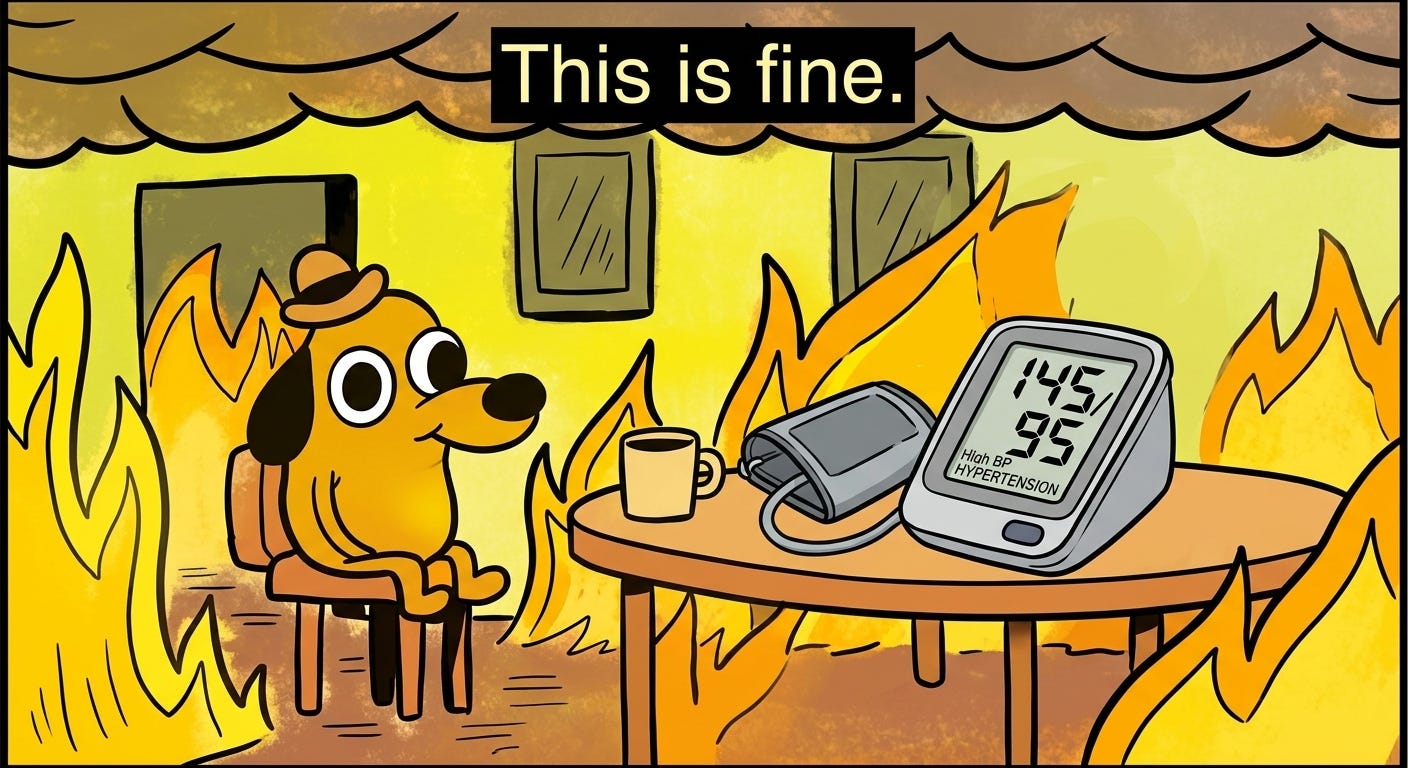
Stimulants raise blood pressure. Caffeine and nicotine both do it, and they can do it additively or possibly synergistically. If your baseline is 135/85 (stage 1 hypertension, and you probably don’t know it), a morning coffee and a mid-morning Zyn could push you to 145/95 or higher. Sustained at that level, you’re remodeling your arteries (not in a good way) and increasing your risk of cardiovascular “events.”
5.2 The Pragmatic Protocol
Buy a blood pressure cuff: they cost about forty bucks. Get an upper-arm cuff, not a wrist cuff. The wrist models are less accurate. Omron is the standard brand, I linked one above. You’re more than welcome to get a nicer one; I linked the bargain-basement model.
Measure your baseline. Sit quietly for two minutes. Even you’ve got two minutes. Feet flat on the floor, arm supported at heart level. Take three readings, one minute apart. Discard the first - it’s mostly to make sure you’ve got the device set up properly - and average the second and third. This is your resting blood pressure.
Measure after your stack. Same protocol, 30-60 minutes after your morning coffee and/or nicotine. This is your on-stimulant blood pressure.
If your resting pressure is ≥130/85: You have hypertension. Make an appointment with your doctor. The stimulant protocol is secondary to getting your blood pressure under control. Don’t worry, there’s a lot of different medications for this, they’re cheap and easy to come by, and you should be able to quickly find one that doesn’t have side effects for you.
If your resting pressure is normal but your on-stimulant pressure is elevated: You have stimulant-induced hypertension, which is totally expected. Cut back on the dosage, increase cycling, or eliminate one of the two compounds - whichever you find easier to give up. If your on-stimulant systolic is consistently above 140, you’re going to do yourself damage. (If you’re borderline acceptable here, by the way, you may well end up in the “totally fine” range after a bit of exercise. Consistent cardio tends to improve your baseline, and weight loss/fat loss nearly always does.)
If both are normal: Congratulations. You are in the 53% of Americans with normal blood pressure. The stimulant protocol is reasonable for you with continued monitoring.
6. DRUG INTERACTIONS: WHAT YOUR OTHER MEDICATIONS ARE DOING TO YOUR STACK
The earlier warning about alcohol (well, and any other recreational drugs, though ganja is the one you’re most likely to encounter) is the most important one: stimulants mask sedation, leading to dangerous overconsumption. But alcohol isn’t the only interaction that matters. If you’re on any of the following, the interaction deserves your attention.
6.1 Antihypertensives (Blood Pressure Medication)
Beta Blockers (metoprolol, atenolol, propranolol, carvedilol): Beta blockers reduce heart rate and cardiac output. Caffeine increases both. They’re working in opposite directions, which means you may need more caffeine to feel the effect - the beta blocker is blunting the sympathetic activation.
The danger is not acute, but you’re masking the feedback signal that tells you when you’ve had too much. Monitor your blood pressure. Don’t trust how you feel - though if you actively feel bad, then definitely monitor frequently. (Also: if you’re taking propranolol for “stage fright” or other antianxiety purposes and you are inclined to use it on dates, keep in mind that it will often mess with your ability to perform in bed. Men may have trouble getting it up, women may have trouble getting to orgasm. Don’t ruin your date night with beta-blockers.)
ACE Inhibitors (lisinopril, enalapril, ramipril): Generally safe with caffeine and nicotine; the mechanisms don’t directly interact. Of course, still monitor your blood pressure, because your antihypertensive dose was calibrated to your unstimulated pressure, and adding 5-10 mmHg from stimulants may push you out of the controlled range.
Calcium Channel Blockers (amlodipine, nifedipine, diltiazem): Caffeine increases intracellular calcium in vascular smooth muscle, promoting vasoconstriction. Calcium channel blockers prevent calcium entry, promoting vasodilation. They’re working against each other at the same target. Net effect varies by individual, hydration level, and general athleticism, so monitor this. At the very least, be aware of it.
Diuretics (hydrochlorothiazide/HCTZ, chlorthalidone, furosemide): Caffeine is already a mild diuretic. Adding a prescription diuretic increases dehydration risk and the risk of hypokalemia (low potassium), which can cause cardiac arrhythmias. Hydrate aggressively and consider potassium supplementation - discuss with your doctor.
As a cheap and easily available answer - carry a couple of Liquid IV foil pouches with you. They’re the sort of things you dump into a water bottle, shake up, and down as an electrolyte/rehydration drink, and they’re sweet, so it’s easily drinkable even when you just need to sip at it. I tend to keep these on hand along with water bottles, because the kids will put up with them. The sugary ones are better for oral rehydration therapy - the sugar-free ones are fine for workout drinks if you don’t want the calories.
6.2 PDE5 Inhibitors (Sildenafil, Tadalafil, Vardenafil)
Viagra, Cialis, Levitra. These are vasodilators, and nicotine is a vasoconstrictor, so they work in opposite directions on vascular tone. The interaction is not acutely dangerous in healthy people, but nicotine’s vasoconstrictive effects may reduce the effectiveness of PDE5 inhibitors. If you’re having inconsistent results, nicotine timing may be the variable you’re not accounting for.

6.3 GLP-1 Agonists (Semaglutide, Tirzepatide, Liraglutide, Retatrutide when it becomes available)
Ozempic, Wegovy, Mounjaro, Zepbound. These drugs slow gastric emptying. That’s part of how they work. They also slow the absorption of anything else in your stomach, and since oral caffeine absorption is delayed and blunted, your morning coffee may take 90 minutes to peak instead of 45. The caffeine is still entering your system, it’s just entering more slowly. Don’t take more to compensate. Instead, recalibrate your timing.
Additionally, as you lose weight on GLP-1 agonists, your caffeine distribution volume changes. Caffeine distributes into total body water (and fat isn’t water), which decreases as you lose weight. The same dose produces a higher plasma concentration in a lighter body. If you’ve lost 30 pounds on semaglutide, your old caffeine dose is effectively 10-15% stronger than it used to be.
6.4 Painkillers
Acetaminophen (Tylenol): Caffeine enhances acetaminophen’s analgesic effect by roughly 40%: this is the Excedrin combination (well, also, aspirin) and it works. Useful for headaches, less useful when you’re taking acetaminophen for chronic pain and drinking coffee habitually without realizing the interaction.
NSAIDs (Ibuprofen, Naproxen, Aspirin): Caffeine and NSAIDs both irritate the gastric mucosa. The combination increases GI bleeding risk, particularly with chronic use. If you’re taking daily NSAIDs, don’t wash them down with coffee on an empty stomach. (Or at least take buffered aspirin.)
Opioids (Codeine, Hydrocodone, Oxycodone): The same masking problem as alcohol. Stimulants mask the subjective experience of sedation without reducing objective impairment. You feel more alert than you are, so you may take more opioid than you intended. This can pretty quickly become a genuine overdose risk.
6.5 Alcohol
Stimulants mask the subjective experience of intoxication without reducing the objective impairment. This is the Four Loko Problem: if you don’t know it personally, you know someone who embodies it. You feel less drunk than you are, so you drink more, so you become more impaired, and the stimulant keeps you awake long enough to reach blood alcohol concentrations that would have put you to sleep otherwise.
Caffeine + alcohol is bad. Nicotine + alcohol is bad. Caffeine + nicotine + alcohol is asking for trouble. Start throwing other recreational chemicals into the mix - I know this is going to happen, people like to party - and your body’s ability to control what’s going on has now been handed over to whatever alchemy you’ve concocted that evening. This is definitely outside the realm of what we’re covering in this document, but … stay tuned.
7. RECOVERY: WHAT TO DO WHEN YOU’VE OVERDONE IT
The cycling protocols in the earlier sections assume you’re following the rules. Life happens. This section assumes you didn’t, or maybe your friend in the next room praying at the porcelain altar, who needs some good advice didn’t. You’re reading this because you feel like garbage: jittery, exhausted, can’t sleep but can’t function without stimulants, irritable, maybe experiencing several of the warning signs from Section 4.

7.1 Acute Overstimulation (Right Now)
You took too much, your heart is pounding, your thoughts are racing, and none of them are useful. If this is your average Saturday evening - let alone your average Tuesday - your friends are probably reading you this document from a safe distance and making snarky comments.
Do not take more of anything. No “hair of the dog,” no “I’ll just have a small coffee to take the edge off” - you’re already over the edge.
Do not reach for a downer. The instinct when you’re overstimulated is to grab something that’ll take the edge off - a joint, a beer, a Xanax, a codeine left over from your dental surgery. This is the chemical yo-yo, and it’s how recreational users become polypharmacy patients.
The stimulant is still in your system, doing everything it was doing to your heart rate and blood pressure five minutes ago. Adding a sedative doesn’t cancel the stimulant; it adds a second set of effects on top of the first. Your cardiovascular system is now being pushed in two directions at once, and neither drug knows the other one is there. You probably aren’t a paramedic or other EMT. One hopes you don’t need Narcan (it’s not for anything in this document, but if you do need it, uh, have someone help administer it, and then seek other sorts of help).

Weed is the most likely candidate for this audience, and it’s a worse choice than people think. Cannabis lowers blood pressure acutely - that’s the “relaxing” effect - while the caffeine or nicotine is raising it. The result isn’t balance; it’s unpredictable swings. Benzos and alcohol have the same masking problem in reverse: they make you feel like the overstimulation is gone while the stimulant is still doing its cardiovascular work. Codeine and other opioids add respiratory depression risk, especially if you also have alcohol in your system. If you’re considering anything stronger than that, overstimulation is not your primary problem.
L-theanine 200-400mg. The only chemical intervention for acute overstimulation with real evidence: it increases GABAergic tone without sedation. You’ll still feel the caffeine or nicotine, but the sharp edges will be filed down.
Hydrate with electrolytes. Stimulants are diuretics and if you’ve gotten to the too much stage, you’re probably dehydrated - sweating, panting, maybe vomiting, all the things that come along with this sort of unpleasantness. Water alone isn’t enough; you need sodium, potassium, magnesium, so an electrolyte packet will help more than plain water.
I mentioned Liquid IV earlier; they’re easily poured into a water bottle and shaken up, and because they’re on the sweet side you can even get the kids to drink them when they otherwise get cranky about electrolyte rehydration. They’re just the thing when you’re sweating like crazy and sitting in a cool shower trying to get over your bad decisions. And for the same reason the kids will put up with them - some mild and sweet and comforting flavor that you already know you like - they’re a lot easier to get down a little bit at a time when you don’t really want to drink water.
Light movement, not exercise. A walk, outside, if possible. The sympathetic activation needs somewhere to go, and intense exercise will amplify it, so don’t go bang it out on the treadmill. A 20-minute walk at a conversational pace helps metabolize the excess catecholamines without adding more. Take your dog for a walk, they’ll appreciate it. (They always do.)
Breathe. Slow, rhythmic breathing - four seconds in, seven seconds hold, eight seconds out, or simply extending the exhale longer than the inhale - is one of the few direct levers you have on your autonomic nervous system. It activates the vagus nerve and increases parasympathetic tone. It’s boring and unglamorous compared to a cold plunge, which is why the biohacking crowd ignores it, but hey, breathing works.
You can also take a cool shower while doing this breathing exercise, if you’re sweating uncomfortably, and maintain it without having to worry about the cold plunge side effects. As above, feel free to take in a plastic water bottle full of an electrolyte drink, one that won’t break if you drop it. The full breathing protocols, including the evidence base for respiratory sinus arrhythmia and vagal tone modulation, are in the Vault.
Do not try to sleep yet. You can’t, and lying in bed with your heart pounding is how people develop conditioned insomnia, which will annoy you for months to come. Wait until the acute symptoms subside. You’ll know when. Then go to bed. Go watch something comforting. Don’t doomscroll or watch a show full of jump-scares.
If you’re having chest pain, severe palpitations, or feel like you might faint: OK, yes, this is the time you do in fact need to go to the emergency department. This is rare at normal doses in healthy people, but if you have undiagnosed heart disease or a conduction abnormality, stimulants can unmask it. Do not tough it out, you don’t want to wait until you’re vomiting, crapping yourself, and in danger of passing out before you make this trip.
7.2 The 48-Hour Reset
Day 1: No caffeine, no nicotine. No surprise, you will feel terrible (you knew this already): headache, fatigue, irritability, brain fog. This is adenosine and nicotinic receptor upregulation announcing itself. Take ibuprofen for the headache. Drink water (or an electrolyte drink, or maybe herbal tea if you’re sure it’s uncaffeinated) constantly. Eat whatever sounds tolerable, usually fruit. Sleep as much as your body will allow. Cancel anything that requires cognitive performance; you’re going to be too cranky to do it.
Day 2: Still no caffeine and no nicotine, but silver lining: the headache should be fading. The fatigue may be worse - this is the adenosine debt being collected - but this is a good excuse to sleep again. Light exercise if you feel up to it, gentle walking generally helps. By evening, you should start feeling something resembling normal.
Day 3: Reintroduce caffeine at half your usual dose, and ideally in a different form. If you usually drink coffee, try tea, etc. 100mg, morning only. No nicotine yet. If 100mg of caffeine feels like 300mg used to, your adenosine receptors have partially reset. This is what you were trying to achieve.
Day 4: If Day 3 went well, resume your normal caffeine protocol. Still no nicotine. Give your nicotinic receptors a full week before reintroducing. They take longer to normalize than adenosine receptors.
If a 48-hour reset feels impossible - if the thought of two days without stimulants produces genuine dread - you are not using these compounds as tools, you are dependent on them. This is information, use it: the more you know, the better you can make informed decisions about your life. Also, be aware that you’re likely to be vulnerable to this sort of behavior with other chemicals or addictive behaviors.

A note on decaf on cycling days. If the ritual of the hot cup of liquid is what you need, decaf is fine. It contains 2-5mg of caffeine per cup - pharmacologically negligible, though not zero. The ritual matters. The practical risk is mixing up which pod or which bag is which. If you can’t reliably keep them separate, don’t keep decaf in the house.
And no, that doesn’t mean you can have thirty cups of decaf to weasel around the restriction. Clever attempt to hack the system. Don’t do it. Don’t pretend you’re a 1970s yogi and make yourself a coffee enema either (yes, this was apparently actually a thing, ugh).
On a full washout week, skip the decaf and drink mineral water. The point of the washout is to break the psychological dependence as well as the pharmacological one, and the ritual of the hot beverage is part of the dependence. You’re not just resetting your adenosine receptors; you’re reminding yourself that you can function without the crutch. Mineral water in a glass bottle gives you something to hold and something cold to sip. It’s not the same and yeah, that’s the point. Don’t substitute Bud Light instead, although you may be forgiven for drinking pina coladas if you’re on a tropical beach for your week off (and if so, I’m jealous).
7.3 The Recovery Stack
For the days you’re cycling off, a few supplements help the process:
Magnesium Glycinate 400mg at bedtime: Improves sleep quality, reduces muscle tension and jaw clenching, mild anxiolytic. Most people are magnesium-deficient even before stimulants. This is probably the single most important recovery supplement. (You can take this even during normal periods, at lower dosage, it’ll help you sleep.)
Vitamin C 1-2g with dinner: Acidifies urine and accelerates caffeine excretion. Same principle as using it for amphetamine comedown, just milder. It’s also and primarily an antioxidant. Careful taking a bunch of vitamin C with milk or a heavy cream sauce or ice cream. You may curdle the milk, which isn’t terribly pleasant for the digestion. (You’re also welcome to take this when not trying to cycle off; a gram a day usually suffices.)
Melatonin 0.3mg before bed: Not the 3-10mg megadoses sold at the drugstore - those tend to produce next-day grogginess. Physiological dosing (0.3mg, what your pineal gland actually produces) supports your natural circadian rhythm without the hangover. (This is also pretty typical to take even during your “on” cycle, along with the above magnesium.) I recommend the extended-release version, such as Life Extension’s 6-hour, 300-microgram version. It will definitely not break the bank, as it’s less than ten bucks. Try taking it about an hour before bed.
L-theanine 200mg as needed: For the irritability and the “everything is annoying” feeling that accompanies stimulant withdrawal.
Hydration and electrolytes: Throughout, stimulant withdrawal is dehydrating. (I probably sound like a broken record here. Water+salts will help your mood, though.)
7.4 When to Get Help
If you can’t complete a washout despite wanting to. If withdrawal produces severe depression or anxiety that doesn’t improve after two weeks. If you find yourself using stimulants despite negative consequences to relationships, work, health… This is the clinical definition of a substance use disorder: think of it as pharmacology, not moral failing.
8. A WEEK IN THE LIFE OF AN INTELLIGENT STIMULANT USER
Monday: Wake 7 AM. Wait 90 minutes. 8:30 AM: 200mg caffeine (large Americano) + 200mg L-theanine. 10 AM: 3mg nicotine pouch for deep work session. Blood pressure check before lunch: 128/82. Yeah, that’s acceptable. You’re likely to have a pretty productive day.
Tuesday: Wake 7 AM. No caffeine, no nicotine, the morning cup is decaf and it doesn’t quite land the same way. Today is a cycling day. You’re mildly irritable and your 2 PM meeting feels like it’s happening underwater. This is the price of not developing tolerance: you’ll be sharper tomorrow. Magnesium glycinate 400mg at bedtime.
Wednesday: Wake 7 AM. 8:30 AM: 100mg caffeine (green tea) + 200mg L-theanine. 10 AM: 7mg nicotine patch applied. Another cup of tea in early afternoon, for a steady cognitive baseline all day. Your blood pressure check turns in a steady 125/80: everything’s cool. If you had to run this particular day reliably, you could pretty well get away with it for weekdays - it’d eventually catch up (but you are better off with cycling).
Thursday: Same as Monday. Your blood pressure check comes back at 130/84, which is elevated, but you had a stressful morning call: context matters, single readings don’t tell the whole story.
Friday: Cycling day. No caffeine, no nicotine. You notice you’re sleeping better on cycling days: deeper, less fragmented. This is not your imagination.
Saturday: Sleep in. 10 AM: 100mg caffeine (cup of coffee, enjoyed slowly). No nicotine. Blood pressure: 118/76 - your true resting baseline.
Sunday: No stimulants. You feel fine. Slightly less productive than your caffeinated self, but also calmer. This is what your unmodified nervous system feels like. It’s worth remembering.
Supplements daily: Citicoline 250mg, B-complex, creatine 5g. Phosphatidylserine 300mg on high-stress days. Magnesium glycinate 400mg at bedtime every night.
Monthly: 3-day complete stimulant washout. Headaches day 1. Irritability day 2. Normal by day 3. Receptor density resetting.
Quarterly: Full week washout. By day 5 you remember what life felt like before you discovered caffeine. It’s not precisely better, but it’s, well, let’s say “informative,” “stabilizing.”
9. WHAT’S BEHIND THE VAULT DOOR
This document covered the compounds you can buy at Starbucks, 7-Eleven, and GNC. The compounds where the risk-reward calculus is different, the legal status is grayer, and the information quality on the open internet is worse… that all lives in the Tortuga Vault.
If you found this useful, the natural next question is: what about the next tier? What about modafinil, the wakefulness drug that isn’t a stimulant? Or what about the racetams: piracetam, aniracetam, phenylpiracetam… the original nootropics developed by a Romanian chemist who coined the term? Then there’s the various peptides, which really move the needle on energy metabolism and cognitive performance. Or - since, inevitably, a lot of you are gonna redline your cognitive motor - what about the full neuroprotection protocol for when you’re running compounds stronger than caffeine and nicotine?
The Vault contains the answers, written in the same style - mechanism first, protocol second, downside signals always, no mysticism, no affiliate links, no biohacking jargon. Just what works, what doesn’t, and how to tell the difference. You do generally have to put up with my memes, though.

This is the “Overclocking Your Brain” material from the Hyperborean Project - the full nootropics supersection that follows naturally from everything you just read. The Vault also contains the recovery toolkit expanded to cover the harder compounds, the pharmacogenetic reference with Labcorp test codes, and the peptide protocols the open internet gets wrong.
Tortuga membership gets you access to the full library - PDFs and EPUBs you can take with you, not just individual Substack articles that disappear into the algorithmic feed. The existing Tortugans already know what’s back there (and what’s coming). If you’re not one yet, this is the invitation.
Postscript: the TLDR Recap
So mostly, this whole concept isn’t new. Your great-grandfather would have had the same chemistry with a couple tablets of Benzedrine (or Pervitin, depending on which side he was on), a pipe or a pack of Marlboros, and a pot of coffee. Not really changing much - mostly flavor - by opting for a Rockstar or Monster Energy Drink and a Zyn to wash down your Adderall-ER instead. Less carcinogens, though.
Let’s see if we can make this a little safer. The patch is a better nicotine delivery mechanism - safer transdermal delivery, long-release, even dosing. Don’t live the Krusty the Clown meme… wearing multiple patches is ludicrous. CVS will ship you the Step 3 low dose patches. Opt for caffeine on weekdays, try to keep it to morning coffee and perhaps a small one - or a green tea - in the afternoon, if you need it. Iced tea may get you through the summer better than other options. Try to take weekends off from your energy boosters if you can get away with it. Keep an eye on your blood pressure, and if it’s consistently high, talk to your doctor - it’s fairly easy to get this back in line.
This document is provided for informational purposes. I am not a physician, and this is not medical advice. The strategies described involve substances that carry legal and health risks. Consult appropriate professionals before making changes to your regimen.
Great write up! Learned a lot. Biggest take away is the need to monitor that BP
Interesting article