

When good King Richard, that’s Richard of Gloucester
Ascended the throne did he
He made good his promise to lower the taxes
And set all the debtors free.You’ve heard of the princes who died in the tower
The Tower of London, you’ve heard
‘Twas Henry of Richmond who blamed his foul murders
On goodly King Richard the Third.With plotting and pledges an army was raised
To force our fair Richard to yield
And the Wars of the Roses then came to an ending
At the Battle of Bosworth Field.Now you may be thinking my story’s told falsely
Because you have read the Bard’s play
About Dicky Crookback, who murdered his brother
All on St. Bartholomew’s Day.But the truth is elusive - ‘twas true then as now
And falsehoods are easily spread
For some men became saints while some became monsters
Because of what Will Shakespeare said.
— “The Ballad of Richard The Third,” Gwydion Pendderwen
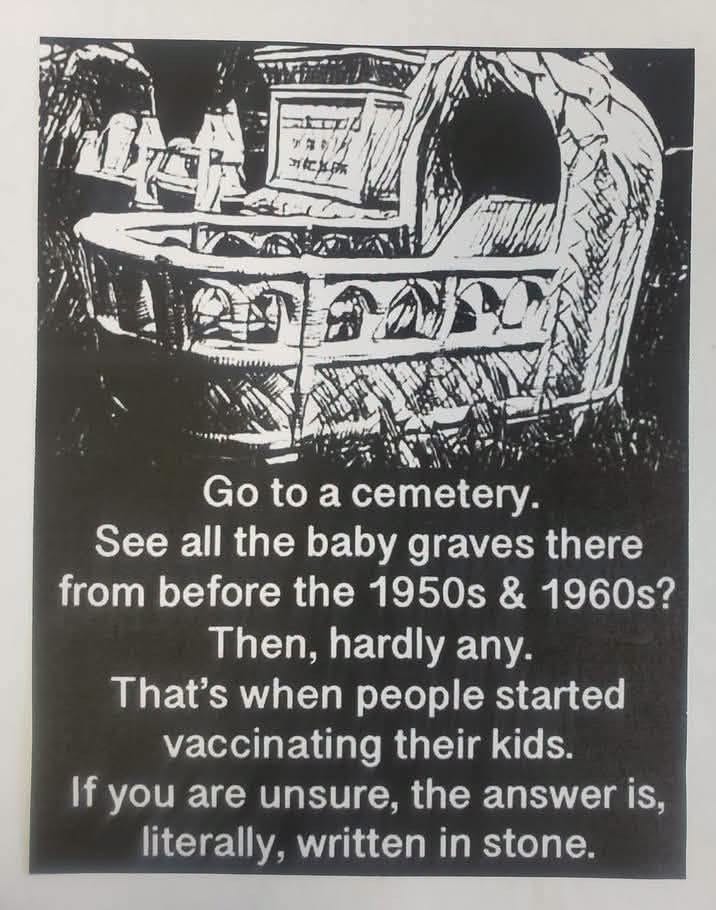
I love this meme.
I happen to live near a cemetery; it’s a restful if somewhat morbid place to stroll; and I’ve enough Addams Family predilections (or occasional nostalgia for the goth-industrial scene from back in the day) that I appreciate it.
But this meme is almost lying by omission. (By which I mean: the statement is true, but vaccines may be the least important factor in infant mortality reduction.)
Three big revolutions really beat infant mortality, and they all arrived in the twentieth century: sanitation (clean water, mostly), then antibiotics, and then vaccines, the third wave. The pathogens that vaccines protected us against tended to be less “fatal” and more “permanently debilitating.” My grandmother grew up with polio and lived, but, man oh man, was she motivated to make sure everyone else did not go through that.
Arguably, nutritional improvements belong somewhere in there too, mostly again “preventing debilitating effects” more than “keeping you from being killed.” There’s the Haber process, which made nitrogen fertilizer cheap enough for industrial-scale farming, and our superior understanding of vitamins and nutrition, which reduces deficiency diseases.
The fifth unsung hero of this story is the anti-parasite push, which was tremendously effective in the United States, but is still a work in progress in various parts of the developing world. Efforts to fight malaria and dengue draw public attention and Effective Altruist optimization efforts (and sometimes they stop there, which is problematic). Filariasis (which you may know as elephantiasis) and similar parasitic infections are readily treated with ivermectin … yes, that same drug that got so much press during COVID. We tend to memory-hole those anti-parasite efforts into the “tropical diseases” group neglected by the West because the most effective means to disrupt malaria, for example, were DDT and bulldozers. Once mosquitoes weren’t a problem here anymore, killing them stopped being a priority.
If you are particularly conspiracy-minded, you might think the Green movement canceled DDT at just the right time: after we’d cleared malaria out of here but left it a problem for Third World countries. That doesn’t seem to have been the political alignment of the Green movement, though. As much as the Club of Rome was very concerned about overpopulation and Paul Ehrlich was telling us that a “population bomb” was going to overwhelm us all, surely Al Gore and friends didn’t want to solve the climate crisis by letting “tropical diseases” cripple or kill off Africa, South America, and South Asia?
Probably just an unpleasant coincidence. After all, it was feasible to continue to wipe out those parasitic diseases worldwide with diethylcarbamazine, off-patent and mass-produced in India (and for that matter, India decided in 1970 to stop recognizing pharmaceutical product patents in order to mass-produce medicine and reduce their cost, so the prospect of domestically producing literal tons of the latest antiparasitic medication became viable). So … probably not any sort of black-hat theory, as hilarious a mental image as mustachio-twirling archvillain Al Gore might be.

We keep running up against the edge of making antivirals work and exhausting certain antibiotics, so that’s a bit of an arms race, but, all in all, modern medicine is awfully darn good. For all the misgivings about mRNA-based vaccines (with some justification given their actual rollout during the pandemic), what data has come out points to problems with dosing and endocrinological complications. I’ll cover that separately, and people who don’t want to read about it don’t have to. It’s interesting to a certain cohort, and for other people, it’s incidental noise or may just be dismissed as conspiratorial. (What’s the joke? It’s not a conspiracy theory if they really are out to get you. Ahh, what would life be without Addams Family–esque humor, where I started this piece?)

COVID itself, for the unvaccinated, hits different populations differently. In 2020, it was commonly understood that the elderly and those with pulmonary conditions (lung troubles of various sorts: pneumonia, lung cancer, smoking, the casual sorts of breathing impairment) were at risk. Likewise, if you were immunocompromised, it was no great surprise to hear that a pandemic was not going to go well for you. You might not have heard, however, that COVID was most harmful to South Asians (secondarily so to Europeans) and least to Africans and East Asians, to the point where Bangladeshi expats in the UK were twice as likely to die as the gent across the street.
If you said Whoa, that makes me all the more suspicious about that Chinese bioweapons lab-leak theory, you’re not the only person to have thought that. Even if it’s verboten to have such a discussion in the polite circles of Western media, the thought is certainly expressed in India, where concerns about an active bioweapons program targeted at their nation are taken quite seriously.

But that’s a separate article. Let’s stay on topic.
“Constructive framing” isn’t all high-stakes material, but it is a way of presenting information so as to influence your opinion by what’s said, implied, and omitted.
When you’re shopping for groceries, most often you’ll find cuts of beef labeled with a certain percentage of lean meat and a certain percentage of fat (which George Foreman said his grill would cook right off—it’s somewhat true). You do want fat (“marbling”) in your meat for flavor, but you also probably don’t want a lardburger that’s 38 percent fat. So, the meat comes labeled either by fat percentage or … by lean percentage. Customers regard “lean” much more positively.
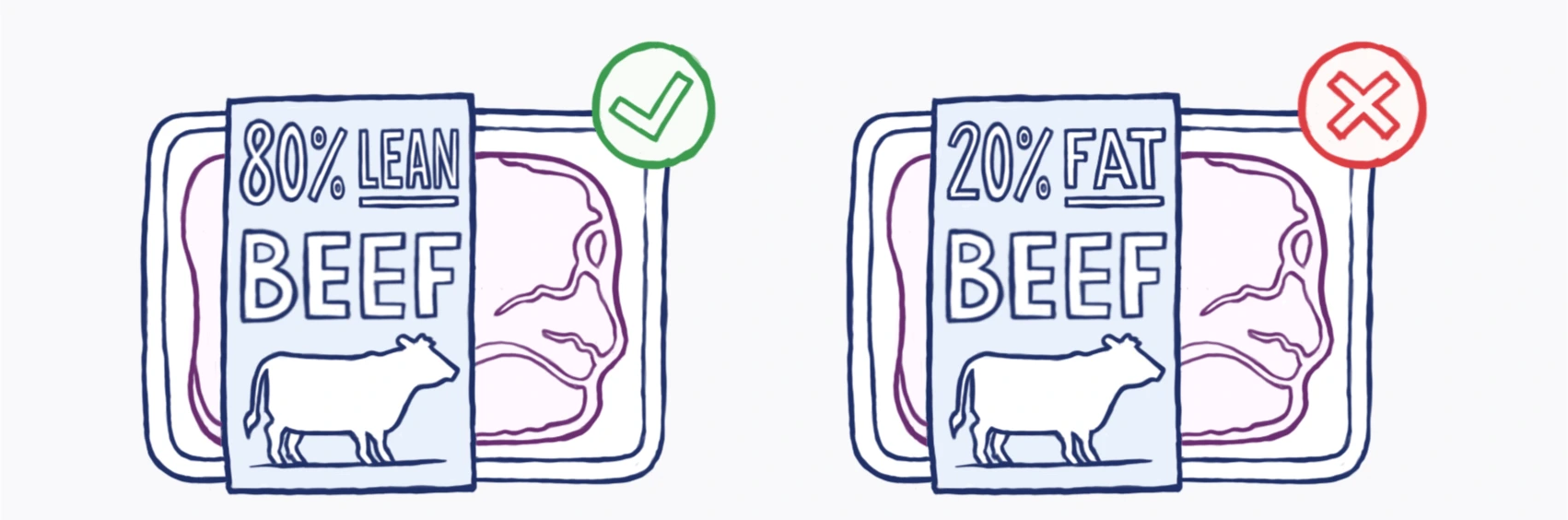
These two packages mean the same thing, but their framing is very different.
Another place you’ll find constructive framing is in the surgeon’s office. Medical outcomes for serious treatments live and die—if you’ll pardon the expression—on presenting a “90 percent survival rate” rather than a “10 percent mortality rate.” This helps patients feel more hopeful and willing to move forward with necessary care.
If you’re allowed to write a ballot initiative this way, of course, or frame an opinion poll … why, you can get nearly any set of results you want, sometimes even from a hostile audience. The endlessly classic Yes, Prime Minister gives a masterclass in this.
Usually, you’ll find press releases about any potentially controversial topic phrased in what’s termed an “opportunity narrative.” For instance, they frame a climate initiative as an investment in “clean-energy jobs and economic growth” rather than focusing on restrictions, taxes, penalties, or jobs lost in other sectors.
So back to that starting meme. It’s the classic think-of-the-children appeal to emotion. “You should be in favor of vaccinations because think of the children” is the whole message when it’s only maybe a fifth of the truth. Why only a fifth? Why else was infant mortality so low after the 1950s and 1960s? Uh, well … that cultural change. Contraception and abortion. We don’t put up gravesites for those. Bleak line of thought to end on, perhaps. But I imagine Morticia would approve.

But the meme I started this piece with is still a great example of framing: an ideal, heartstring-tugging appeal to support vaccination, a think-of-the-children piece (another tactic virtually guaranteed to shut off rationality in many readers). It isn’t, strictly speaking, wrong in what it says, but it is only a relative sliver of the truth. It’s constructive framing of the “why would you possibly oppose this?” mindset.
To be fair, many of the reasons people give for opposing vaccination are arguments that were valid at one point and have been addressed some time ago. For instance, a concern about the use of mercury led to the removal of thimerosal in 1999. By 2001, it was out of childhood vaccines in the US and Europe. (It’s still used to produce some shelf-stable vaccines distributed in developing nations, the sorts of environments where refrigeration for medical supplies is not reliable. But even there, hospitals have the newer vaccination and field clinics have the ruggedized version.) In short, vaccines are safe for your kids.
Keep those children safe, or my grandmother would never let me hear the end of it. It takes far longer to rebut all the objections than to just throw up a meme that makes people say “awwww,” though, and in our world of soundbite attention spans, brevity wins.
Thanks for reading! Subscribe for free to receive new posts and support my work.
I thought you'd address concerns around absolute versus relative risk in Baccine studies. Or critically look at placebo definitions and uses in these trials.
Good article, especially driving the point home that MANY other factors, particularly sanitation practices, are doing 80% of the heavy lifting. But I have 2.5 major quibbles with you, here.
1. mRNA concerns are fr and you didn't go into specifics here. I would too, but I don't have the stamina to give you the 4 page answer, and unfortunately it really can't be explained in less than 4 pages, but they're objectively unsafe approaches as implemented currently.
1.5. Adjuvents, as you mentioned, like mercury to spur the immune system into responding to something tame like a half-HP virus injection, were not entirely removed. Mercury, specifically, was. But in many cases in American and UK vaccines, instead they stepped down to aluminum. It's less toxic, but all the same issues still apply. Who the fuck eats aluminum on the reg? The human body isn't meant to deal with that! And furthermore, the immune system is surprisingly elegant and tracks every minute detail of previous bodily invasions, down to the vector. You get tetanus from getting pricked by rusty metal, getting into your bloodstream; as such, an injection of (anti-)tetanus makes sense, it's the same delivery vector. You get the flu from breathing in flu viruses into your lungs; it DOESN'T make sense to try to train your immune system to expect a future flu to come through an injection like the shot. There is some cross-over, but there's also confusion to your immune system introduced, and that's how you get random ass allergies to other shit, like by sheer coincidence you haven't eaten peanuts in about 10 years, but today is the day you both got a flu shot AND ate some peanuts, so your immune system is very much "WTF is happening?!" and freaks out about the peanuts because why is respiratory shit coming down my veins, is it actually coming from my mouth or stomach?? That's how that shit happens, RFK isn't insane.
2. And I will seriously take you to the mat for this one. I will die on this hill, unpopular opinion that it is.
While he did commit a stellar performance, in a role he absolutely sold despite the film being otherwise shitty from the ground up... I cannot abide by the idea that Raul Julia "owned" the M. Bison character. No, not at all, the movie was not written well for an accurate M. Bison, you are seriously triggering my Street Fighter canon autism. I love the film, sarcastically/ironically as many do, cult classic awful thing that it was, and for that, I am still grateful that Raul Julia delivered in this abortion of a flick. But that's my beef: it's an abortion of a Street Fighter movie, and whatever Raul Julia was playing, while awesome, was NOT M. Bison, that is, Vega, a.k.a. "Dictator," and his high-risk/high-reward strategies, nor his Psycho Drive derived abilities rooted in the Alpha lore.
I accept your condescending reply acknowledging my deep Street Fighter plot knowledge, and its irrelevance to pop culture writ large. BUT MY POINT STANDS.