
This is a cross-post from Koz, a Tortugan and contributor to Ordinary Times.
The Preamble, History and Loyalty
We the People of the United States, in Order to form a more perfect Union, establish Justice, insure domestic Tranquility, provide for the common defence, promote the general Welfare, and secure the Blessings of Liberty to ourselves and our Posterity, do ordain and establish this Constitution for the United States of America.
Obviously we live in a time of partisan animosity, and bitter political and cultural conflict. Maybe still nonviolent conflict for the most part, but conflict nonetheless, and certainly more intense now than in comparable ways say 20 or 40 years ago. Of course, this is a political and cultural conflict and will have to have political resolutions in some way. But in addition to that there is also a need and some desire for unity, and with that one or more things which serve as a symbol and instrument of that unity, which can create the possibility of common ground for all Americans and the chance that our internal conflicts might diminish over time.
To that end I assert that the Preamble to the Constitution is that thing. Very brief, very elegant, yet even now a bit obscure given its central role in the drama of America.
So, begging the indulgence of the reader, this piece is longer than most that have been published here at the League, and certainly longer than anything I have written before. Nonetheless, I feel that there is a certain thematic unity between the Preamble here such that it’s worth the read. And to that end, let’s start with a little bit of context, and then some history.
## The Chain
The Preamble didn’t appear from nowhere, and it didn’t end with itself. Before there was a Preamble, there were the abstract intentions and aspirations toward fellowship and common purpose of 1790s-era colonists. There were the ex-colonies themselves, soon-to-be states, who were the sovereign political actors at that time. Those aspirations, organized and represented state by state, led to the Preamble. That in turn led to the rest of the Constitution, which led to the formation of the federal government. This led to two things which for the most part are interchangeable but yet slightly different enough to be worth making note of. The first is the United States as a nation-state, which happened more or less immediately upon ratification and whose existence was never seriously threatened after the War of 1812. The other is the United States as a nation, one people united in solidarity and purpose, built up gradually over the following years and decades.
The point is not to say the whole world flows downstream from the Preamble. Instead the idea is the Preamble is one integral link in a chain of very important things, some of which are more important than others in various circumstances, but which is collectively the conceptual foundation of America as we know it. Therefore we should take the context of the Preamble seriously, as well as its substance. In more explicit terms, it is the Preamble which explicitly and concisely describes the purpose of America, which is for Americans to be able to raise families, earn a living, protect themselves, and hand the legacy of having done these things down to their posterity.
The 19th Century
For our purposes, two important things happened in the 19th century. First, the pioneers subdued most of the land mass of an entire continent, transforming North American wilderness into what became part of, even most of, America. In doing so, they were fulfilling the intentions of the Preamble, specifically its substance. They claimed land, raised families, and created a legacy to hand down to their families and to us.
The federal government wasn’t necessarily that important in this. It was relatively weak in terms of internal governance at that time, and weakest on the frontier. But the Preamble still mattered, not through federal power, but through the crystallization of common intent among the American people. Someone in Missouri or Minnesota still had common purpose with someone in Pennsylvania. And in concrete terms, there was almost completely free trade among Americans. The “We the People” was real even where Washington was far away.
Also, the Federal army defeated slavery and the Confederacy in the Civil War. This also fulfilled the intentions of the Preamble, but in a different way. The Union victory created the foundation for co-national solidarity among all Americans, no longer corrupted by slavery’s existence in our lands.
Both of these things were crucially important factors in the growth of the United States as a prosperous nation. The westward expansion of the pioneers meant that an entire continent’s worth of natural and human resources became fuel for the American economy. And, as one consequence of the Civil War, the economy of the entire United States was reconstituted away from slavery. Free labor is far more economically powerful than slave labor; that, among other things, was a lesson of the war. As the Republican Party of that era had it, “Free men, free soil, free labor.” So in the course of the fulfillment of the intentions of the Preamble as stated by the Founders representing the former colonies of that time, the United States became a wealthy nation.
What Freedom Means
In addition to economic wealth, both of these events from the 19th century are also crucial events for the meaning and legacy of freedom in America. Regarding the defeat of the Confederacy and the eradication of slavery from America as a landmark in our legacy of freedom, well, that part should be pretty obvious.
But the westward expansion is important as well. Because in the context of the founding and the 19th century, freedom didn’t necessarily mean what many Americans might now assume. It didn’t mean abstract self-expression or autonomy from all constraint. It meant you weren’t a subject, a serf, a slave, or anything of that sort. That is, a person whose fundamental social status is a state of obligation to somebody else. And crucially, the checks and balances of the Constitution, the freedoms in the Bill of Rights, the practical autonomy of the pioneers, those things didn’t just arise out of the ether. They arose from having a preponderance of citizens and citizens’ interests among the population of America, thereby empowering a group of citizens, typically prominent men and landowners, to create the legal machinery we have today on a foundation of self-government and self-determination.
Therefore, on a deep level our freedom is a collective accomplishment of our class of citizens and required a widespread class of citizens to create and sustain it, and the westward expansion of American into continental North America did that (among many other things of course). That is, we created thousands of new citizens and landowners who weren’t serfs owing allegiance to some feudal lord, but instead economically productive first-order citizens who had a meaningful and legitimate interest in governance organized to protect and defend their freedom.
In particular, over the course of the 19th century, due to the economic and cultural development of the United States, economic control over America by England (or anybody else for that matter) diminished to basic irrelevance. Therefore, our legal and political systems could be and were developed as an expression of self-governance of our citizens.
It’s also worth noting that to a very large extent the purpose of the specific promises of freedom in the Bill of Rights and the like was to empower our citizens to defend their status as citizens, and also to raise families, earn a living, leave a legacy to their posterity, ie, more or less to empower those citizens to realize the intentions stated on their behalf in the Preamble.
The Declaration of Independence
As various people have noted, typically the explicit promises of freedom in our Constitution or laws were restricted to citizens, in particular men, (or white men until the Civil War), landowners, property owners, etc. This sounds jarring to modern ears, so let’s take a quick digression on that.
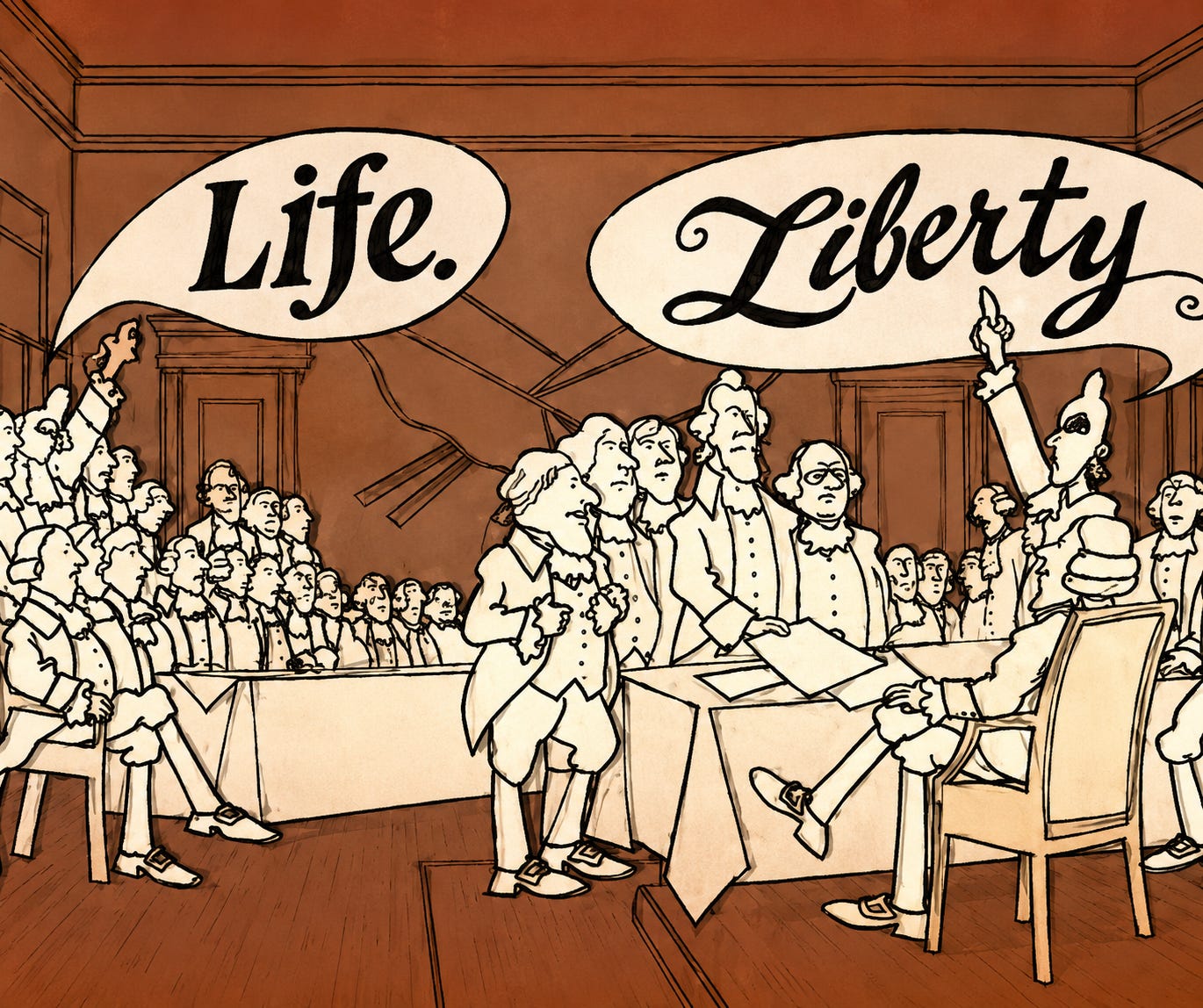
The Declaration of Independence tells us that we are all endowed by our Creator with certain unalienable rights, and among them are life, liberty, and the pursuit of happiness. These are things we deserve, things we ought to have as a gift from God. But that is not at all the same thing as actually having them. This is obvious from a cursory glance at the world. Many people in many situations do not have the freedoms described in the Declaration, yet they have the same endowment from God as we do. The endowment is universal; the enjoyment is not.
As we have expanded qualifications for the franchise and citizenship in general since colonial times, and we have expanded them a lot, the newly eligible citizens are called to sustain the same common intentions that were previously held by landowner men, or whoever citizenship was previously restricted to. In particular, to preserve and expand the common capacity for earning a living, raising families, protecting ourselves, and leaving a posterity. And to defend the legal and social machinery which supports those things. The circle widens, but the obligations remain.
Therefore to actually have our freedom as a practical reality, this requires ongoing support from our citizens. And the particular rights or guarantees promised in the Bill of Rights, or in statute, or the Tenth Amendment, or wherever, must be restricted to citizens, at least in general. The Left likes to think this happens because America hates brown people, or the like. But as it is typical for the Left, they are wrong about this as well. Non-Americans and non-citizens might be our adversaries in some circumstances, but there is no reason to think things have to be that way by default. It is simply a recognition of the reality that our citizens are the people who sustain us, and whose interest we have the duty and the capacity to defend.
The Declaration asserted an entitlement as a bequest from God. But it is the Preamble and the institutions associated with it who have made it real and defined its limits.
The Failure of Liberal Solidarity
Now let’s fast-forward a few years to the beginning of the 21st century. A number of things have happened basically starting then, which have had severely adverse consequences for solidarity among Americans. But there’s three in particular worth mentioning.
First, to a very large extent our universities lost their mission of scholarship to political agitation and academic novelty. Historically, universities were institutions that transmitted knowledge and cultivated inquiry. And for whatever other problems they may have had, they upheld that vocation in a fairly serious way. The professoriate and the administrators tended to be Left politically, many of them fairly committed radicals even. But for the overwhelming majority, quasi-political activism was not to be taken as being the same thing as scholarly accomplishment, which was a separate and more or less apolitical thing.
But like other institutions, universities want to be seen as being on top of the hot new thing. As such, there’s been a proliferation of new fields which aren’t really scholarship at all, and whose knowledge base has no real value outside the university itself. This has had a few unfortunate consequences. Among other things, there were millions of high school graduates poured into our universities, many of whom might not have gone to college in prior generations. For a lot of them a more traditional curriculum was too rigorous, too difficult, and not very much fun. So from these students there’s a significant amount of bottom-up demand for easy-A departments to major in (as well as some academically lax traditional majors), and campus activism. Not everybody can succeed in a challenging course of work, but almost everybody can get a useful credential, and maybe feel as though they are living an important vocation through raising awareness of Gaza, or the like.
And, the “experts” in these novel fields are another part of the problem. They are highly motivated to dominate university governance, and they tend to do so. The MBA types up and left to work for General Electric or the like. The real experts in rigorous fields are working hard in their disciplines and don’t have as much energy to fight office politics. And to the extent they do, those people are motivated to protect their own field and their own work. As far as general university life or cultural politics goes, the world belongs to those who show up, as supposedly attributed to Ben Franklin. And for our universities those are the activists, not the real scholars.
The upshot is that a couple generations of students and ex-students have gotten a very distorted picture of the intellectual currents in the world. And this cohort includes pretty much everyone who got or aspired to a white collar job in America. The people who would be in a position to say otherwise had other fish to fry.
Do Not Ask For Whom The Dean Screams, He Screams For You
Second, the Howard Dean campaign of 2004. Dean was for the majority of his career a completely unremarkable politician, an obscure governor of a very small state. But in that election cycle, he rocketed up the Democratic primary polls on a campaign of palpable anger, not merely opposition to George W Bush and the Iraq War. Dean eventually lost the nomination, but his campaign infrastructure became the foundation for much of what followed, the netroots, the small-dollar donor base, the internet-centric campaign, it all followed from the reality that for Gov Dean partisan hatred was a feature rather than a bug.
Around the same time and in a similar way the lib pundit Jonathan Chait invented Chaitred, the argument that the politics of that time were properly organized around hatred of George W Bush and for that matter Republicans in general. It is true for many of us that it is easy for us to harbor unkind thoughts toward our political adversaries. But it was the Democrat activists and lib punditocracy of the time which made explicit the idea of hatred as an organizing principle for the Left in America.
## California Dreamin’
Third, California. The economy of 21st century California is deeply connected to the Pacific Rim, especially for upper-middle class white collar Californians. Its trade, entertainment sector, technology sector are all enmeshed with Asia. Even for those who not explicitly involved in international trade across the Pacific, California’s professional class had connections with suppliers, clients, customers, and sometimes finance based in Asia. Obviously there had always been lots of trans-Pacific trade of one sort or another long before the 21st century. But this particular thing became especially important as Asia itself became wealthier. Among other things, there arose a new class of very wealthy Asians who had Asian-based income streams but needed more stable assets and cultural connections in America.
California’s white collar professional class came to see these connections as their own proprietary achievement, a mark of their sophistication and cosmopolitanism. But in reality, the Pacific Rim’s professional connections in California are downstream of its interest in America as a whole: our elite institutions, our high-wage culture, our consumer markets and above all else our political and financial stability. And of course those things were largely a creation of our history of governance and the Republican Party, especially in California. But California’s elite forgot this. They imagined themselves as the crucial actors in the matter, as the key intermediaries between Asia and the United States.
Accordingly, they developed a mindset where they are not accountable to American governance, but a separate thing, outside of any legal system except the norms governing their particular slice of international trade. It’s not just a matter of California becoming a blue state at this time, but also Democratic Party as a whole taking on the mentality of California writ large. There were other interests and other elements of geographical representation inside the Democratic Party, but to the extent that there was any conflict or difference in emphasis among them, the coastal Democrats would always win. Not only is California and a few other California-like places where a very large percentage of Democratic general election votes are, but it also holds an even larger percentage of lib money, talking class professionals and messaging infrastructure.
The Hostility Crescendo
So over roughly the past fifteen or twenty years, in at least three meaningful and important ways, contemporary American liberals have failed their obligations of loyalty to the United States, especially liberals at the staff and activist level of Democratic politics. They have rejected solidarity with normie America. It’s important to be able to conceive of this failure of loyalty in a broad scope. In fact, for many libs this is a significant point of failure. A decent number of them want to rationalize that they are not opposed to the American project in general, they are simply hostile to W or Trump, their personal aesthetic, or their particular political agenda.
But unfortunately that is simply not true, at least as it pertains to the main currents of American liberalism over the last 15 years or so. Liberals aren’t merely opposed to one or more particular politicians for any number of credible reasons. They are hostile to the very design of America itself, as that has manifested from colonial times for a hundred years or more.
So, why are the libs doing this? For many of them, especially for those in the Democratic Party with the California Dreamin’ mindset, the dominant motive is disdain. They don’t necessarily hate Middle America, at least not at first. They simply insist on creating a world, or at least their part of it, where what we do doesn’t matter. Unfortunately for libs, when that ambition is frustrated, when Middle America successfully asserts itself, then the disdain turns to bitterness and antagonism. That’s whats behind most of the polarization of our political culture. We broke their assumption that they could ignore us.
Think of our system of governance as a complicated machine with inputs and outputs. Citizens participate as inputs, voting, advocating, engaging, and accept that outputs somehow emerge from the machine, outside the control of any one actor or political intention. That’s democratic solidarity. Contemporary libs believe something different. They believe they’re entitled to manipulate the outputs directly, not just to participate, but to control the results. This is what PMC-ism actually means as an operational matter. It’s a claim to a different status in the system.
This disloyalty manifests in specific policy areas, in particular what I somewhat theatrically call the Four Horsemen of the Lib Apocalypse: trans, immigration, DEI, Hamas. Clearly lib activists see these issues in a much different light that mainstream America, or conservative America. Even so, a lot of what’s going on here is not about sincere policy convictions. Even activist libs aren’t really committed to sex change operations for convicted felons, in spite of what Vice President Harris once promised an activist group. What they are is displays of where solidarity lies. Taking these positions signals: I’m with the activist class, not with Middle America. Their values and concerns don’t constrain what I advocate.
This is sometimes a conscious choice by individuals, but not always. But it does require a culture of disdain and repudiation of solidarity to marinate in. The cumulative effect of that culture produces clearly antisocial policy positions from what used to be mainstream liberal America.
Ultimately this is still history, albeit 200 years ago or 15 years ago but history nonetheless. How does the Preamble fit in now? Specifically, how does the Preamble illustrate our values and our intent in a way that might help us in 21st century America?
Well, there’s a few ways.
We the People
Let’s start with the obvious. America was founded by white people. Not all the white people in the world, but a particular group of them, colonists in British North America who had a specific history and specific reasons for what they were doing.
This is important in a couple of ways. First, it refutes the critical theory Left. If your fundamental position is that America is illegitimate because it was founded by white settlers perpetuating colonialism and capitalism, then you can’t be loyal to the posterity of those settlers and their project. You’ve disqualified yourself from the conversation about what America should be.
But also, this is not a white nationalist framework either. America is not about the greater glory of the white race. It’s about the success of a particular project that those people established, for themselves and their posterity. The Preamble tells us what that project aims at. Those things are America’s purpose, not racial advancement or purity.
And by implication, there is a reasonably clear context to describe how people of other races or other ethnicities could conceivably be American. Either they or their ancestors were American citizens in the Founding era, or at some point between then and now they became grafted on to the “We the People” of the Preamble as immigrants.
And following from that, the Preamble invites us to think deeply about immigration in general, in terms of who is really an American in a more meaningful way than simply what it takes to get a green card or a passport, though obviously in an ideal world it should inform those things as well.
First, it’s important that they are asked to be here, or at least acquiesced to, in our laws. It’s typical for immigrants to America, including illegal immigrants, maybe even especially illegal immigrants, to be sympathetic people with readily understandable reasons for doing what they do. But even so, their interest is not necessarily our interest, and it’s very difficult for an illegal immigrant to really be an American when their first meaningful interaction with America is to be here in repudiation of our laws.
Secondly, they came to America as it is, specifically to participate in the American project as outlined in the Preamble. They are not here to resolve grievances related to their home country, or to advocate for meaningful changes in foreign and domestic policy. Of course, in many circumstances advocating for American policy changes is a reasonable thing to do. But intentions of American immigrants cannot be contingent on that. If the possibility or reality of some American policy or facet of culture is unbearably offensive for one or more immigrants, they should not be here. The American people deserve to know that new immigrants are not here to exacerbate domestic polarization and animosity, and that it is their intention to make a new life in America, with America as it is.
Finally, this state of affairs lasts and even improves over time. It is not momentary or opportunistic. It’s a genuine, sustained commitment. And over time, this loyalty is strong and bidirectional. As immigrants demonstrate commitment to America, they give native Americans an occasion to be loyal to them in return. As these conditions are met, those immigrants are fully and completely American at the deepest level. Not probationary or second-class, but the real thing.
The libs are right about one thing: many immigrants are absurdly, wildly patriotic, even to an extent that would be cringe for some native-born Americans. For large numbers of native Vietnamese, Filipinos, Venezuelans, Cubans, Poles, Eastern Europeans here in America, it is obvious that those people are deeply committed to the American project as described in the Preamble. And it is not remotely a coincidence that those are the sort of immigrants most likely to support the Republican Party.
But the libs are wrong to treat this as automatic boilerplate that applies to all immigrants in all situations. This is a contingent thing. Some immigrants clearly pass, some clearly don’t. The liberal error is collapsing a conditional claim into an unconditional one. “Immigrants who demonstrate loyalty are fully American” becomes “all immigrants are fully American, and questioning this is wrong.”
That leaves the issue about what we about the immigrants who don’t make it, whose presence in America hurts our solidarity instead of helps, and can’t or won’t act any other way. Well, the obvious answer is deportation. But, the key point is that deportation is a thing, but not the only thing, and maybe not even the most important thing.
First of all, many immigrants are here legally in some way, even some of the worst actors. So at least in an immediate sense, deportation is not on the table for them anyway. But well beyond that even, immigration restrictionists have oversold our capacity for deportation. They like to say things like, “They all go back,” mostly because for them it feels good to say it. This is especially relevant in a world where Donald Trump and Stephen Miller are in charge of federal immigration enforcement. I don’t trust either one with effective immigration enforcement along the lines of what’s being pursued now. I don’t trust that it is effective, I don’t believe they can maintain morale at ICE and other enforcement agencies. I don’t trust they can maintain public support for their enforcement strategy.
So, it is important that the government’s response to illegal and unwanted immigration must go beyond deportation. Specifically, it needs to include E-Verify, defunding, and visa management. Discourage illegal unemployment, defund all the ways anti-social immigrants defraud and exploit our government and our people. Revoke visas for anti-social elements. Do not extend visas to foreigners who are demographically or ideologically similar to anti-social elements already here. If done correctly, this is more practical and more time-effective than a program of mass deportation.
## Solidarity From Americans
And it’s not just about immigrants either, this is useful for native-born Americans too. One useful interpretive key is to note that the Preamble is relatively vague as to who We the People are, but it spells out in some detail what the purposes of our union are. This is contrary to typical lib advocacy which in an attempt at bean-counting and micromanaging representation. “Are you really sure there will be a credible number of Puerto Rican transgenders represented in this agency if we don’t legislate a set-aside mandate for it?”
The point being, for rhetorical libs gambits such as this, they don’t have to be specifically refuted. In fact, they don’t have to be meaningfully engaged at all. Most importantly, we have other purposes and priorities, and it should be our intention to advance those priorities, ie things downstream from the various clauses in the Preamble.
There’s also the reality that for the most part libs don’t have the cultural competency to advance their own agenda in a spirit of fairness. And sometimes it might be possible to try to sort this is out toward some mutually beneficial end, but for the most part it serves no purpose. If libs want to talk to us in spirit of respect and mutual interest, absolutely we are not too cool to listen. But for the most part they don’t. Either libs don’t want to talk to us at all, or they are just giving voice to troll-y performative jabs and disparagements. So maybe we can hold some hope toward a friendly resolution to our ideological polarization, but not very much. At least not in this environment. And to the extent we can, we should avoid the distraction.
Of course for the libs themselves, they should advocate for fairness or a collective effort to minimize poverty and material privation, or whatever it is they claim to be believe in. But this must happen in a spirit of solidarity and respect for the citizenship of those who might disapprove.
## From Reactive to Purposeful
The Preamble is especially useful for the American Right. For a long time, conservatives have been trapped in reactive politics, ie “own the libs.” That’s not definitionally bad. Liberals had enormous institutional and cultural power, and there was a real need to push back. Sometimes theatrical confrontation was what worked.
But the reactive posture doesn’t tell you what you’re for. It only tells you what you’re against. And a movement that’s only against things eventually loses coherence.
The Preamble fills this gap. Our governance is not just about owning the libs, it’s the purpose that our constitutional order is actually meant to serve. That’s the test for whether a fight is worth having: does this advance that purpose, or is it just noise? This also helps avoid overcommitting to short-term news cycle dramas. If you’re clear on the ends, you can evaluate whether a confrontation is necessary or just entertainment for the activist base. Some fights are essential; many are just distractions.
The move from reactive to purposeful is the move from resistance to governance. This is especially valuable to bear in mind now, during President Trump’s second term, where the distinction between reaction and intention maps pretty closely to the distinction between Trump’s clear objective successes and lifeless haphazard bluster.
In spite of sometimes needlessly alienating some allies, Trump is clearly the best foreign policy President for America since Reagan. Between both halves of the Trump Administration, the United States has realigned the political structure of the Middle East according to our values and interests, without spending a whole lot in terms of manpower or money.
There is a pattern in President Trump’s leadership. He is cunning, often savvy, reactive, and opportunistic. But his capacity for creativity or implementing long-term constructive solutions is really bad. So that means, when the stars align and there is an opportunity to make strategic gains in America’s interest, President Trump can and often times will capitalize on the opportunity. That’s the way it’s been with the Abraham Accords, Venezuela, Iran, even to some extent Ukraine and Syria, where in spite of being humanitarian disaster areas, have actually worked in America’s geopolitical interests in bankshot ways.
Contrast this with China, where the Administration’s record isn’t as good. In at least some economically crucial sectors, we are simply being outcompeted by China. And to address this, we would have to make meaningful thoughtful changes toward improving our capacity for this or that. Trump sometimes talks a good game here, but this isn’t the sort of thing he has the expertise or the desire to execute on, so for the most part we haven’t.
Of course, the worst of it is domestic policy, which tends to be what Americans care about the most. For at least six months, maybe a year or so, it’s been pretty apparent where the real energy in the Administration is, specifically three things: immigration enforcement theater, largely credited to Stephen Miller, alternative medicine advocacy led by HHS Secretary Robert Kennedy, and tariffs which the President clearly cares about and is handling himself.
The American people are not invested in these things, at all. It is an enormous failure of American Right thought-leaders that almost all of them are continuing to front for Trump here. Even restrictionist Americans don’t necessarily support Stephen Miller immigration theater. There is negligible grassroots support for MAHA or tariffs.
What the American people do care about, is standard of living, jobs, wages, inflation, crime, energy, border security, fairness. And it’s not even that the Administration’s record is particularly bad. But bad or not, these are issues where the Administration just can’t be bothered.
In concrete terms, it’s been made clear by several pollsters that the hopes of the grassroots regarding affordability was that the price level would revert to the pre-Biden inflation levels. As a practical matter, that’s not how modern economies work and on this point we are no exception. The second Trump Administration successfully ended the Biden-era inflation basically by not repeating the Biden stimulus appropriations and then let the matter go. Of course in doing so, price levels did not revert to the pre-Biden levels. As a policy response it was a reasonable thing, but it clearly did not address the hopes or expectations of America voters, especially a large number of voters who voted for Trump on the inflation issue.
This is why for the American Right, we cannot allow ourselves to be closely tied to Trump’s spastic persona. Our loyalty must be to the voters, who have the legitimate sovereignty to speak in the name of America, and to our fundamental intentions laid out in the Preamble. Trump is simply much too erratic to be reliable.
The Jurisprudential Gap
There’s also a gap in conservative legal thinking that the Preamble can fill.
The mainstream legal right, basically the Federalist Society and its orbit, is overwhelmingly textualist and originalist. What did this text mean when it was written? That’s the right method for most things, but not everything. It doesn’t answer a complementary question: what are we doing this for? It also doesn’t address the particular problem of the lib legal establishment motivated to project PMC class values as if they had force of law. Or for that matter the conservative legal establishment, in the case of Bostock v Clayton County.
Justice Gorsuch, writing for the majority, held that under Title VII transgenders are a protected category regarding employment discrimination.
Justice Alito, in dissent, argued that “sex” in 1964 did not mean sexual orientation or gender identity. Alito was right, and if we had a better collection of Supreme Court justices Alito would have carried the day. But his argument was essentially originalist and textualist and said basically Gorsuch was doing textualism wrong. But Gorsuch could say he was “textualist” as well and who’s to say who’s right? There needs to be a point where we can say, these sort of word games are simply facepalm stupid.
There have been a few others on the right who have noticed this as well, most prominently the professors Adrian Vermeule at Harvard and Patrick Deneen at Notre Dame. Unfortunately the things they suggest to replace PMC entitlement, such as Thomas Aquinas, natural law, Integralism, the authority of the pope and so on, have no meaningful constituency beyond themselves really.
The Preamble is a much better alternative imo. Let’s face it, if you’re transgendering you’re already a little bit out there by yourself. In that way you’re not really fulfilling the purpose of our constitutional order, which at least in principle is ok. For the most part America allows for individuals to do their own thing. But also, in the same way it’s unrealistic and unfair to expect the rest of America to conform to your particular eccentricities.
The best part is, contra Vermeule and Deneen, we don’t have to import any foreign jurisprudence or legal influence to do this. The Preamble is already at the center of the beginning of our constitutional order, we simply should invoke it more often.
## Diamonds Are Forever
The Preamble is a diamond in words: small, dense, multi-faceted. In the Founding era, it was the crucible where abstract colonial aspirations became a concrete nation that has existed in continuity ever since.
What the Preamble offers us now is not a program, but a standard, a guide and an aspiration. It tells us what the American project is for, and therefore what loyalty to that project requires. It gives us a way to distinguish between those who are genuinely part of the “We” and those who for various reasons are not. It creates clarity about what we owe each other, about what we can legitimately demand, about where the boundaries of solidarity lie. The Preamble does not promise that everyone will be included. It does promise that those who are included share a purpose. That is a harder thing than universal belonging, but it is also a real thing, something that can actually sustain a nation across generations.
For a country that spends enormous energy fighting about what America means, we should not neglect the 52-word sentence that actually tells us.