

Please allow me to introduce myself
I’m a man of wealth and taste
I’ve been around for a long, long year
Stole many a man’s soul and faith
- “Sympathy For The Devil,” The Rolling Stones

Sympathy for the Devil
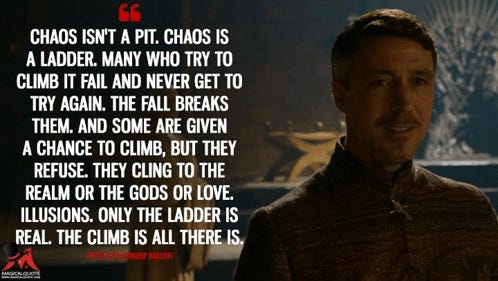
You’re much more likely to have watched “Game of Thrones” than to have read Saul Alinsky’s book Rules for Radicals, so think of Baelish’s monologue: chaos is a ladder. Littlefinger climbed from nothing and threw down everyone who opposed him, and this is the thesis of the book that we are reading this month in the Tortuga Society book club.
Saul Alinsky wrote Rules for Radicals in 1971, opening it with an epigraph to Lucifer, “the first radical known to man.” That tells you something about the man’s sense of humor and of the game. He probably had the 1968 Rolling Stones song playing when he wrote it.
I’m not much of a fan of Alinsky, but I think it’s helpful to know his methods and motivations. Yes, he’s the Temu version of Lenin, but for all that, he set the course for the modern Left. His book is honest about the methods necessary to succeed (think Machiavelli-through-a-Chicago-lens), it’s brief (at roughly two hundred pages), and it’s surprisingly funny. It deserves study the way a weapon does; you learn how to disarm it, turn it, or at minimum recognize it when someone uses it to try to kill you.
So: sympathy for the devil, in the literal sense.
The Rules
The first thing to understand about Rules for Radicals: it’s not a manifesto. It is a manual with some attached snarkiness (anyone who reads my writing may appreciate that I at least agree with Alinsky on this front). Manuals are prescriptive, since they are largely written by people who have already done the thing and are now teaching it to the next batch of recruits.
Alinsky organized the poor in Chicago’s Back of the Yards and built the Industrial Areas Foundation. By 1971, he had been in the fight for thirty years, an underdog against entrenched power. You can see his desperation in his tactics.
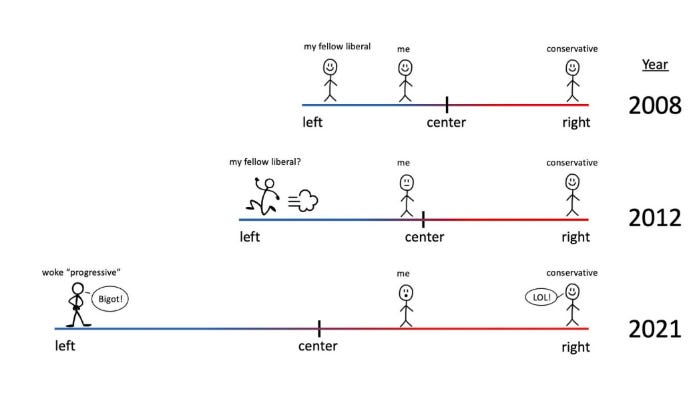
The Have-Nots against the Haves. Alinsky divided society into the “Haves,” the “Have-Nots,” and the “Have-a-Little, Want Mores” class, which he saw as the swing vote in any campaign. (If you think this sounds like a basic class-warfare split overlaid on a left-right political diagram, you got it. Arguably this is why Alinsky didn’t get anywhere, but we’ll talk about that more during the discussion.) The organizer’s job, as laid out in his book, is to pull the sympathies of the Have-a-Little middle class away from the Have reactionaries and toward the Have-Nots.
Alinsky addresses the organizer, not the organized. He wrote to a small cadre of activists about how to move large numbers of people with thirteen (spooky!) rules. They’re not especially warm and fuzzy:
1. Power is not only what you have but what the enemy thinks you have. The appearance of power (the “paper tiger”) is more useful than the exercise of it, if only because you can only exercise it in so many places at once.
2. Never go outside the experience of your people. Keep it local, keep it specific, keep it in the language of the street. This has probably always been good advice, but certainly seems to have been accentuated in our short-attention-span era.
3. Whenever possible go outside the experience of the enemy.
4. Make the enemy live up to its own book of rules. Turn the opponent’s stated values against him. He will either comply, which costs him, or refuse, which proves his hypocrisy. Either way… you win. This hypocrisy-judo works best when the media is on your side. The trick might not work so well if you’re trying to report something that the state wants to suppress and the mainstream media refuses to pick up.
5. Ridicule is man’s most potent weapon. Mockery moves people where argument does not (at least partially because everyone’s attention span is about one clever quip long). Ridicule is cheap, fast, and it bypasses the part of the brain that would otherwise ask whether a claim is true. Case in point: Twitter, or, uh, the last few elections.

6. A good tactic is one your people enjoy.

7. A tactic that drags on too long becomes a drag. Keep the action fresh, keep it concrete, and never let it settle into routine.

8. Keep the pressure on. A method built on perpetual conflict can’t really have an off switch: a movement that wins almost has to move the goalposts and manufacture new enemies for the Permanent Movement to fight. Having won Stonewall, the list of gays deserving rights grew to encompass half the alphabet, because the alternative was declaring victory and letting go of the grifts – and why let go of a good crisis when you still have a donor base? The Great Society was a… seven? nine? year plan, but all its initiatives continue on and grow larger and hungrier, even though the original names have disappeared.
9. The threat is usually more terrifying than the thing itself. Escalation is theater.
10. The major premise for tactics is the development of operations that will maintain a constant pressure upon the opposition. This is the “flood the zone” tactic, the drumbeat of constant news that tends to start looking kayfabe to the jaded observer.
11. If you push a negative hard and deep enough it will break through into its counterside.
12. The price of a successful attack is a constructive alternative.
13. Pick the target, freeze it, personalize it, and polarize it. A system cannot be hated, and a movement runs on hate, so name the villain, put his face on the poster, let the crowd do the rest.
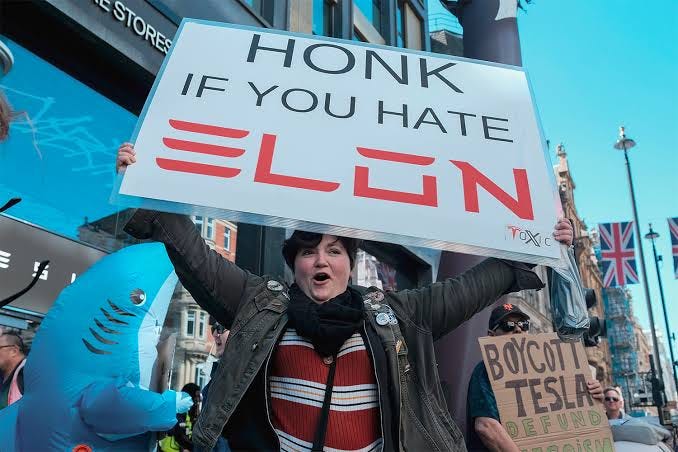
I’m not sure I agree with this one – people really hate the healthcare system, but everyone remembers the shooter Luigi Mangione, not the fellow who got shot.

Who’s this guy again? The audience doesn’t care. They hate the system. Brian Thompson was a replaceable cog, and killing him didn’t fix healthcare; it caused UnitedHealthcare to spend more money on executive security.
So, About Those Killings…
Rules for Radicals has no moral floor, but Alinsky would say: yes, that’s the point. He would probably even go on to say let’s have some fun with it. Politics is a dirty business and pretending otherwise gets you beaten by the people who are not pretending. That’s pretty much impossible to refute, so it’s kind of the reason the book works.
Moralizing without power is impotence; these days, everyone will outright call you a cuck. Alinsky ignored pearl-clutching moralists. As we pointed out when discussing Starship Troopers, the state that can’t defend itself doesn’t get to keep its moral preferences. Similarly, the movement that can’t wield power doesn’t get to keep its principles. While Alinsky certainly wasn’t saying “service guarantees citizenship,” ruthlessness does seem to be a predicate condition to power.
Where I agree with Alinsky most is that people are motivated primarily by their own self-interests, and cloak them in what he calls the “passport of morality.” That’s refreshing. In a world of euphemism, a man who says the quiet part loud is worth reading, if only to be explicit about what the quiet part is. It’ll convince all the autists in the room who are pathologically unable to read between the lines: “Oh, yeah, that is actually what’s going on.”
It is notable that Alinsky – in his prologue – calls out his fellow leftist cohorts for espousing violence in the name of the cause as “people who are merely hiding psychosis behind a political mask” – pointing out that the backlash against these murderous acts will invariably turn off anyone not already radicalized. It’s not particularly clear that Alinsky actually opposes the bloodshed, just that he feels the backlash is going to be too reputationally expensive.
Alinsky could afford to be cynical because he wasn’t running for office. He was the vizier, the kingmaker, and a kingmaker isn’t asking anyone to vote for him. His acolytes, though…
The True Believers
Rudi Dutschke coined “The Long March Through the Institutions” in 1967 to tell the powerless how to infiltrate the universities, the bureaucracy, media, and the courts, thus becoming the powerful. Now, in the 21st century, when leftists have become the establishment, we can see that although Alinsky claimed to have written them to help the Have-Nots, in practice his Rules seem to work better for those who already hold the institutions.
Now you have true believers running a playbook written by a cynical manipulator. It’s interesting that these people – Obama and the social justice crowd – who picked up Alinsky’s teaching and cite him… don’t seem to want to admit to using the propaganda and manipulation he endorses; they seem to think people should actually buy in. Or at least profess to do so. I don’t quite follow why that seems plausible; it seems contrary to Alinsky’s thesis, which is that, rather than the “true believer,” the organizer needs to be a detached “dedicated man.”
The organizer’s first job is to manage his own ego - keep his public image small - because a movement built around his vanity will die with him. He should not be a leader in the charismatic sense, but a technician of power, what at that time they would have called a technocrat. This is a hard role to fill, because anyone who wants to do this has… aspirations.
It’s obvious who has read Alinsky. Rules for Radicals clearly got Obama a lot further than any community organizer ever plausibly could go. The Peter Principle in action, I suppose. As technocrats go, ol’ Barry might have been better than Hillary. Who remembers the controversy over the fact that Hillary Clinton’s senior thesis was… basically a love letter to Saul Alinsky?
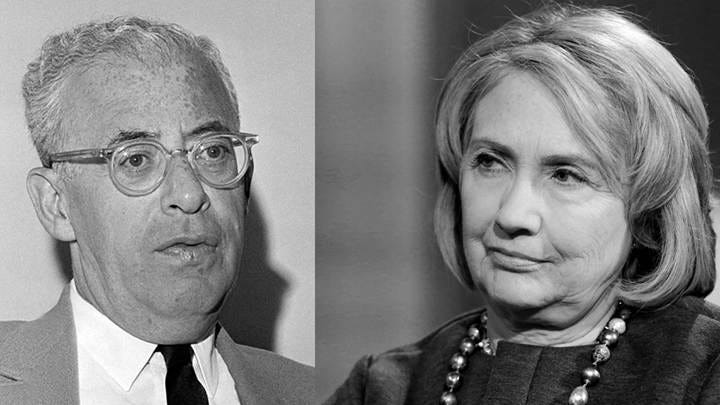
Hillary was the only other choice for president we had at the time, because the DNC was going to give us someone in 2008. The country was too mad at Republicans after the economic crash, which is ironic, because that bank crisis was mostly stupid government-mandated decisions to placate the underprivileged, and a smarter conservative policy would have said “keep your hands off the mortgage risk levers” because of… exactly what happened.
A Loser’s Manual
Rules for Radicals was fun the first time I read it back in college. A lot of people were taking it far too seriously at the time, but thankfully, the Left wasn’t doing all that well back then. I remember thinking that Alinsky was pretty condescending to his audience. His followers were definitely all treated as useful idiots. Which – okay, fair enough – that was a pretty level-headed view of things, but it meant most of Alinsky’s followers didn’t like him much, even if they learned from his book.
It doesn’t get mentioned in his book – in fact, mostly gets laughed off – but there was a lot of racial animosity of the groups in question against Alinsky. Blacks were quite interested in building their own racial enclaves in the 1970s and were uninterested in being subservient to a Jew who was clearly there to try and use them in his own rise to power. That’s come back into the open on the left these days, with outright hatred for the Jews having now become as popular amongst the US’s DSA and EU’s Greens as it was amongst the SS.

One notes that Alinsky did not manage to climb his ladder himself. With no alliance from the successful leftist factions of the time, Alinsky rabble-roused class warfare for decades without much to show for it.
But hindsight is always clearer – and this book is still impactful today; it (perhaps improbably) shaped operational politics for decades after it was written.
Defense Against the Dark Arts
It probably doesn’t surprise you that I put Rules for Radicals on the book club agenda as a “Defense Against the Dark Arts” sort of class – this is what I expect most of the book club meeting to talk about.
How to recognize a practitioner: He keeps everything concrete and local. He demands you live up to your own rules while exempting himself from his. He reaches for ridicule before reason. He escalates theatrically; the threat does more work than the deed. He always has a constructive alternative ready - no rants. He personalizes and polarizes, naming a villain instead of arguing a policy.
How to disarm him. Out-concrete him. Refuse his battlefield; make him fight where you choose. Audit his book of rules and turn the hypocrisy attack around. His values are more aspirational and less down-to-earth than yours. Answer ridicule with boredom and minimalization. Call his escalation out – loudly – as a tactic. Steal the constructive alternative, or grant the reasonable part and isolate the rest. Refuse the personalization and drag the fight back to the system. Cake-slice his faction apart, to get them to split their support into different directions. Often, someone else from his side will try and stab him in the back (meant metaphorically rather than “Arkancide” – though I’m sure history records more examples of this than we’d like to think, too). Cf. the Bernie Bros getting subverted in Seattle in August 2015 by the Clinton Machine courtesy of some hired-gun BLM activists.
The only way to win against the Permanent Movement is literally to defund it, à la USAID or Obamacare/ACA subsidies. Hard to get people to go for cutting entitlement programs, but we cut NASA post-Apollo and DOD spending as part of the “peace dividend” despite enormous job losses, so it can be done. Declare the war over and defund the army.
Alinsky could survive being seen as a cynical operator… after several decades, he was one and mostly didn’t care, but his heirs can’t: they need to believe they are sincere, and they need you to believe it too. So, the single most effective counter against a modern practitioner is to make their manipulation visible, to show the puppet strings they have on their people.
In Closing
The powerless need a manual. The powerful have always had one, written in the language of law and capital and connections: at the very least, people successfully followed the principles of Machiavelli’s The Prince. Alinsky wrote this other book for the people who had nothing but numbers and anger. There is something sort of … admirable in that, even if you do not particularly care for the uses it’s been put to, and it’s better than the simple calls to mayhem from Che Guevara or other bloodthirsty sorts.
The interesting thing is that the Right is often not the establishment in many major areas – urban environments, universities, increasingly the judiciary/law, certainly not the media – so there’s plenty of room to run Alinsky’s rules against his ideological heirs.
But that’s hard to do without a sympathetic media. Alinsky could assume he would always find some fellow-travelers amongst the journalists who would report things his way, but that isn’t the case for the Right (in education or media, at least). The partial answer is its own ecosystem, which is the Long March’s logic applied in reverse: institutions first, then the megaphone. The Right needs something more than just online press and podcasts. Maybe this monster acquisition of Paramount-and-everything-associated shifts the media balance a little.
The One Ring. The weapon shapes the wielder. Alinsky forged the technique. His heirs picked it up and look what they have become. That is the price of the dark arts: gradual moral corruption.

For the Debate
I don’t just want this to be “Street Fighting Man: the Saul Alinsky Edition,” so here are a few debate theses that aren’t just “how do we deal with this nonsense when it crops up.”
1. Politics is the exercise of power, and moralizing without power is impotence. Must the organizer think in power first and ethics second?
2. Can means be separated from ends? “The end justifies almost any means” — where is the floor, and who sets it?
3. Does the method serve the powerless or the powerful? The Long March Through the Institutions certainly suggests the Have-Nots used it to become the Haves.
4. Should the organizer be a leader or a technician? Alinsky’s “dedicated man” against the older ideal of the citizen who governs himself.
5. Can a movement built on manipulation survive its own success, and does the method require a permanent enemy?
6. Can the Right use the techniques without becoming Alinsky? Is the method separable from the man who forged it?
If you want to become a Tortugan and join the book club, you’ve got until the 24th – ordinarily it would be the last Saturday, but that’s Halloween, and too many people are busy with family stuff. As spooky as Saul Alinsky is for Red October and all.