

“What makes you look so white, so white?” said Files-on-Parade.
“I’m dreadin’ what I’ve got to watch,” the Colour-Sergeant said.
For they’re hangin’ Danny Deever, you can hear the Dead March play,
The regiment’s in ’ollow square - they’re hangin’ him to-day;
— Rudyard Kipling, “Danny Deever” (1892)

The Political Philosophy Think-Piece
Starship Troopers might be taken, at first glance, for a bit of Heinlein’s young-adult fiction that outgrew its britches when it swallowed a civics textbook. The plot isn’t complicated: Johnnie Rico, a young, rambunctious Filipino rich kid, gets his blood up and enlists in the Mobile Infantry against his father’s wishes. He gets his ass kicked through boot camp by a drill sergeant named Zim, drops on various planets in powered armor, watches friends die, becomes a noncom, and ends the book a lieutenant with his own platoon.
The interstellar war is against the Bugs - communist hive aliens - and the Skinnies, their humanoid client race. The Skinnies are a bit like the Czechs in this metaphor, or you might even draw the parallel to Korea, or the late-1950s Sino-Soviet split.
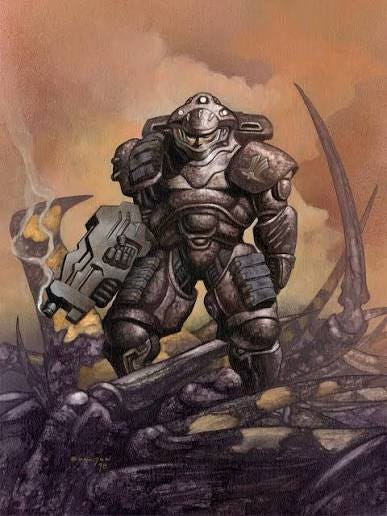
Between scenes of Johnnie’s training and his orbital drop-missions, Heinlein inserts a civics course called History and Moral Philosophy, taught by a disabled veteran named Mr. Dubois. Everything but that course is set dressing; very good set dressing, mind you: Heinlein invented the powered armor that every science fiction writer since has been stealing, and the combat scenes read like the work of a man who knew soldiers, but we don’t care about that. Starship Troopers is the most argued-about political novel in the American science fiction canon because of the arguments it makes about obligation and duty: what do you owe the state, and what does the state owe you in return?
The Obligation
The book’s central claim is straightforward and serious: citizenship is not a right. You get “the franchise” (the ability to vote and hold office) through serving your civic duty. The modern frame treats the franchise as a starting condition rather than an earned one, but Heinlein is arguing from the opposite direction.
A polity is a cooperative enterprise that exists to secure the conditions under which its members can live well. But…

Freedom is purchased by people willing to defend it. That price is paid in service, sometimes in blood. The citizen who has served in the military has demonstrated that he values the polity above himself, and therefore can be trusted with a share of its governance; the citizen who has paid nothing has demonstrated nothing: he has no stake in the thing he is voting about. You do not get a seat in the boardroom just because you work in the building. You have to put in your own investment, so everyone else knows you can be trusted not to loot the firm (a bar most of the current shareholder/voter class would fail).
Is that true? It’s a better question than the one most readers bring in. These days we are not used to thinking of both civil rights and civil responsibilities, which is, if you watch how people behave under the current system, rather a lot of the problem.
We’re again doing Starship Troopers for the Tortuga Book Club on Saturday - similarly to how we did The Populist Delusion last month - and I have many excited readers going through it. (Quite a number of veterans, quite a number of SF fans.) Come join the discussion with us. Members only.
Governance: The Franchise as Voice
Though it appears to run relatively democratically, the Terran Federation is not a democracy. It is not a military junta either, though it is routinely accused of being one (mostly what we see in the book is the military command structure, so the view is a little tilted). What Heinlein does show us is a republic, in which the franchise is restricted to those who have completed a term of voluntary federal service.
For any volunteer, of any aptitude, the state must find a slot. The catch is that the state chooses the slot, and it is not obligated to make your term of service pleasant (it is, in fact, somewhat obligated to make it unpleasant). If you are young, strong, and stupid, you may end up in the Mobile Infantry, which has the highest casualty rate of any branch.
Heinlein wrote Starship Troopers against the cultural default of his own moment. Johnnie Rico is Filipino by ancestry, and his native language is Tagalog. The Mobile Infantry is multiracial, and the book makes a point of the races serving side by side. Women serve; in 1959, the real American military was closed to women in combat. Heinlein is making an argument with the casting: the Federation does not franchise by ancestry or by sex, only by service, which is open to everyone. But the inclusiveness of Starship Troopers is not the DEI of twenty-first-century armed forces. The Federation cares about what you do and how well you do it (a standard the diversity office would find terribly un-inclusive).
Consequential Service
The assignment has to be consequential or the whole thing collapses into special-case exceptionalism carved out for the politically privileged. In the book, the maimed veterans teach and recruit and run logistics. The state assigns service and decides what counts as a job well done.
Two tensions remain. The first is that the state is the arbiter of its would-be citizens’ service. An elite would form, capture the state, and just assign den-mother make-work to their children.

The second is the demographic blind spot. If contribution to the state was the criterion for franchise, then childbearing would surely qualify - what could be more worthy than literally propagating the existence of the state? - but the Terran Federation does not assign anyone to be a mother. They might tell a woman to be a nurse or a logistician or a teacher (or a Fleet pilot), in which case the nursing or the teaching or the military duty is the service, and the children are beside the point.
Why doesn’t Heinlein go there? It may be as simple as “assigning brood-mare as a role is an icky prospect for a sci-fi novel,” but the book never says whether citizens are expected to become parents. Or perhaps our own demographic crisis is our state leaning in the other direction, and a polity generally favorable to marriage and children might have a different experience … Heinlein might have thought the natalist question quite curious in 1950s America.
History and Moral Philosophy
This is the part that gets quoted in every debate about it. Dubois teaches four things:
1. Violence has settled more issues in history than any other factor. This, the book’s most famous line, does not celebrate violence, but makes a claim about the world: moral suasion is a late and fragile development, and the state that cannot defend itself does not get to keep its moral preferences.
2. Moral faculty is a human attribute, and its development requires a society that can afford to cultivate it. You cannot have philosophy in a society being raided by barbarians.
3. Duty, honor, and loyalty are the predicate virtues of any society. The book holds in contempt the soft civilian who wants the benefits of civilization without the costs.
4. The basic unit of moral accounting is the polity. This makes modern readers uncomfortable, and Heinlein means it to. He portrays Rico’s father, a wealthy businessman, as a man who has confused his own comfort with the good of the species. The book’s arc is Rico learning that his father was wrong.
The above philosophy is taught by a veteran with a prosthetic arm (visibly maimed), which is Heinlein’s way of saying: the man teaching you about duty has paid for the lesson in pain and suffering. A veteran knows what the state costs because he has paid some of its maintenance. A civilian does not, so his opinion is worthless.
The World That Made It
Heinlein published Starship Troopers in 1959, and you cannot understand the Federation’s response to the Bugs’ attacks without understanding what the West looked like from the inside during the fifteen years after World War II.

1945 ends with the atomic bomb and the Soviet Union as an ally of convenience that immediately becomes a rival; 1946 Kennan’s Long Telegram and the containment doctrine; 1947 the Truman Doctrine and the Marshall Plan; 1948 the Berlin Blockade and Airlift, the Czechoslovak coup, and the reinstatement of the American draft; 1949 NATO, the Soviet atomic bomb, and Mao taking Beijing. By the end of 1949 the world is bipolar with two communist giants, and the West has lost China.
1950 NSC-68 and the militarization of containment, and then Korea in June. In Korea, the United States fights a limited war against a Soviet client, has the power to win outright, but chooses not to because escalation means general war with the Soviets. MacArthur is fired in 1951 for wanting to expand the war. The armistice in 1953 leaves the peninsula divided, thirty-six thousand Americans dead, no victory, and a permanent DMZ.
The initial drop in Starship Troopers - the “limited engagement” - is basically the Korean War (MacArthur’s solution would have been to glass the planet). The war ends with some of the Skinnies peeled off as Terran allies against the Bugs, like the North Korea/South Korea split that persists to this day. The tactical incoherence critics love to point out is the incoherence of American limited war doctrine.
1952 and 1953 the hydrogen bomb on both sides and mutually assured destruction becomes a permanent condition; 1956 Khrushchev’s Secret Speech, Soviet tanks crushing the Hungarian Revolution, and the Suez Crisis, when the West loses its moral authority in the Third World; 1957 Sputnik and the missile-gap panic - for the first time the West feels strategically behind; 1958 the Berlin ultimatum and the Taiwan Strait crisis; 1959, the year Starship Troopers was published, gives you Castro in Cuba and the Kitchen Debate. The world feels like it is losing ground to communism on every front.

Heinlein’s personal history is routinely gotten wrong. He ran for the California State Assembly as a Democrat in 1938 on a quasi-socialist platform, moved right through the 1940s, and by 1959 was a libertarian with a Cold War hardening that would keep going for the rest of his life. He wrote apocalyptic essays on civil defense and survival and the decline of American will, saying the West could not outbreed the communist bloc and had to outkill it.
The doctrine of the moment was the Eisenhower New Look. The West could not match Soviet manpower, and it certainly could not match Chinese manpower, so it focused on firepower: the tactical nuke as the equalizer, the neutron bomb, massive retaliation.
If Heinlein’s Bugs are the communist bloc, the hive has no individual will to negotiate with. It will also beat the Federation in demographic terms; the Bugs can replace their losses faster than the Federation can replace its own. The only way to stay ahead is with atomic weapons; Heinlein describes “delivering destruction in impersonal wholesale.”
The Common Critiques
The fascist charge. The most common critique is that the Federation is a fascist state in all but name. The franchise is restricted, the military is glorified, the individual is subordinated to the polity, and the enemy is dehumanized. The book’s defenders point out that the Federation has no secret police, no single leader, no racial ideology, and no territorial expansionism. It is fighting a defensive war it did not start. The Federation appears to be more meritocratic or even bureaucratic than fascist. “Service guarantees citizenship” might even count as a peculiar form of credentialism.
A libertarian would object to the franchise restriction on principle, because the franchise is a right and rights are not earned. Heinlein does not object; he thinks the franchise is a privilege (carrying the social obligation of service) and privileges are earned (by performing that same duty). That is a somewhat novel departure from libertarian orthodoxy, but remember that Cold War timeline. You can afford luxury beliefs after the tanks have stopped rolling.
The system is unstable. Any reasonable criticism of this particular governance really ought to address that a franchise restricted to veterans quickly turns into aristocracy of the British-Navy-officer-class sort. This may look more like nepotism: the children of the successful martially inclined citizens entrench their best-and-brightest as the future governors of society if only by ROTC-style programs and elite military academies. Yes, and isn’t that what you’d want? The highly competent and elite, dedicated to public service rather than personal greed and aggrandizement?

The service filter does not test civic virtue. This is the strongest critique. Military service does not select for wisdom, judgment, or moral seriousness. Adolf Hitler volunteered for the Bavarian army in 1914 and served with distinction, which did not make him a great choice for national leader. The book itself notes that veterans commit crimes at the same rate as civilians, which undermines the claim that service uniquely instills social responsibility. If the franchise is a certification of civic maturity, that certification isn’t very reliable.
The filter selects mostly for stubbornness. In addition to physical courage and obedience, the trait that gets you through the service requirement is the refusal to quit. A franchise selected by endurance is selected for the least corrigible citizens in the polity, which is the opposite of what governance requires. Stubbornness is not the trait we want to select for in every decision-maker in society. If any service counts, the service measures nothing except someone’s willingness to endure the boneheaded decisions of those in command.
If you think IQ would make a better selection mechanism, think harder. Take Robert McNamara, a Ford executive and one of the so-called Whiz Kids brought to the Pentagon to reform it with systems analysis and statistical management. Bluntly, he failed. McNamara was brilliant, and so were the men he brought with him, but the framework he applied did not capture the reality of the situation; he got wrapped up in his own model. The body counts, the systems analysis, the rationalization of the war, all of it failed against the actual war. The Whiz Kids could not see what their model missed; they could only (very intelligently) rationalize it. Intelligence does not prevent framework capture. It can, in fact, enable it: a lesson we’ll see again in discussions of climate change, for instance.
The ability to see what the framework misses goes by several names: wisdom, prudence, and phronesis among them. This good judgment comes partly from experience, partly from temperament, partly from the willingness to hold the model loosely and to be wrong in public. No IQ test captures it.
Governance requires cognitive ability plus domain judgment. A cognitive filter measures the former, while the service filter … measures neither well, unless it’s practical service. And speaking of practical…

Heinlein possibly refuted his own thesis in the funniest scene in his book. During recruitment, Johnnie learns that if you want the franchise and you are a ninety-pound asthmatic with no mechanical aptitude, you may have to spend your service years counting the hairs on a caterpillar in a research station on Luna. (This is - most likely - lampshade-hanging of a humorous justification. One notes that the state does not actually opt for this; it instead sends its maimed to be teachers, recruiters, debaters, logistics personnel, etc.) Here, Heinlein is having some fun with make-work compliance jobs, but he’s telling us the paraplegic in the wheelchair can still do his duty and get the vote if he’s got the grit. One struggles to see how the poor bastard would get through boot camp.
The occasional sinecure for the occasional unsalvageable but vastly determined edge case does not sink civilization. The flood of bullshit jobs for well-connected grifters, on the other hand, is the curse of our modern era. The Terran Federation is good at finding still-useful roles for people if they aren’t suited to drop into combat, so perhaps this is all extrapolation from a joke line … but people often seem to blow this joke out of proportion.
The tactical criticism. Rico’s unit carries roughly 240 kilotons of nuclear yield in micro-warheads, equivalent to about sixteen Hiroshima-sized explosions, which contradicts the mission’s stated goal of restraint and smash-and-run. The tactical rationale is nonsensical. Equivalent destruction could be achieved more safely by orbital bombardment.
This is a fair critique of the book’s military realism, but it misses the point: Heinlein was writing about the moral experience of the infantryman, not optimal force employment doctrine. One must also consider that a brigade-level maneuver would perhaps be less plausible, given the need to transport a small cadre over interstellar distances. The Roughnecks in their powered armor with solutions ranging from knives up to micro-atomic weapons are discreet in the same way that special-ops raids might be today.
The “everybody drops” doctrine. The book insists that every member of a unit, including the chaplain, drops with the troops. Critics note that this is inefficient and that specialists should be kept out of combat. Defenders cite Patton: leaders must share the risks of their men, or they will not understand the costs of their orders. This is the “every Marine a rifleman” premise of the Marine Corps. Given their powered armor, this criticism seems doctrinaire at best. If you want officers who know what their orders cost, you put them on the drop. They’ll be fine.

Tortuga’s book club is a reading and discussion group for people who like their books with a fight in them. Veterans especially welcome - you have paid for this argument in a currency the rest of us have not, and we want to hear what you think of Heinlein’s version of the deal. If this is the kind of thing you enjoy, come find us.
The Steelman
Now, let’s make a serious case for Starship Troopers, because the refutations above are mostly a pile of gotchas. A book club that only tears a book down hasn’t really engaged with it.
Heinlein would have been utopian and silly to write a book in which the Federation was perfect. He wanted to ask what a polity owes to the people who defend it, and what those people owe to the polity. What sort of responsibilities belong with rights? The modern answer, that the franchise is a natural right and military service is a job like any other, is not obviously superior. It produces citizens who have no stake in the state’s survival beyond their own comfort, and it produces soldiers who are treated as employees rather than as members of a political community, somewhat interchangeable with mercenaries, though we still wrap them in the flag. Heinlein’s answer is that the franchise should be earned by those who have demonstrated that they will pay for it. Some may find that answer uncomfortable, but it is not obviously wrong.
On moral philosophy, violence does settle things. The state that cannot defend itself does not get to keep its moral preferences. The soldier (and by extension other agents of the law) is the guarantor of the conditions under which moral life is possible.
The book’s defenders also point out that Heinlein was writing against the draft; the Federation’s service is voluntary. The point of the franchise-through-service system is that the state cannot compel service, and therefore cannot compel the sacrifice that justifies the franchise. You choose to serve; you are not punished if you stay home, but are simply not given a share of governance. This is a libertarian argument, and a republican argument in the older sense of the word, the sense in which the republic is a commonwealth of those who have accepted to share in its maintenance.
A self-selecting elite bound by honor and duty is better than a self-selecting elite bound by nothing. What we have today is a meritocracy of the credentialed, selected by the ability to game a system designed by the previous generation of the credentialed. The Federation’s elite at least has to risk its life; the modern elite has to risk a bad LSAT score. The officer who commands a platoon in combat has been tested in a way no examination can: he has made decisions with lives on the line and lived with the consequences.

The Pentagon Question
In WWII, the US mobilized an economy, built a two-ocean navy, produced the atomic bomb, and ran the Normandy invasion, all of it in more or less four years. The people who did it were a mix of military officers, corporate executives on loan as dollar-a-year men, and scientists. The political class, I’m sure you’ll be shocked to note, was mostly a hindrance. The competent organizers delivered, the politicians did not, and let the organizers run things into the ground.
To Heinlein, the lesson was clear: let the leaders lead. But WWII was a total war with a clear objective and a unified command, and the Pentagon’s peacetime record is much worse: procurement overruns, Vietnam, Iraq, the F-35, the Afghanistan withdrawal. The Pentagon’s competence in WWII did not generalize to peacetime governance, which has no clear objective, no unified command, and no enemy.
Can Pentagon can fix a city? It arguably has. From 1948 to 1949, the Soviets blockade West Berlin, a city of two million, and the US Air Force and the RAF deliver 2.3 million tons of supplies over fifteen months and break the blockade. The Army Corps of Engineers also built the Panama Canal and the Mississippi flood control system. MacArthur’s military occupation reconstructed postwar Japan. Disaster response is a fourth solid example; the military is routinely the first and most competent responder to domestic and international disasters.
The Pentagon is good at physical reconstruction and logistics where the objective is clear and measurable and the feedback is fast. It is bad, however, at social reconstruction, where the objective is contested, the feedback is slow, and the causes are political. More or less the same organization that ran the Berlin Airlift also ran the far less praiseworthy reconstructions of Iraq and Afghanistan. (Call those what they were: persistent insurgency versus denazification and Marshall Plan / GARIOA / EROA reconstruction. Also, one might reasonably say we rebuilt Japan at least partially in order to fight the Korean War.)
The organization that can airlift food to two million people doesn’t necessarily make a city work for several reasons. It is generally not in charge of the city, and running one requires solving a coordination problem that has no clear objective and no unified command, and many people with contradictory incentives trying to pull the soldiers in many directions at once, which is not a thing the Pentagon’s model handles well. The Federation’s competence claim is about governance, which is the social kind of problem, and the Pentagon’s record on the social kind probably doesn’t comfort you.
For the next problem, consider the business executive. The highly successful career man from IBM (an archetype so worn it has its own name in Silicon Valley) leaves for a startup and discovers that half of what he thought was his skill was actually IBM’s infrastructure: procurement, legal, HR, the brand, customer base, supply chain, and the compliance apparatus: all of it was doing work he was attributing to himself. The startup strips it away and he freezes, or he imports the processes of the big company without the scale that makes them work, and the startup drowns in overhead. He’d have the same problem at an NGO, or in politics, where the infrastructure is the party machine and the donor network and the press relationships, and the executive who has none of it discovers that his boardroom skills are a smaller fraction of the job than he assumed.

The admiral assigned to command the cavalry is the same problem inside the military. The admiral knows how to command a fleet. The cavalry is a different arm with different doctrine, different logistics, different culture, different tempo. He will make mistakes the cavalry would not make and he will miss things the cavalry would catch. His competence was fleet-shaped, but the cavalry is not a fleet.
The Federation assumes that competence in one domain, military service, transfers to governance. It is the inverse of Rico’s father’s problem: private competence and no civic competence. The veteran has military competence and may have no civic competence. Both are domain mismatches, but Heinlein only describes one of them.
The Elite-Formation Taxonomy
If you want to take the argument past the book, the question to ask is how a polity forms its elite.
The bureaucracy selects for administrative competence. The Deep State is a real institutional actor with real preferences, preferences that are not the polity’s. As Jerry Pournelle put it, “The people devoted to the benefit of the bureaucracy itself always get in control.”
An aristocracy selects for a long time horizon. The British aristocracy thought in centuries and was not captured by electoral incentives (it was captured by its own sense of entitlement). It was also parasitic, self-serving, and obsolete. By and large, it died to artillery and machine guns on the battlefields of the First World War and went on to lose its empire.
A theocracy selects for zeal. It has the long time horizon, because the religious frame is eternal, and is resistant to capture because its legitimacy is not electoral. What it does not have is competence. Theocracies select for doctrinal mastery and religious devotion, and those are orthogonal to the ability to manage a complex economy or fight a modern war. Ancient Rome or Islamic Iran could be the working examples, although one might note that these days, they’re not working all that well.
The junta selects for command and is captured by the officer corps. Its time horizon is short because its legitimacy is its grip on power, and its grip is always contested. Pinochet’s Chile is the interesting case of a junta that transitioned out after a decade. This is rare and arguably the best outcome a junta can produce. Most juntas just ossify into a kleptocracy with epaulettes.
The fifth category, the one we are living under, is the oldest of them all. The republican mode selects for support-command and the ability to command the support of the citizen body. Its mechanism varies with the technology of the age. In the Roman cursus honorum, the elite was selected by birth, wealth, military glory, oratory, and electoral success in the assemblies. It was captured by the network of patrons who traded support for votes. In the modern instance, the elite is selected by charisma, coalition-building, name recognition, and fundraising, and captured by the party apparatus, the donor class, and the media coalition. The elite serves the coalition that elevated it. (The aspiration this mode never delivers is the natural aristocracy: the elite of virtue and talent.)
The sixth category is oligarchy, the one we do not name. The oligarchs do not need to hold office because they hold the thing the officeholders need, and the officeholders serve them in the ordinary course of business. It has the ability to accumulate and deploy capital, but the polity it creates serves that capital. We have a great deal of oligarchy and almost no vocabulary for it (the vocabulary gap is itself a feature of the oligarchy), which is why it hides in plain sight as the sixth of our five categories.
So, where are we? The twenty-first-century US is republican plus oligarchy plus a large bureaucracy. The elected elite serves the electoral coalition, including the compliance bureaucracy and the professional-managerial class, the oligarchs fund the coalition, and the civil service administers it. Each component fails in the direction of its own proxy. The republican mode fails toward the coalition, the oligarchy fails toward the capital, the bureaucracy fails toward the institution, and the mix fails in all three directions at once, which is why it makes us feel like we’re being governed by no one in particular and everyone in general.
For the Debate
The pro and con versions of the theses herein, as suited for debate purposes:
1. Is the franchise a right or a privilege? If it is a right, the Federation is illegitimate on its face. If the franchise is a privilege, what earns it? Service? At what age and in what condition? On what occasions might one lose the franchise (or other civil rights)? (Usually by some violation of the social contract such as the more serious crimes. Likewise, traditionally, it’s been frowned on to trade your franchise away, to literally sell your vote, for instance.)
2. Does obligation ground the right to vote, or does that right exist independent of the obligation? Heinlein says the obligation comes first. The modern frame says the vote is a birthright and the obligation is a separate matter, for example conscription. Which is right, and what follows from the answer?
3. Does competence in one domain transfer to another? The Federation assumes military competence transfers to governance. The IBM executive in the startup and the cavalry admiral suggest it does not. If competence does not transfer, what does, and can it be measured? The Gordian-knot question suggests a simple answer: “Does it do better than the other guy?” After all, our existing “leadership” makes some pretty mind-boggling errors.
4. Is a hazing-based filter better or worse than a credential-based one? Both select for proxies of good judgment. The hazing filter selects for stubbornness and would tend to develop into a caste of warrior-kings. The credential filter selects for the ability to pass exams and is gameable by the wealthy, giving birth to a bureaucratic nerd caste, which would then lock others out in a long-march-through-the-institutions fashion. (One reasonably postulates an oligarch class that might flirt with either, and game the appointment process for sinecures rather than spots for its sons in the Mobile Infantry.) Which failure mode is worse?
5. Does the West survive, and was that survival ever in doubt? Heinlein’s answer in 1959 was that the West survives by becoming martial without becoming totalitarian. The historical answer is that the West survived with liberal democracy intact, which is evidence against his thesis. Does that settle the question, or does the current crisis reopen it? It doesn’t seem clear from where I sit that an economic challenge to leadership is best answered by the military, but Clausewitz would certainly scoff at that.
6. If the Federation is a bad answer, what is the good one? Every elite-formation model on the table fails in its own characteristic way. Is there another viable solution, or is the choice between failure modes? Can we, perhaps, find some means to check and balance more effectively than we currently do?
Pick one and fight.
A Closing Note
Starship Troopers is a thought experiment about what a society looks like when it takes obligation seriously as the foundation of the franchise, but Heinlein did not fully script out what it would do over the next sixty-plus years (he was not the first builder to have this problem). From our perspective sixty-seven years later, we can see how things turned out: more or less fine. We haven’t gone extinct. We have the leisure to argue about a sci-fi novel.
Is citizenship (and the franchise) a right or a privilege? To what extent do you have civil responsibilities to match your civil rights? Where do they delimit one another? How much does competence transfer across domains, how do you filter the right people into authority and leadership roles, how do you inculcate people with moral behavior? Will the West resist its various threats? Soviet-era communism has faded, yet the memetic contagion of communist and socialist ideals continues to rot people’s brains while the PRC seems to have figured out how to do capitalism better than we do (but who knows, Japan in the 1980s looked unbeatable too). If the various offerings of the Terran Federation don’t add up to the correct answer, what’s the better one?
Service guarantees citizenship! The scissors are issued, the lawn is waiting. Cut the grass, comrade, and the franchise is yours.
If you really want something to fight about, next month we’re going to visit Saul Alinsky’s famous Rules for Radicals, for (Red) October. Everyone should know this book that shaped the Left. It’s a quick read, and it taught generations of community organizers (yes, including the guy you’re thinking of) how to cause trouble.