

“I am leaving, I am leaving, but the fighter still remains.”
- “The Boxer,” Simon & Garfunkel

The Fighter Still Remains
You’ve discerned this already, but the syllabus for Tortuga’s Book Club has been a bit of a tour through the intellectual foundations of the American right. Heinlein’s Starship Troopers asked us to explore how you earn power, the balance of civil rights vs. responsibilities. Parvini’s The Populist Delusion gave us elite theory: an argument about who holds power (not the masses). Alinsky’s Rules for Radicals was the manual for those who would seize power: the tactics of pressure and disruption. Now, we come to Goldwater’s Conscience of a Conservative, the 1960 book that defined the limits of power, as well as what “conservative” would mean in America for the next half-century.
Naturally, none of the Tortugans I talked to had read this book, and only the elderly ones remembered Goldwater at all, so I thought we should explore his work. I also put him on the list as a counterbalance to Alinsky: where Alinsky is about how to seize power, Goldwater is about how to limit it; where Alinsky is a tactician, Goldwater is a constitutionalist … and where Alinsky says the ends justify the means, Goldwater says the means are the point. The two books are mirror images, and reading them together outlines the American political argument of the last generation.

Nobody reads Goldwater anymore, or much acknowledges the man existed. The book sold millions in 1960 and went through dozens of printings, but today it’s a period piece, read only by elderly Republicans. Alinsky, by contrast, is still assigned in schools and quoted (and practiced) by organizers. Why is the community organizer remembered and the presidential candidate forgotten? We’ll come back to that - but first, the book itself.
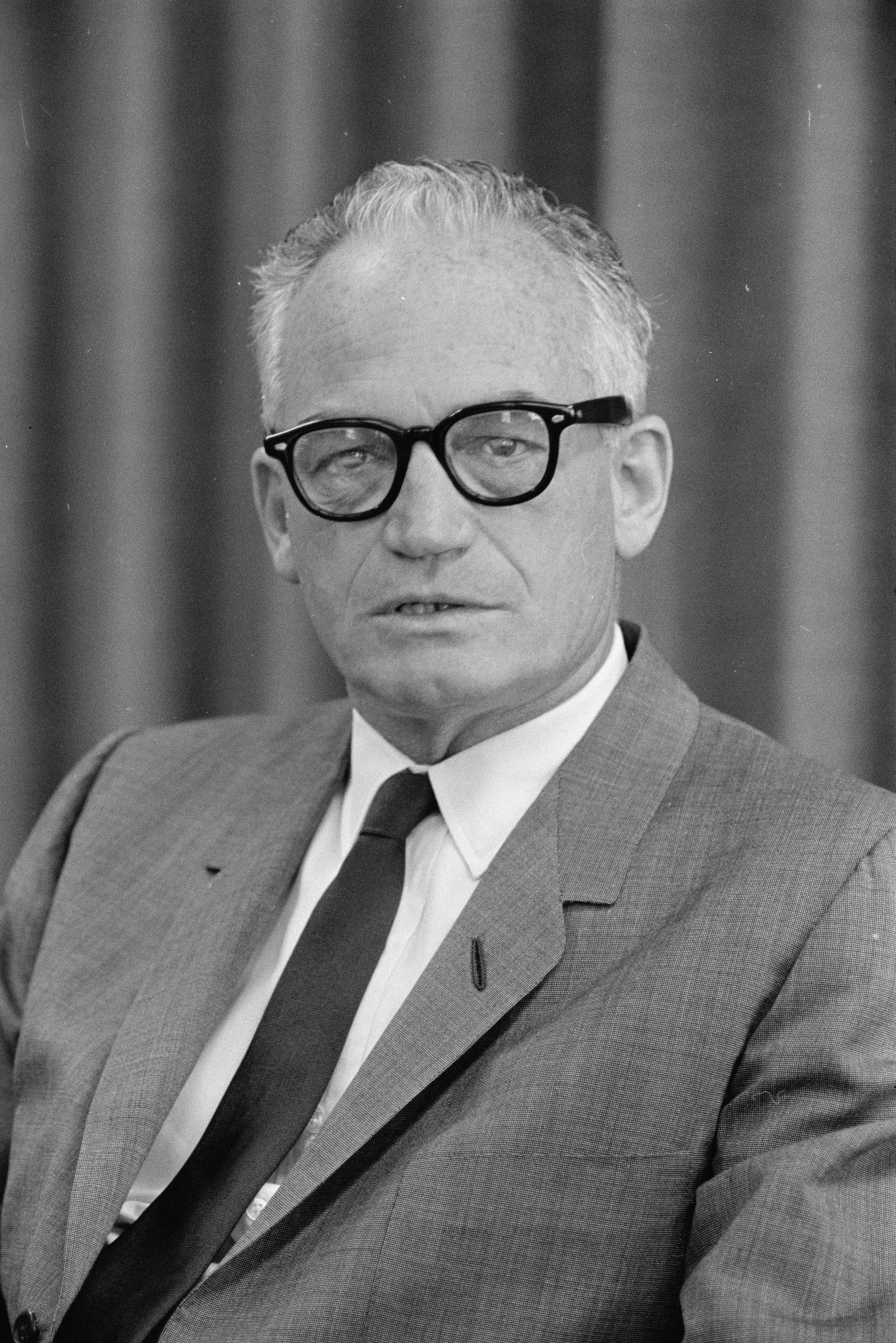
The Book
One might call The Conscience of a Conservative a fusionist document. It’s not a libertarian tract, despite the reputation, but a synthesis of three strands: constitutionalism (limited government, states’ rights, the Tenth Amendment), economic conservatism (anti-union, anti-welfare, anti-tax), and anti-communism (the Soviet menace, anti-containment).
The book was ghostwritten by L. Brent Bozell Jr., a speechwriter for Goldwater and brother-in-law to William F. Buckley Jr. This explains its Buckleyite register: measured, moralistic, more Catholic-traditionalist than libertarian. The Conscience of a Conservative is not a free-market manifesto so much as a moral argument about the limits of power.
The outline:
The Conscience of a Conservative. Politics is a matter of conscience, not interest. A conservative should act on principle and refuse the “me-too” Republicans of the Eisenhower years, who tried merely to administer the New Deal more efficiently. Goldwater’s answer is that they should not administer the New Deal at all.
The Perils of Power. The central chapter. Power is the enemy, but the Constitution restrains power. “I have little interest in streamlining government or in making it more efficient, for I mean to reduce its size.”
States’ Rights. Federalism, upheld by the Tenth Amendment, is a check on tyranny. The states are the proper locus of most governance, and centralization leads to tyranny.
And Civil Rights. The controversial chapter. We’ll come back to this.
Freedom for the Farmer. Agricultural subsidies are a case study in federal overreach. Farmers don’t need the Department of Agriculture to tell them how much wheat to grow and what to do with it. Just leave farmers alone and let market forces run. Yes, that means we’ll end up with a smaller number of larger farms, but if we go the other way we’ll have tons and tons of wasted food.
Freedom for Labor. Right-to-work, the case against compulsory unionism. The union is a cartel that restricts freedom. A worker shouldn’t have to quit his job because he doesn’t like the union his employer has partnered with.
Taxes and Spending. The case for lower taxes argues that the real problem is spending. The welfare state sells compassion, but really it’s a power grab.
The Welfare State. The argument against federal welfare is the case for private charity and local responsibility. Dependence on state aid “transforms the individual from a dignified, industrious, self-reliant spiritual being into a dependent animal creature without his knowing it.”
Some Notes on Education. Federal aid to education is overreach. Schools teach values, and the values should be local.
The Soviet Menace. A harsh critique of containment. We should not aim for coexistence with Communism, but victory over it. World War III is likely, but we probably won’t need to use more than one or two “small, clean nuclear weapons.”
The thesis, in one sentence: the federal government has exceeded its constitutional limits, and the remedy is to reduce it. The Goldwater Conservative acts on principle, refuses to trade freedom for security, and insists on limits to government even when it costs him. This is a call to political virtue.
Why We Forgot Him
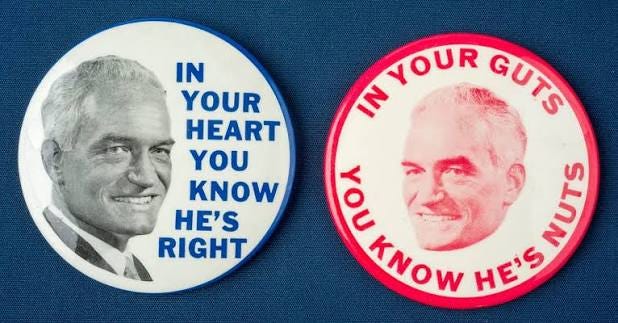
Then, Goldwater ran for president.
As aggressive as the last chapter of his book was, the campaign that followed was even less measured. The “Not ‘peace,’ but victory” line seemed dangerous in a nuclear age, and Goldwater’s loose talk about tactical nuclear weapons and NATO commander discretion scared voters.
Then there’s the “famous” LBJ attack ad.
People of a certain age say they regard it as influential, but I’d never seen it until I went to put this Substack article together. It doesn’t seem to have nearly the propaganda value that, say, The Day After did.
Still, Goldwater got resoundingly clobbered in the election. It was a pretty bad spanking: 38.5% of the popular vote, 52 electoral votes. Losing candidates get filed under “do not repeat this mistake.”
Part of it was the fact that he was running against the vice president of the beloved and tragically assassinated President Kennedy. But voters were surely also concerned that Goldwater might usher in the nuclear apocalypse. (History will note the massive escalation in Vietnam under Johnson, but never mind that.)

The Civil Rights Lampshade
Goldwater voted against the Civil Rights Act of 1964. That’s what will dominate the comments section if we don’t address it, so it deserves some explanation.
His argument was legalistic, not sentimental. Goldwater defined civil rights narrowly: a civil right is “protected by some valid law” and the federal government can only protect rights already in the law. (“The Constitution is what its authors intended it to be and said it was - not what the Supreme Court says it is.”) The Fourteenth Amendment was not intended to desegregate schools, so Brown v. Board was wrongly decided. The remedy was not judicial imposition, but a constitutional amendment that would “reaffirm the States’ exclusive jurisdiction in the field of education.”
Goldwater was explicit that he agreed with the goal of integration: “I believe that it is both wise and just for negro children to attend the same schools as whites, and that to deny them this opportunity carries with it strong implications of inferiority.” He was equally explicit that he would not impose that judgment on Mississippi or South Carolina: “That is their business, not mine.”
Goldwater was not a segregationist by conviction, but was a strict originalist, and his originalism led him to a position that did give cover to segregationists, whether he intended it or not. I’d ask the reader to consider whether Goldwater’s constitutional argument was right on its own terms. The point of the book club is to discuss the book, not to relitigate 1964.
The Alinsky-school critics will try to make the whole essay about racism. That’s exactly what Alinsky would have told them to do: find the pressure point, apply it, don’t let the other side set the agenda. Good job, comrades, but now we’ve acknowledged our privilege, and we can move on to the question of what part of Goldwater’s legacy survives.
What Survives
Although you might have never heard of Goldwater’s book, or even his name, his ideas weren’t forgotten. “Goldwater Republican” became ambient in the party mindset. That later became “Reagan Republican” because Reagan won (and because Reagan was more charismatic). But Reagan was still quoting Goldwater in the 1980s. In 1994, the Contract with America was Goldwaterite. The Tea Party and Trump and the whole MAGA thing are all downstream of The Conscience of a Conservative.
Goldwater’s asymmetry with Alinsky is instructive: Alinsky is remembered because his method is still contested. His ideas were never fully absorbed by a governing coalition (it would be difficult to do so since they’re predicated on resistance to “the Man”), so he remains a live reference point. Goldwater is echoed by politicians who don’t know they’re doing it.
What Goldwater Got Right
Centralized power is inherently corrupting. Goldwater didn’t think the federal government was staffed by bad people, but that the structure of concentrated power makes good people do bad things. Now, in the age of the administrative state, we see that he was right.
Federalism is a check on tyranny, not because states are virtuous, but because competition among jurisdictions limits the damage any one can do. If you don’t like the laws of one state, you can move to another. If you don’t like the laws of the federal government, though, you gotta emigrate (shout out to my boy Edward Snowden). It’s important to be able to vote with your feet.
The distinction between “freedom to” and “freedom from.” The welfare state trades freedom for security, at the cost of independence. “Man’s political freedom is illusory if he is dependent for his economic needs on the State.”
The moral case for limited government. Government mistakes the material side of man for the whole man. “It is Socialism that subordinates all other considerations to man’s material well-being. It is Conservatism that puts material things in their proper place.”
Dependence corrupts character. Charity is a virtue only when voluntary. The man who is forced to give is not generous; he is taxed. The man who is forced to receive aid is not grateful, but resentful.
The two sides of Goldwater’s moral case only lasted as long as the coalition between the libertarian and traditionalist Republicans. The libertarians want to legalize everything and the traditionalists want to ban everything, so any time their party is in power, they stop cooperating.
The anti-communist posture has aged better than its critics allow. The book’s argument that coexistence is not a strategy - that the West needed an affirmative goal rather than a holding pattern - anticipated the approach that ended up winning. Reagan’s pressure, the arms race, the support for anti-communist movements behind the Iron Curtain: that was closer to Goldwater’s instinct than to the détente pursued by the American Left.
It also got expensive. Reagan discovered that you can’t cut taxes and increase defense spending without deficits, in this case the largest peacetime deficit in American history (to that point).
The Conscience of a Conservative might seem to have been wrong about how victory would be achieved. The fall of the Iron Curtain ran more through internal Soviet collapse - the oil price crash, the Afghan quagmire, Gorbachev’s reforms - than American pressure. However, the standard account tends to forget Solidarity, the mass workers’ movement led by Lech Wałęsa (a man whose conscience Goldwater would have recognized even where he’d have disagreed with his politics). Solidarity cracked the Warsaw Pact from within, exposed the exhaustion of the Soviet regime, and triggered the cascade of 1989. Goldwater’s book is full of talk about the “enslaved peoples” in Soviet satellites, and sure enough, the prisoners’ revolt of Solidarity did more to destabilize the Soviet bloc than anything our 600-ship Navy did.
The Andor Question
You want to talk about Andor?

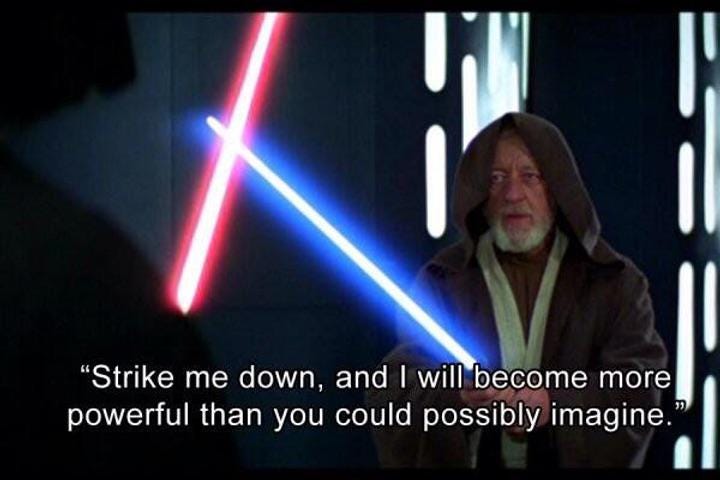
Andor (Star Wars for people who hate Star Wars) is about the tension between the Rebel Alliance’s need to win and its commitment to not becoming the Empire. See Luthen Rael’s speech: “I burn my decency for someone else’s future.” Do the ends justify the means?
Alinsky’s answer was, hell yeah! Hail Satan! But Goldwater’s book makes the opposite bet: do not burn your decency. Winning with the Empire’s means is losing.
But as they say, losing is also losing. Goldwater did not get elected president.

(If you want a second reference: Yellowstone is the on-the-nose one for the federalism chapters. The Dutton family’s fight over land and federal authority is a direct map onto the states’ rights argument.)


Closing
Barry Goldwater lost the election but won the argument. He’s the prophet without honor in his own country, the conscience that the movement absorbed into its subconscious. Read The Conscience of a Conservative and ask what survives. What concepts of his retain validity, and what has been effectively conserved? The answer is more than you’d expect.
Debate Points
A few propositions for the comment section, pro and con:
1. “The federal government has no constitutional authority to legislate on civil rights.”
Pro: The Tenth Amendment, the original understanding, the danger of unlimited federal power, the fact that the states are closer to the people and more responsive.
Con: The Fourteenth Amendment, the failure of states to protect rights, the moral imperative, the fact that “states’ rights” language was co-opted by segregationists.
2. “The welfare state trades freedom for security and corrupts both.”
Pro: Dependence, incentive effects, the voluntary charity argument, the moral case for independence.
Con: The counterfactual (what happens without welfare), the empirical record of poverty reduction, the moral case for social insurance, the shortcomings of private charity.
3. “Coexistence with the Soviet Union is not a strategy.”
Pro: The failure of détente, the moral clarity of anti-communism, the argument that appeasement invites aggression, the success of Solidarity.
Con: The recklessness of “victory” rhetoric, nuclear risk, the record of containment, the fact that the Soviet Union collapsed without a war.
4. “States’ rights are a check on tyranny.”
Pro: Competition among jurisdictions, the laboratory of democracy, the limit on centralized power, the exit option.
Con: The use of federalism to protect injustice, the race-to-the-bottom problem, the reality that states can be as tyrannical as the center.
5. “The conservative is a man of conscience, not interest.”
Pro: Politics as a matter of principle, the rejection of mere coalition-building, the moral seriousness of the book.
Con: The naivety of principle without power, the way “conscience” can become self-righteousness, the fact that politics can only be the art of the possible.
6. “Goldwater’s defeat was a victory for his ideas.”
Pro: The Reagan revolution, the absorption of his program, the fact that his book sold millions and shaped a generation.
Con: The cost of losing, the way defeat shaped the movement’s psychology, the fact that the ideas were absorbed only after being diluted.
If you want to discuss these questions with us, become a Tortugan and join the book club. You’ve got until November 21st.
With the exception of Goldwater's altruism toward blacks, his worldview is an extraordinarily sensible one, especially regarding the inadequacy of mere containment of communism.
Anyone interested in reviving the Goldwater coalition should join my organization Liberty+, Austin Petersen's 4Liberty Network, or both.
I was looking forward to these :)