


Cost-Benefit Analysis
“It’s called the Tortuga Society,” said Dan.
“As in pirates?”
“Yeah. The idea is that all the independent pirate captains would go to this place to have fun, but also to meet other captains and discuss problems, form alliances, and fight the world together.”
“And make money?” I am an economist.
“They are all about making money. But it has an entrance fee.” Dan is uncomfortable about spending money on his writing career. He makes enough as a Business English teacher in Bulgaria, and he supported both of us for a few years while my first business was trying to get off the ground. This frugal sense of honor never left him, and I suspect it’s been holding his writing career back.
“Is this the one with the writers?”
“Right. Johnson and Krug.”
“That sounds oddly formal, like it should be his last name.”
“On Substack he goes by Centaur Write Satyr, PhD.”
“Was he the guy who sent you a picture of himself reading Tyrannosaur Queen1 on a plane?”
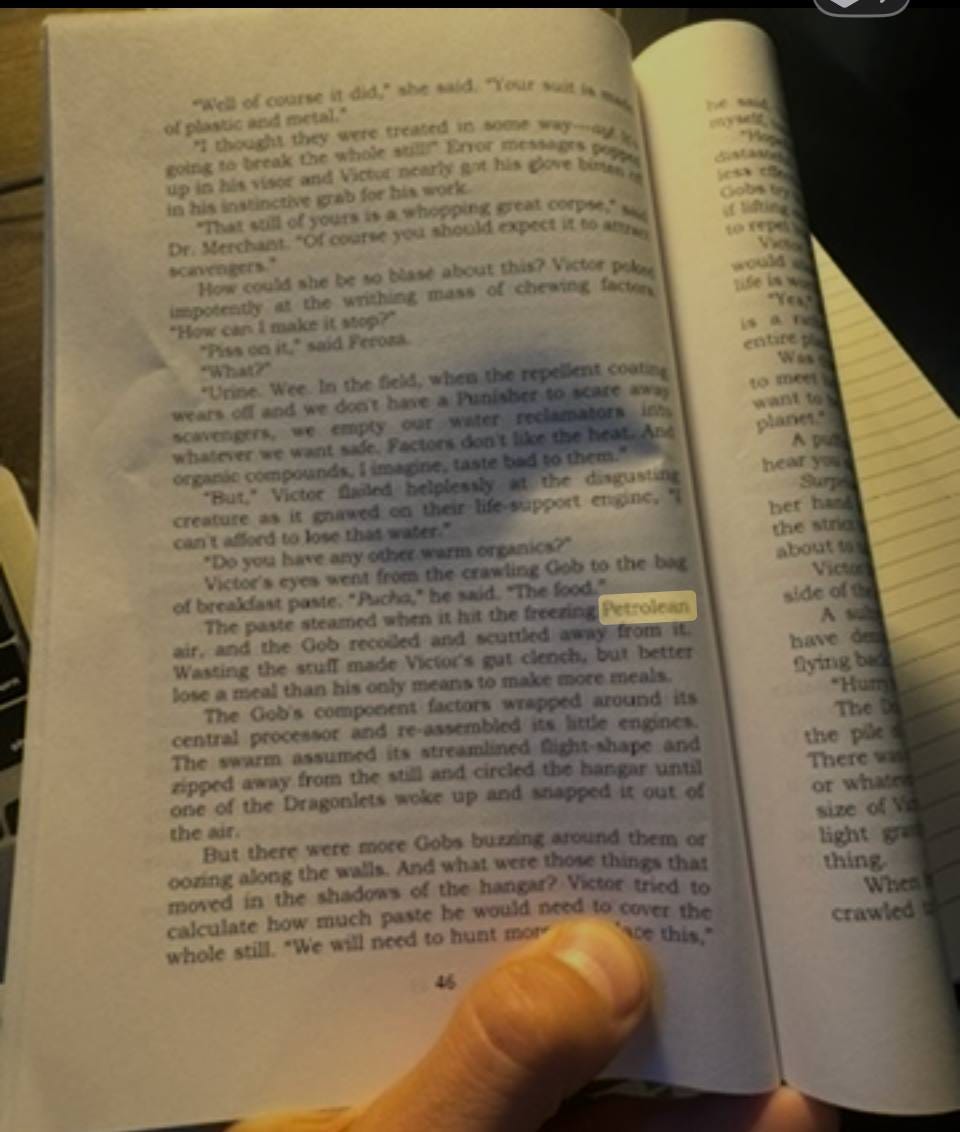
Groom of the Tyrannosaur Queen was one of Dan’s first books. I adore it because it’s funny and wise, but it was rejected by mainstream publishing. The acquisitions editor said it was because of the book’s “violence against women.”
Johnson won my personal sympathy, not just for buying and enjoying Dan’s book when few other people did, but for being thoughtful enough to send my husband that photograph and remind him that his works weren’t forever trapped in some forgotten hard drive.
Pirate captains indeed, I thought. What kind of pirate captain would think to send an independent writer a picture of himself reading his book on a plane? What are they - the Care Bear pirates? I was interested.
“How much?” I asked.
“$500.”
That month I had wasted between $2,000 and $3,000 on marketing, and I was in the process of wasting about as much that quarter on professional organizations. $500 for something that deserved investment, like Dan’s writing career, and that was already endorsed by two authors with proven good judgment? The Care Bear on the airplane was unlikely to pull my husband into a Ponzi scheme, and even if he was, $500 was cheap. Dan could make that in a week of lessons. I felt a little guilty that he felt he should ask me.
“$500 is not that much money,” I told him. “Do it.”
From the Outside
Dan worked alone and isolated in Bulgaria for ten years. As part of Tortuga, he built and became part of a team that in weeks got more done than I thought was at all fair.
I spent those weeks waiting for the hidden crazy to appear. When it didn’t, I stopped being suspicious and started to get jealous. The Tortuga boys were doing something right that I wasn’t.
I run two companies, and some weeks most of my resources and mental power go to just keeping my people from flying apart. Those guys at Tortuga had instant chemistry - intellectual TNT, but with zero office drama. They inherited an organization with many moving parts, and kept it working for its members. During its transition from its old owners, Dan and the rest of the new Privy Council didn’t miss one Friday stand-up.
When they were redoing their payment process, I told Dan, half jokingly, “I’ll be the first trial case.” I wanted to support his new venture, and I know the value of the first payment coming through a new payment method.
I wasn’t really serious about joining, but he said, “Yeah, I think you might really like it.”
In August we were in the US at my brother’s house with Dan and the kids. We were horribly jet-lagged and I was facing some pretty significant negotiations with a client. I made the Tortuga payment as a way to take my mind off my real problems.
The first thing that impressed me was how fast their intake went. I knew they were still figuring out their new process, but these people coordinated across several time zones to have me interviewed less than 48 hours after I paid.
I don’t remember the interviewers’ specific questions, but I remember their attitude. The 13th Grade was active in the writing and culture part of the organization,2 and Bingo Bobbins mentioned that he was a retired engineer.
Now, I work with a lot of engineers, and I have been to literary conventions with Dan, so my expectations for the call were not high. Senior writers and software engineers know they’re smart, and they have already built in their mind a model of me. I show up, and the conversation revolves around me disproving this model. Yes, I know what a server is. The Taming of the Shrew? Problematic, you say. How fascinating.
My Tortuga interview was nothing like that. My interviewers had to be wondering about how much I was doing this in order to control my husband. They definitely pushed me, but they listened, and they spoke freely. That was my first inkling that this Tortuga-joining thing might be more than a test of a payment system in production.3
Before we flew back to Bulgaria, it so happened that there was an opportunity to meet some of Dan’s (and now my) fellow Tortugans face-to-face in Seattle. At their different ages and different backgrounds, each in his own way, they were sharp. Sharp enough that both Dan and I had to work to keep up in the conversation.
The Book Club
Some conversations are only possible in the company of curious, courageous people who are not working to impress you. They’re not going to demand intellectual serfdom from you; they want to find out more. They’ll give you a chance, but they’ll also poke you and push you.
For example, the Tortuga Book Club is a directed and managed effort. Our captain, Professor Axelrod, organizes it and selects titles, leads the discussion, and, most impressive to me, publishes lecture notes on each book. It’s hard to describe how valuable it is, as a professional in your 40s, to be in a classroom where a serious, knowledgeable adult has given real thought to what you should read.
There is nothing businessy or practical-sounding about the titles Axelrod chooses. So far it has been science fiction or highbrow politics. And yet I have learned more about how to manage people and lead them through crisis from these books and the conversations around them than I could ever learn from a Coursera course.
In the Tortuga Book Club, nobody is there to have the correct opinions, or to show how smart they are, or to be in charge of something. It’s a curious, courageous, and therefore challenging group of people. I find our discussions professionally useful, because a courageous, intelligent conversation about ideas tends to uncover truths. And truth is more useful than “emotional intelligence.”
The Costs
In contrast, I have had extensive experience with professional organizations in my industry in Bulgaria. None of them are remotely serious.
My company paid approximately 2,500 to 3,000 leva a year - $1,400 to $1,700 - to each of Bulgaria’s two software industry associations. That fee did not include the executive retreats, which I paid for from personal funds: another $1,000 to $1,500 a year.
None of it benefited my business in any way. We never received any discounts on health or professional insurance - somehow the rates were always inaccurate or didn’t apply to us - and we never received any tangible partnerships.
When I went to the CEO retreats, I was always the mascot. Tell us how you built a reputation in the Middle East, Pavlina; don’t they hate women there? Tell us how you train your people, Pavlina; why would you pay for a language tutor for programmers? Tell us how you retained operations in Israel after Oct. 8th, 2023, Pavlina, with all your clients’ teams being called up to the military?
I was one of the three female founders in the software association. I’m telling you this to make you laugh because, of the other two, one had founded a nonprofit and the other a design studio. Everyone wanted to know how I could run a software company with my two X chromosomes, but nobody was willing to share any real stories or insight, or even think through problems with me. They wanted to extract information from me or market things to me. After two years, I disengaged from these events, and in the summer of 2026 (unrelated to Tortuga) I gave up on those industry associations altogether.
I also tried to get something useful out of Coursera (for about $70 a month). No, I have yet to finish a single course. I began many - in organizational design, general management, building teams, financial management, etc. - and some did start out interesting. Then we got to the middle part, where it’s just fluff delivered by young, eager academics who, it is painfully obvious, have never created or managed a team in their lives. “Culture eats strategy for breakfast.” The superficial tips on how to be compassionate failed to grow my emotional intelligence, but definitely insulted my real IQ. There was no pertinent advice for someone running a company that has to pay salaries, benefits, and taxes for 60-70 people a month. I canceled that Coursera membership.
The Right-Wing Thing
“So what’s this I hear about you joining a right-wing extremist organization?” my husband’s best friend asked him on a video call this summer.
“It’s worse than you think. Pavlina joined it too.”
They both laughed. I couldn’t help but notice that, of all the people my husband had told about Tortuga, his friend was the only one who had bothered to Google it. It doesn’t take much internet sleuthing to discover that Tortuga is out to “ransack woke corporations.”
So how right-wing is this organization, really? All I know is I am a 42-year-old woman, and no Tortugan has yet given me any indication of a lack of respect. No one has offered me any sheep or moonshine in exchange for my daughter’s hand, although that was the tradition here in Eastern Europe. My husband, who now runs the organization’s Substack, has not tried to stop me from voting, either.
On the other hand, I am frequently told by my left-wing friends in the United States that women shouldn’t be made to make decisions, or have to make a living, or be expected to be rational. They tell me my daughters should not study too much math in case their squishy female brains get overly stressed. So, I don’t know what to tell you. Americans are crazy. Don’t allow their political tribalism to determine what kind of people can be your allies or teachers.
Tortuga is conservative in the sense that all the people I have met here share the understanding that some things in the world are good and some are evil. It is good people’s duty to be strong and courageous, and to use their power and resources to do good in the world. Have a family. Get married. Have children. Raise them well. Educate them. Don’t be their friend; be their parent. When life throws curveballs at you, whether in health, work, or money, fight.
Tortuga is conservative about courage, and it’s conservative about honor. It’s conservative about what husbands and wives owe each other. And it’s conservative about how good men and women act in the world. It is very conservative about what wastes your time and what is actually valuable. It is a welcome conservatism for me. Most truly successful people I know are conservative in this way sooner or later.

The Writing Group
I am a professional, an eldest daughter, and a very serious woman. My life has been building one skill after another. I’m pretty confident at most things I touch, from accounting to nursing (multiple major surgeries on kids and husband, and helping to take care of a grandpa with Alzheimer’s provide excellent practical training).
It has been a long time since I was the most junior, inexperienced, and worst-skilled person in the room, but that is definitely the case in Tortuga’s writing group. All of the other members of the Tortuga writing group are better writers than me. Some are genuinely excellent - their writing even in raw form works on your heart. It’s hard to show people like that something that you wrote when you know you are not very good. But the conquest of fear pulls me forward, and that spills into my professional life. After a two-hour block of cleaning up a piece of my own writing, company decisions I had been ambivalent about for weeks become very clear.
Putting yourself in the room with real masters, and receiving their serious, thoughtful criticism of your work, has done more for my professional development, even though it has nothing to do with my job, than any business coaching in the past year.
A side effect is that I have become a huge literary fangirl. I have discovered the writing of several people I really enjoy: fast-paced stories where problems are real, and solutions have seriously been thought about. It replenishes my mind after some very tense days at work.
I recommend the writing group, and not just because I am trying to find more people who are as junior and amateur as me. We know this in business: lack of skill is not the problem. Attitude, and the ability to conquer new skills, will always outpace mastery. Being part of the writing group keeps my attitude fresh.
Cost Benefit Analysis
I’m good at making contacts and doing business myself. Tortuga gives me what a professional association is meant to provide: intellectual resources, so that those of us running companies can work not just in the business, but on the business. The numbers run to about $11,000 to $15,000 for the associations, against the $500 I paid Tortuga, so that’s a clear win. The book club and the writing group gave me more professional development in three months than my Coursera subscription, which I have canceled: about $840 a year, against $500 once and $50 annual dues after that.
The other cost is time, and that is expensive for a CEO with two school-aged children. On admin and ops, I spend zero. That is perhaps my favorite thing about Tortuga: I do not run it, and the people who are running it are doing an excellent job. Everything is arranged so I can just show up as a member and student, and learn or contribute to someone else’s learning.
I spend four to five hours a week on my creative writing, which I would do without Tortuga writers’ inspiration, encouragement, and feedback. The reading for the book club is half an hour to an hour on work days. Meetings and lectures take maybe 1.5 hours a week, and stand-ups with other members another hour. The book club and the writing group meet for about two hours each, once a month. That’s roughly 10 to 13.5 hours a week. Take out the writing and the reading, which I would be doing anyway, and the time I spend only on Tortuga is about three and a half hours a week. It’s not nearly as much as the software associations demanded of me, it’s actually useful, and I enjoy it.
Three months in, the $500 has paid for itself. I can’t say that of any other professional organization I have ever belonged to.
The Verdict
I am restructuring a small software company. The thing that used to feed its engineers was outsourcing, but that’s been a dying art form for a decade. With the advent of AI, outsourcing’s death finally came.
Now I have to find new ways for them to work. In their mid-to-late thirties, my engineers are too young to give up and sink into obsolescence. I’ve been working several weekends in a row, trying to inspire the old team and hiring new people, and seeing possibility again with them.
I need to have evidence that progress is possible and I’m not crazy, and nobody in my time zone was going to show me that evidence. Without Tortuga, I would have just abandoned that team.
The Tortugans are not idealists. They have fears, they see the problems of the world (and discuss them at length, with much humor and some swearing); they’re just not ready to wave the white flag.
A Shameless Pitch, and Some Real Advice
To join Tortuga, you must be a pirate, with at least the aspiration of being a pirate captain. So if you, like me, have a serious suspicion of traditional authority and a track record of making your own way against significant odds; if you would rather strike out on your own than join the well-trodden path; if you value intelligent, serious conversation, even when it points out you’re wrong; if you’re not going to be offended by someone’s real opinion, then Tortuga might be your best investment this year. It was for me.
That $500 will buy you access to people who solve problems and build things. In today’s world, where everyone is versed in the vocabulary of complaining, weakness, and justifying mediocrity, no business school fee will buy you that. I haven’t even accepted any jobs or started any professional connections as a result of being part of this organization, and it’s still been worth it.
Join us. I am happy to answer questions from anyone who is curious and considering joining. DM me if you want to talk.
That was my shameless marketing pitch. Now, here is my serious personal advice.
Do not spend another hour in the company of people who are more involved with their problems than with building the solution to said problems. In today’s world, that is the norm, and it is contagious. It will poison your mind, and your work. If, like me, you have to work with people who have bought a story about reality that is not true, you have to actively take countermeasures so their limitations do not infect your mind.
The best way I have found is a community of people who build. They have problems. They’re not perfect. But they are a daily reminder that solutions exist. There is no way for me to quantify the value of this daily evidence. It’s like a prisoner being shown the blue sky.
It was Petrolea, but whatever. Centaur also reviewed Tyrannosaur Queen - Ed.
He has since become one of my new favorite authors, but at the time I hadn’t read him.
I’ve been told never to do this.

Great read Pavlina - it's been a pleasure to have you join us!
Very touched by the shoutout here 🥹